 EveryMemory
The Memory Palace Technique: A Step-by-Step Guide
The memory palace turns a place you know well into a storage system. Build your first one in minutes with this step-by-step guide, and learn what makes the images stick.
Part of the guide: How to Improve Your Memory: The Complete Beginner's Guide →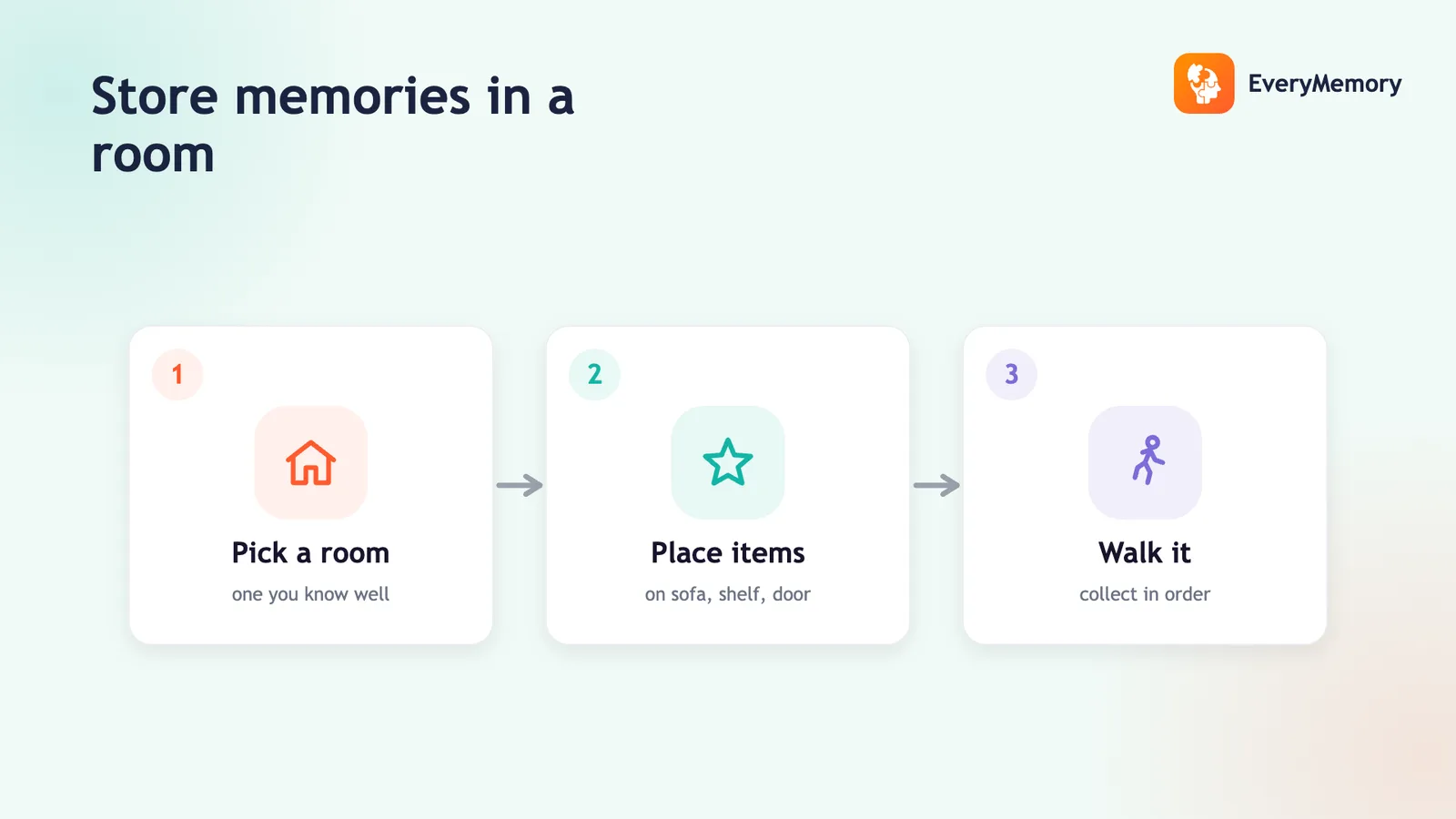
⚡ Quick answer
A memory palace (the method of loci) turns a place you know well into a storage system. You mentally walk a familiar route - your home, say - and 'place' each thing you want to remember, as a vivid image, at a specific spot along the way. To recall, you walk the route again and the images are waiting. It works because spatial memory is one of the strongest kinds we have.
Key takeaways
- A memory palace (method of loci) stores items as vivid images placed along a familiar route you walk in your mind.
- It works by borrowing your strong spatial memory - you can picture your home effortlessly, and new information rides on that map.
- Build one in four steps: pick a familiar place, fix a route, choose stations, place an exaggerated image at each.
- Images must be vivid, strange, in motion and interacting with the spot; dull images are forgotten.
The memory palace is the oldest serious memory technique there is - used by ancient orators to deliver long speeches without notes, and by today's memory champions to recall the order of a shuffled deck. It sounds advanced. It isn't.
It works by borrowing a strength you already have: you can picture your own home, room by room, without effort. This guide builds your first palace in a few minutes.
What a memory palace is, and why it works
A memory palace is a familiar place you use as a mental filing system. The technique is also called the method of loci (Latin for 'places'). You don't memorise a list as a list - you convert each item into a picture and leave it somewhere along a route you know by heart.
It works because human spatial memory is exceptional. You can walk through your home in your mind and 'see' every room. The technique piggybacks new, hard-to-hold information onto that effortless spatial map.
Build your first memory palace, step by step
- Choose a place you know cold. Your home is ideal. Anywhere you can picture room by room without thinking works.
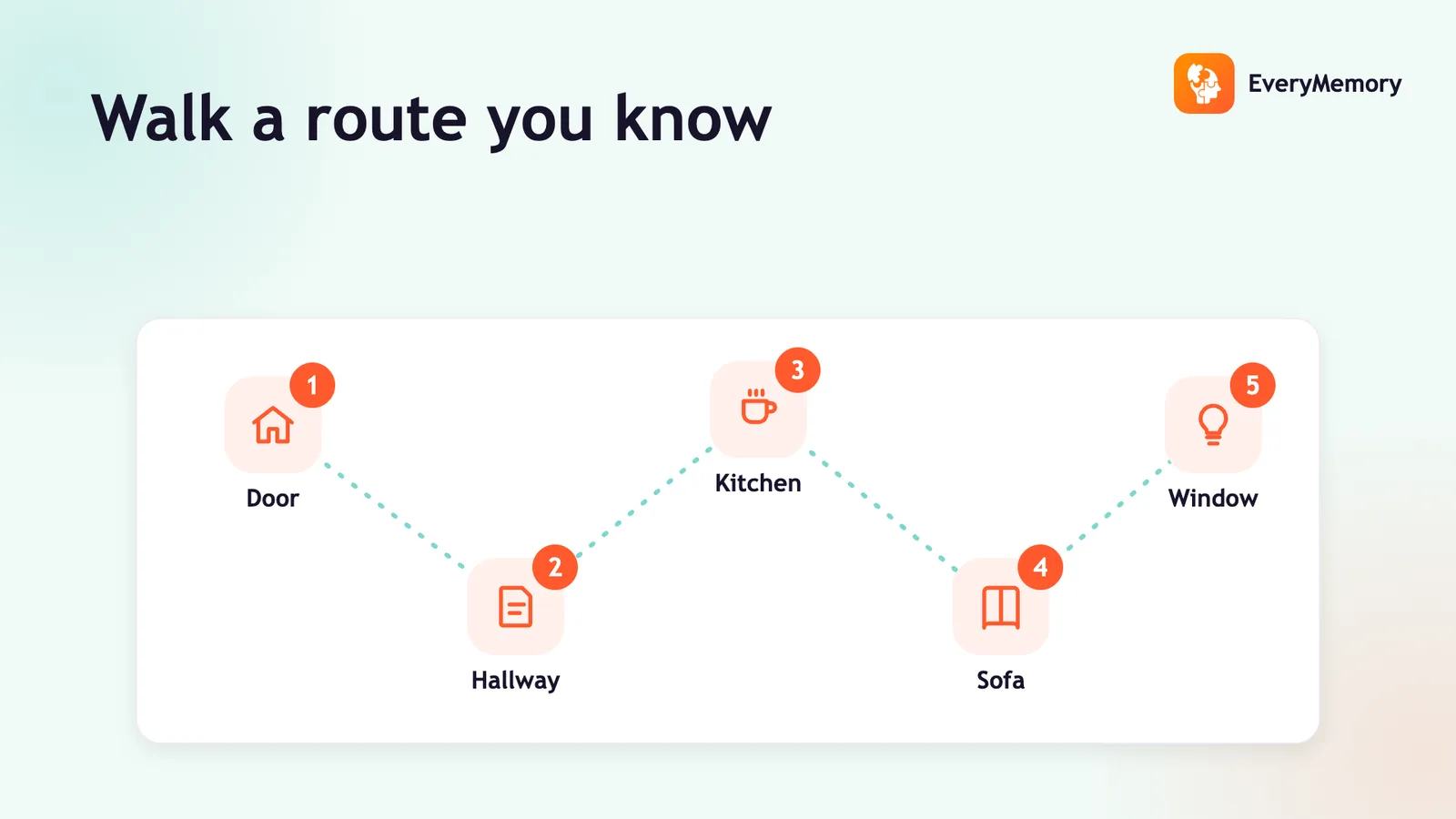
- Fix a route. Decide a fixed path through it - front door, hallway, kitchen, living room, and so on. Always walk it the same way.
- Pick your stations. Along the route, choose 5–10 specific spots (the doormat, the kitchen sink, the sofa). These are where things will live.
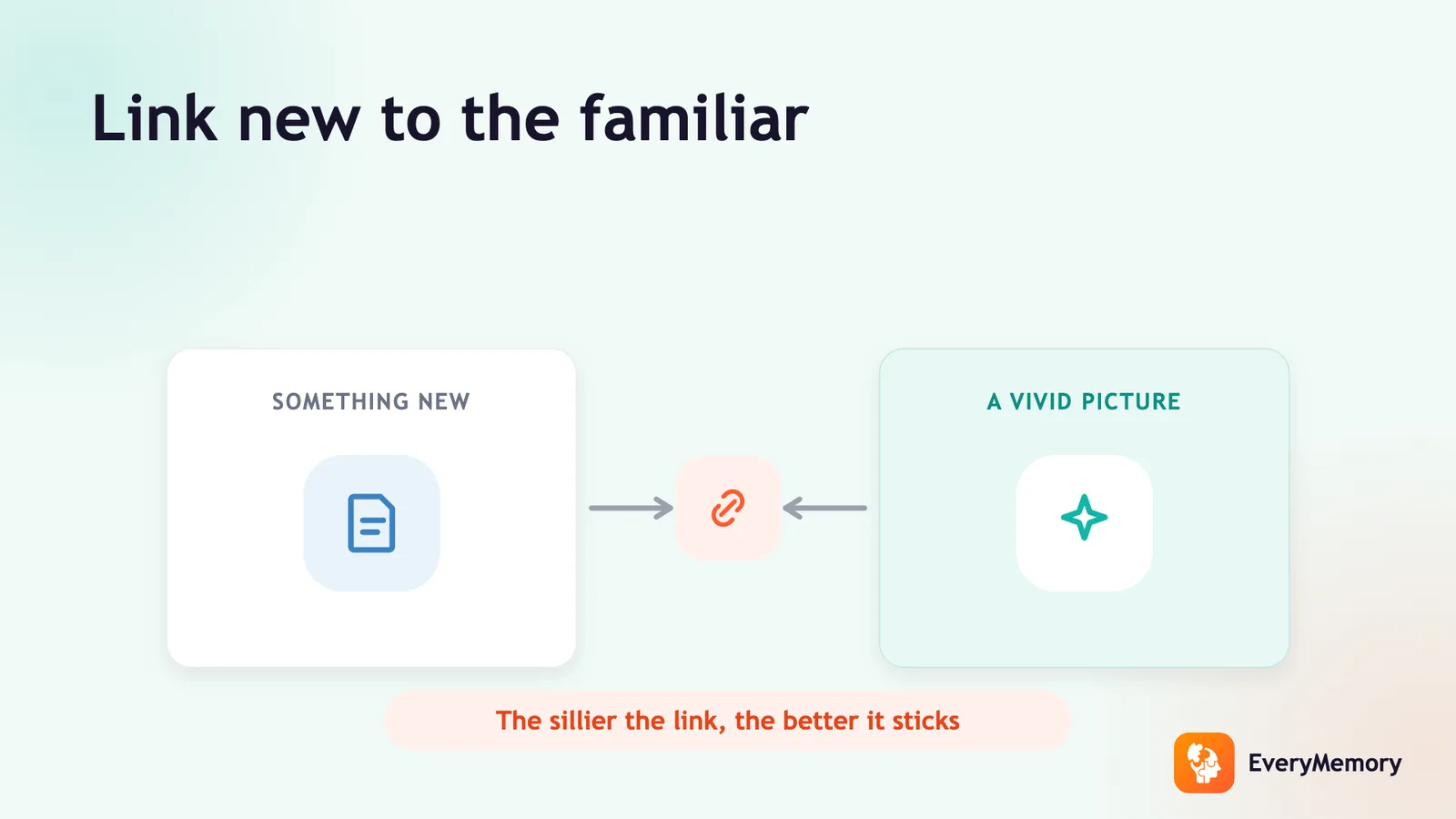
- Place a vivid image at each station. Turn each item into an exaggerated picture and 'put' it there. Milk on the shopping list? A flood of milk pouring off the doormat.
- Walk the route to recall. To remember the list, take the mental walk. Each station hands you its image, and the image gives you the item.
That's the whole method. The skill is entirely in step 4 - the images.
What makes the images stick
A bland picture won't survive. Make each one:
- Vivid and exaggerated - oversized, colourful, loud.
- Strange or funny - the brain ignores the ordinary and remembers the absurd.
- In motion - something happening beats a static object.
- Interacting with the spot - the milk should soak the doormat, not just sit near it.
If an image feels forgettable, it is. Push it further until it makes you smile. This vividness is the same engine behind association generally.
What to use it for - and its limits
Memory palaces shine for anything with order or a list: a shopping list, the points of a speech or toast, steps in a process, names at a gathering. They're less suited to understanding ideas or remembering how something feels - they store items, not comprehension. Use it as one tool, not the only one.
Common beginner mistakes
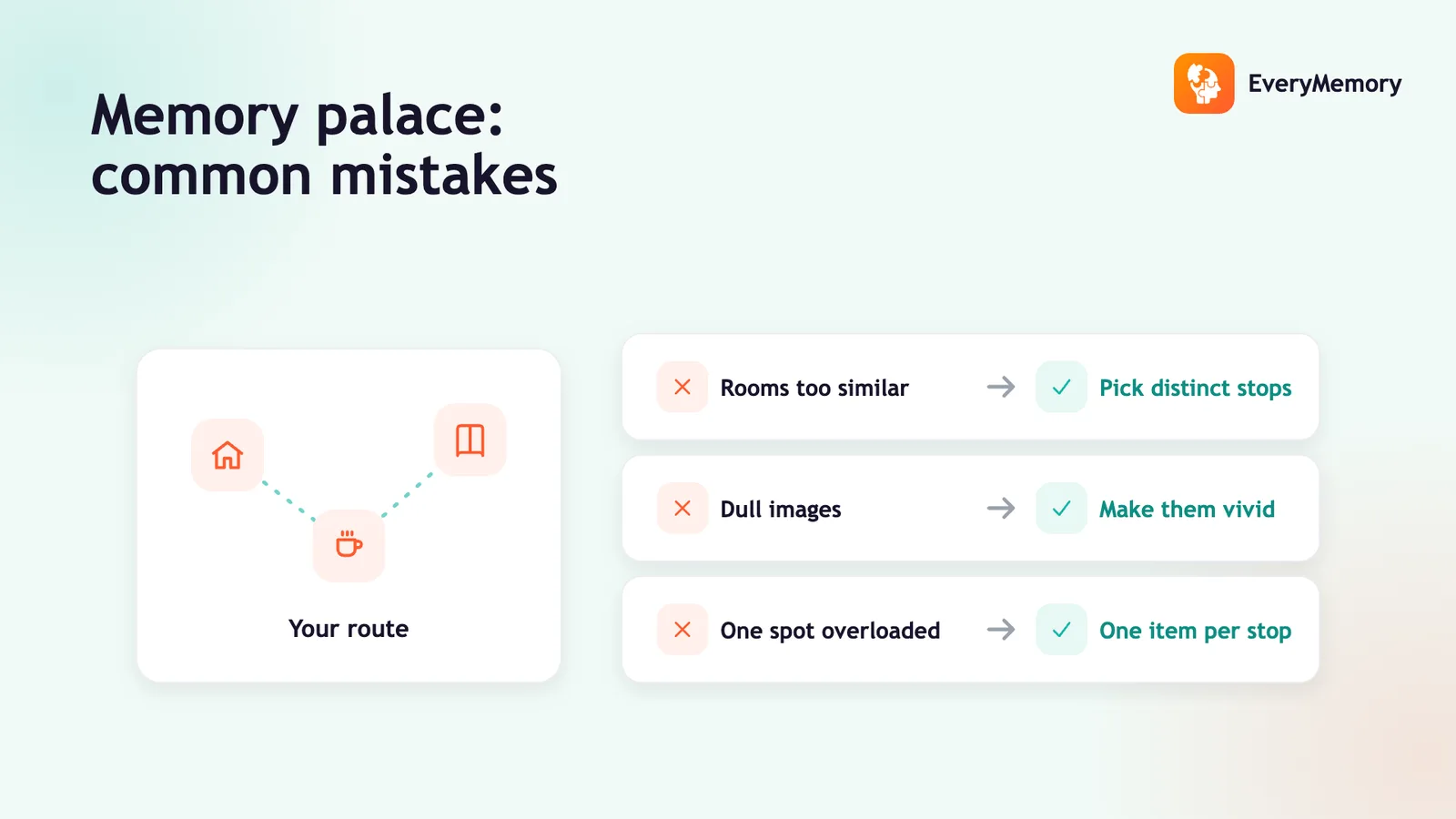
Most first attempts fail for the same handful of reasons: too many stations crammed too close, images that are too dull or too literal, or a place you don't actually know well. Start with one familiar route and five strong images before scaling up. The full list of pitfalls is in memory palace mistakes and how to fix them, and a gentler on-ramp is the memory palace for beginners.
✅ Try this today - store a 5-item list in your home
Build a working memory palace in three minutes:
- Pick five things to remember (a short shopping list works).
- Choose five spots on a fixed walk through your home: doormat, sink, sofa, and so on.
- Place a wild, exaggerated image of each item at each spot.
- Walk the route in your mind once now, and again in an hour - the list will be waiting.