EveryMemory
How to Improve Your Memory: The Complete Beginner's Guide
A comprehensive, beginner-friendly guide to improving your memory - how it works, the core techniques, a simple daily practice, and the lifestyle basics that make the biggest difference.
⚡ Quick answer
To improve your memory, combine deliberate encoding techniques (like association, the memory palace, and chunking) with the lifestyle foundations that consolidate memory at a biological level - principally sleep, regular movement, and a brain-supportive diet. A short daily practice of ten to fifteen minutes, sustained over weeks, produces reliable, noticeable improvement for most adults.
Key takeaways
- Most forgetting happens at encoding - giving new information three seconds of deliberate attention fixes the majority of everyday memory slips.
- Spaced repetition, association, chunking, and the memory palace are the four techniques with the strongest real-world evidence behind them.
- Sleep is the single most important lifestyle factor for memory - consolidation of new information happens during sleep, making consistent rest non-negotiable.
- Ten to fifteen minutes of daily practice sustained over four to eight weeks produces reliable, noticeable improvement for most adults.
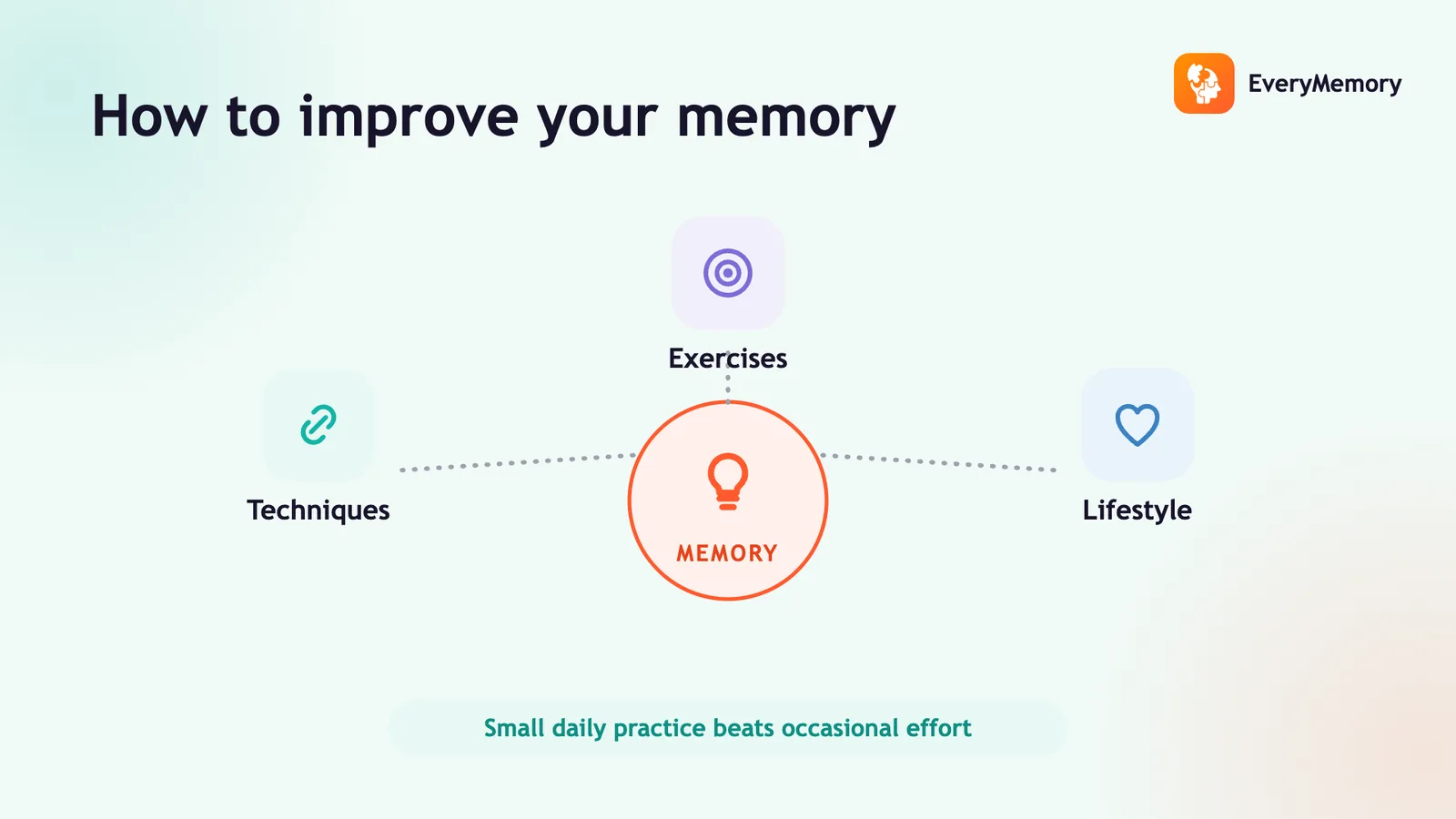
Memory improvement is one of those goals that sounds complicated until you understand the underlying mechanics - and then it becomes surprisingly practical. You don't need to spend hours studying memory science or buy expensive software. A small number of well-chosen techniques, applied consistently, account for most of the real-world gains people notice.
This guide brings together the full picture: how memory actually works, the most effective encoding techniques, the lifestyle basics that support everything else, and a simple daily practice you can start today. Each section links to a deeper guide where you can go further on any particular piece.
How memory works - and why that matters for improvement
Before choosing a technique, it helps to understand the basic mechanism you're working with. Memory is not a recording device. It is a reconstruction process - each time you recall something, your brain rebuilds it from stored fragments, which is why memories can change over time, and why the way you encode information matters enormously.
The brain moves information through three stages: encoding (taking it in), consolidation (embedding it into longer-term storage, largely during sleep), and retrieval (pulling it back out when needed). Most everyday forgetting happens at the encoding stage - information was never properly stored in the first place, usually because attention was divided at the critical moment.
Our guide on how memory works covers the full picture, including the difference between short-term and long-term storage, what the hippocampus does, and why understanding these basics changes how you approach every technique in this guide.
The core encoding techniques
Encoding is where most memory improvement lives. These four techniques address it directly - each one works by giving new information stronger, more distinctive connections to things you already know.
Association. Memory is built on connections. When you link a new piece of information to something you already know vividly - a person, a place, an emotion, a story - it becomes far easier to retrieve. The connection gives your brain multiple retrieval paths to the same memory. Our guide on how to use association to remember more shows how to build these links deliberately for names, numbers, facts, and everyday tasks.
The memory palace. One of the oldest and most reliable techniques in existence: you place the things you want to remember inside a familiar mental location - your home, a route you walk regularly - and "walk through" it to retrieve them. The method works because spatial memory is one of the brain's strongest systems. Our memory palace for beginners guide walks you through building and using your first one.
Chunking. Working memory can hold only a limited number of individual items at once - typically around four. Chunking groups items into meaningful clusters, so each cluster is handled as a single unit rather than many. A phone number broken into three groups is far easier to hold than ten separate digits. Our chunking technique guide explains the principle simply and shows how to apply it to numbers, lists, and new concepts.
Names and faces. Forgetting someone's name immediately after being introduced is one of the most common memory frustrations - and one of the most directly solvable. The fix is a short encoding ritual at the moment of introduction: repeat the name, anchor it to a distinctive face feature, and use it once more before parting. Our full guide on how to remember names and faces gives you the complete method.
Why spaced repetition is the most reliable technique for retaining anything
Encoding gets information in. Spaced repetition is what keeps it there. The idea is straightforward: instead of reviewing something many times in a single sitting, you review it at increasing intervals - after one day, then three days, then a week, then three weeks. Each review, just before the memory fades, strengthens the consolidation and extends how long the memory lasts.
The underlying mechanism is the spacing effect, one of the most consistently replicated findings in memory research. It outperforms re-reading, highlighting, and most other passive review methods by a wide margin.
Our guide on spaced repetition for everyday memory shows how to apply the principle practically - without flashcard apps or complicated systems - for names, language, work knowledge, and general recall.
- Spacing works because each retrieval attempt strengthens the memory - the struggle of trying to recall something is itself part of the learning.
- Even informal spaced review - thinking through the day's new information before sleep - is meaningfully better than no review.
- The technique pairs naturally with any of the encoding methods above: once you've used association or chunking to encode something, a spaced review schedule keeps it accessible.
Handwriting, physical practice, and the body–memory connection
Some of the simplest memory improvements come not from mental techniques but from changing how you engage with information physically. Writing by hand is a prime example: when you write notes by hand rather than typing them, you are forced to slow down and paraphrase, which means you are processing the ideas more deeply rather than transcribing them verbatim. Deeper processing at encoding reliably produces better recall later.
Our article on writing by hand and memory covers the research behind this effect and how to apply it - not just for studying or work, but for everyday tasks like shopping lists, appointments, and things you want to remember from conversations.
Physical movement is equally important. Regular aerobic exercise - including something as simple as a daily walk - is associated with better blood flow to the brain, stronger neuroplasticity, and improved performance on memory tasks. The body–brain relationship runs in both directions: improving physical health genuinely supports cognitive function.
A simple daily practice
Techniques are only useful if you use them. The best approach for most people is a short, consistent daily practice rather than occasional long sessions. Ten to fifteen minutes a day, sustained over several weeks, typically produces more noticeable improvement than two hours once a week.
Our 10-minute memory workout for beginners is a good place to start - it combines several of the techniques above into a single daily session structured for people who are new to deliberate memory practice.
If you want a longer-term framework, our daily brain training routine shows how to build memory practice into a broader daily habit - including when in the day to do it, how to track progress, and how to adjust as you improve.
The question of whether brain training programmes and games actually work is a fair one. Our article on whether brain games really work gives an honest assessment of the evidence - what transfers to real life and what doesn't - so you can invest your practice time in approaches that are most likely to produce real-world results.
- Morning is generally the best time for memory practice: alertness and working memory capacity tend to be higher, and there are fewer competing demands.
- Consistency matters more than duration. A ten-minute daily habit built over a month is more effective than sporadic longer sessions.
- Track what you notice week to week - not to measure performance precisely, but to stay aware of which skills are improving and which feel challenging.
The lifestyle foundations: sleep, food, and reducing cognitive load
Memory techniques work. But they work best when the underlying biology supports them. Three lifestyle factors have the strongest evidence base for memory function: sleep, nutrition, and managing cognitive load.
Sleep. Memory consolidation - the process by which new information is embedded into longer-term storage - happens largely during sleep, particularly during deep NREM and REM stages. Consistently short or fragmented sleep genuinely impairs recall, even when you don't feel impaired. One night of poor sleep reduces next-day performance on memory tasks measurably. Our guide on the sleep and memory connection explains what each sleep stage does for memory - and what to do if your sleep has been unreliable.
Nutrition. What you eat affects how well the brain can encode, consolidate, and retrieve information. Diets rich in omega-3 fatty acids, antioxidants, and B vitamins are consistently associated with better cognitive performance in research. Chronic blood-sugar instability, ultra-processed foods, and dehydration are associated with worse performance. Our article on the best foods for memory and brain health covers the specific foods with the strongest evidence and how to weave them into ordinary meals without overhauling your whole diet.
Managing cognitive load. Attention is memory's gateway - if you're not paying attention at the moment something happens, it won't be stored clearly regardless of what technique you use. Reducing multitasking, creating a quieter environment for tasks that require remembering, and building predictable routines all free up attentional resources for the moments that matter most.
Realistic expectations - and when to talk to a professional
Memory improvement through technique and lifestyle is real, but the timescales are honest ones. Most people notice meaningful change over four to eight weeks of consistent practice - improved name recall, better retention of things read or heard, and a reduction in the "tip of the tongue" frustrations that signal weak encoding. Dramatic overnight change is not a realistic expectation, and anyone suggesting otherwise is overpromising.
Normal aging brings some reduction in processing speed and the ease of encoding new information - this is not pathological and does not mean memory is failing. What research consistently shows is that deliberate practice, active lifestyle habits, and a supportive social environment are all linked with maintaining strong cognitive function well into later life.
That said: some patterns of forgetting are worth discussing with a healthcare professional. If you notice sudden, rapid, or noticeably worsening changes in memory - forgetting entire recent events, confusion about familiar places or people, or changes that others have remarked on - these are worth raising with a doctor promptly rather than waiting to see if they resolve on their own.
Explore the full guide
Each section of this overview links to a deeper article. Here is every piece in the cluster, in case you want to jump directly to the topic most relevant to you:
- How memory works - the science behind encoding, consolidation, and retrieval
- How to remember names and faces - the full face-anchor technique
- Memory palace for beginners - build and use your first memory palace
- Chunking technique explained simply - group information to hold more at once
- How to use association to remember more - link new information to what you already know
- Spaced repetition for everyday memory - the most reliable retention strategy
- Writing by hand and memory - why pen and paper still beat the keyboard for recall
- 10-minute memory workout for beginners - a structured daily session to get started
- Daily brain training routine - a longer-term practice framework
- Do brain games really work? - an honest look at the evidence
- Sleep and memory connection - what each sleep stage does for recall
- Best foods for memory and brain health - nutrition with the strongest evidence base
✅ Try this today - Your first week of memory improvement
Start small and build. This simple sequence introduces the most important elements in a manageable order.
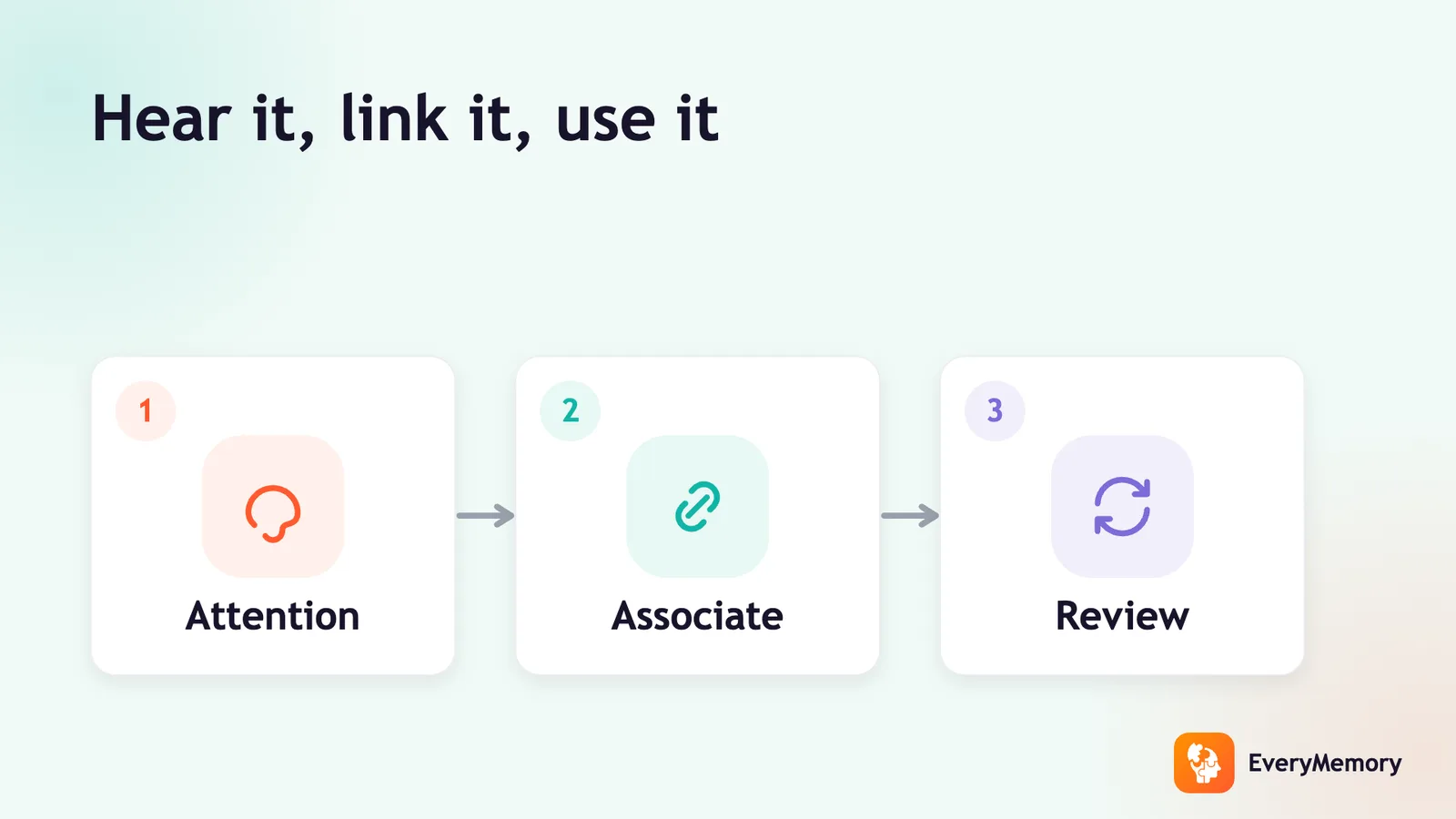
- Day 1–2 - Attention first: For two days, focus only on being fully present at the moment you receive new information. Put the phone down when someone is talking, read one thing at a time, and pause before moving on from anything you want to remember. Notice how much better recall is when attention was complete.
- Day 3–4 - Add association: When you encounter something you want to remember - a name, a fact, a task - spend three seconds connecting it to something you already know vividly. Exaggerate the connection; make it unusual. Notice how the unusual ones stick.
- Day 5–7 - Add a daily review: Before sleep each evening, mentally walk through the most important things you encountered that day - people, information, tasks. The review takes two to three minutes. This short spaced rehearsal will markedly improve what you retain by the following week.
⚠ When to talk to a professional
This article contains general, non-medical information about memory techniques and lifestyle. It is not a substitute for professional medical advice. If you notice sudden, rapid, or worsening changes in memory - or changes that are affecting your daily life or safety - please speak with a qualified healthcare professional promptly.