 EveryMemory
How to Memorize a Speech
Memorize a speech by its structure, not word for word - outline the key points, anchor them to a route, and rehearse the transitions out loud until they're automatic.
Part of the guide: How to Improve Your Memory: The Complete Beginner's Guide →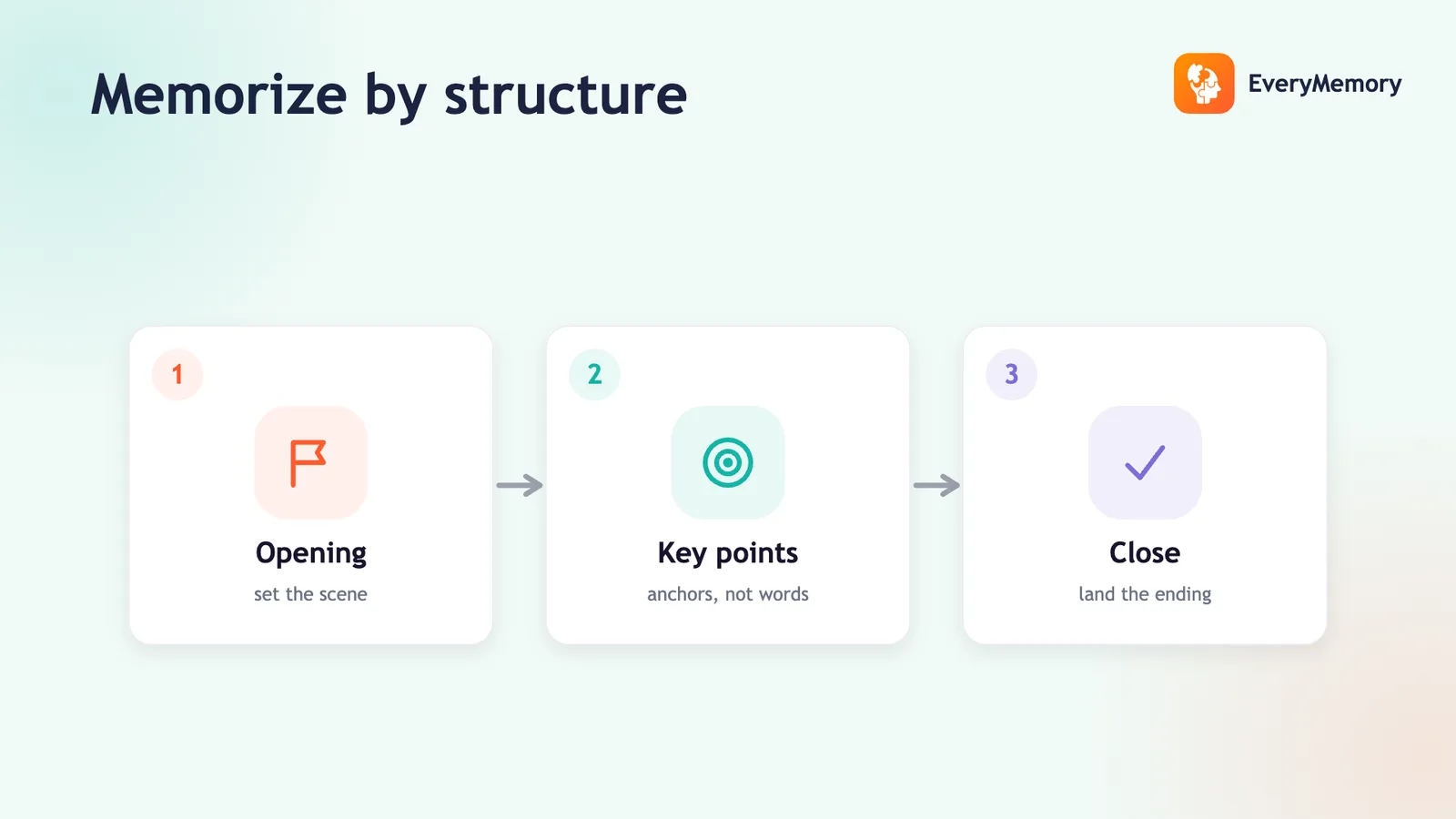
⚡ Quick answer
To memorize a speech, break it into a sequence of key points rather than full sentences. Anchor each point to a spot on a familiar mental route (a memory palace), so walking the route in your mind retrieves the points in order. Then rehearse the transitions out loud until moving from one point to the next is automatic. Memorize ideas and order; speak the words fresh.
Key takeaways
- Memorize the structure and sequence of points, not the speech word for word.
- Anchor each key point to a spot on a familiar mental route (memory palace) so the order holds.
- Rehearse transitions out loud; learn only the opening and closing lines verbatim.
- Space rehearsals across several days rather than cramming the night before.
The mistake most people make is trying to memorize a speech word for word. Do that and one forgotten phrase derails the whole thing - you freeze, hunting for the exact sentence instead of the idea.
Speakers who never use notes don't have superhuman memories. They memorize the structure - the sequence of points and how each leads to the next - and let the wording flow fresh each time. Here's how to do the same.
Memorize the structure, not the sentences
Write your speech as an outline of 5 to 9 key points - the spine of your argument. These are what you must recall in order. The exact phrasing between them can vary every time you deliver it, and it'll sound more natural for it. Word-for-word memorization is brittle; structural memory bends without breaking.
If a point is too big to hold as one idea, break it into two. This is chunking applied to a speech: each chunk is one retrievable beat.
Anchor each point to a route
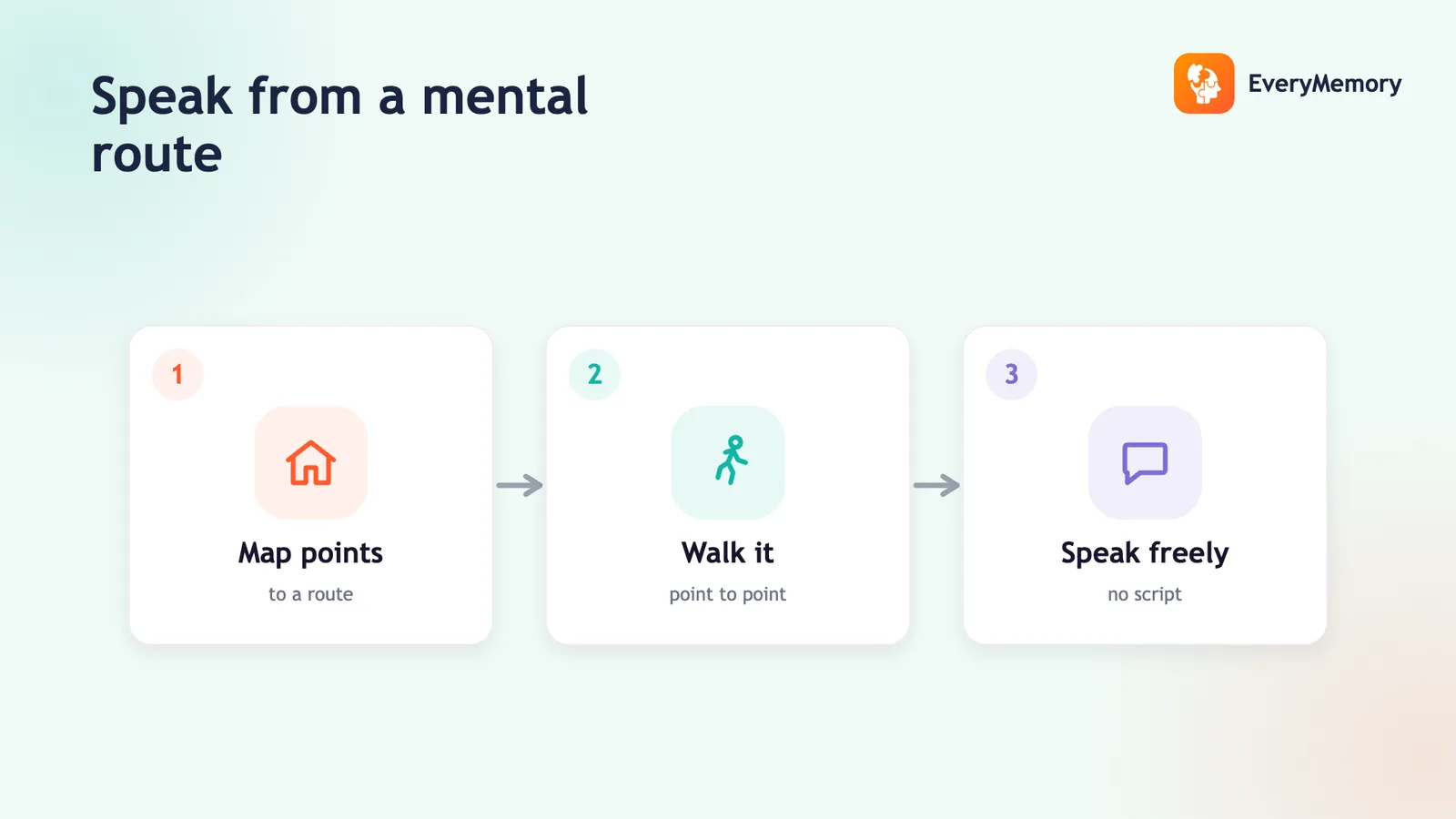
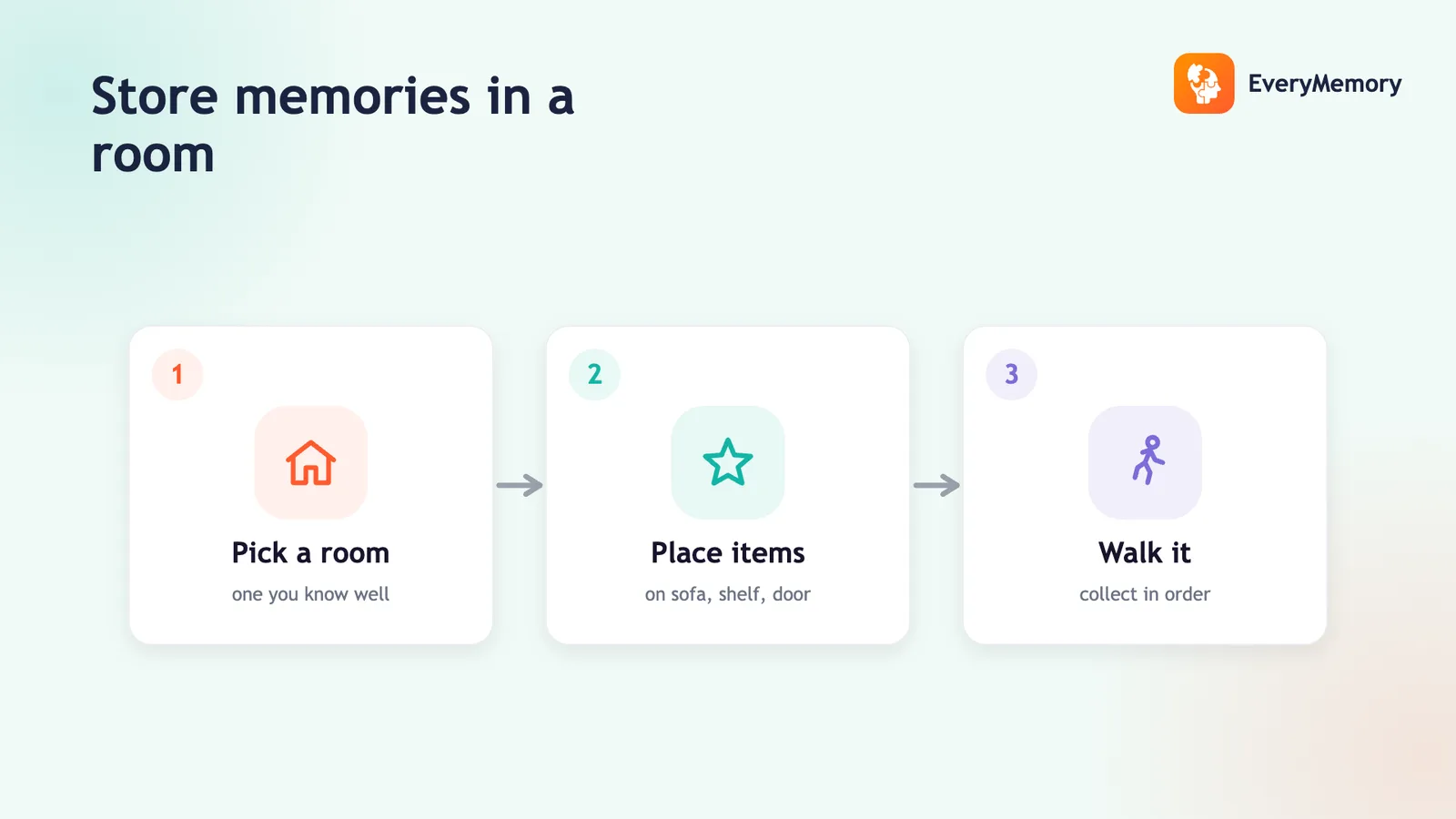
Use a memory palace - a familiar place you can walk in your mind, like your home. Assign each key point to a specific location along a fixed path: the front door, the hallway, the kitchen counter, and so on. Make each one a vivid image, the stranger the better, so it sticks.
When you speak, you mentally walk the route. Point one is at the door; point two in the hall. The locations hand you the points in the right order, every time, with nothing to lose your place in.
Rehearse the transitions out loud
The places you stumble are almost always the joints between points - the moment you finish one idea and reach for the next. So rehearse those specifically. Say the last line of one point and the first line of the next, out loud, back to back, until the handoff is automatic.
Practising silently in your head doesn't count. Speaking aloud rehearses the actual motor and verbal act you'll perform, and it surfaces the awkward seams you'd never notice reading on a page.
Memorize the opening and close word for word
Two parts are worth learning verbatim: the first 30 seconds and the last 30 seconds. A clean, confident opening sets your nerves and the room; a crisp closing lands the message. The middle can flex, but bookend it with lines you know cold.
Space your rehearsals
Don't cram the night before. Rehearse the full speech a few times across several days - the spacing burns it in far deeper than one long session. Sleep between rehearsals consolidates what you practised, so each run-through starts from a stronger base.
✅ Try this today - Build a 5-point route in 10 minutes
Take any speech or talk you need to give and try this now:
- Strip the speech down to 5 key points. Write each as a short phrase, not a sentence.
- Pick five spots along a familiar path through your home, in order: door, sofa, kitchen, window, bed. Place one point at each as a vivid mental image.
- Walk the route in your mind three times, speaking each point aloud as you arrive - using fresh words each pass. Notice how the route, not the wording, holds the order.