 EveryMemory
How to Memorize Vocabulary
Memorize vocabulary with spaced repetition and vivid association: link each new word to a sound-alike image and meaning, then review on an expanding schedule.
Part of the guide: How to Improve Your Memory: The Complete Beginner's Guide →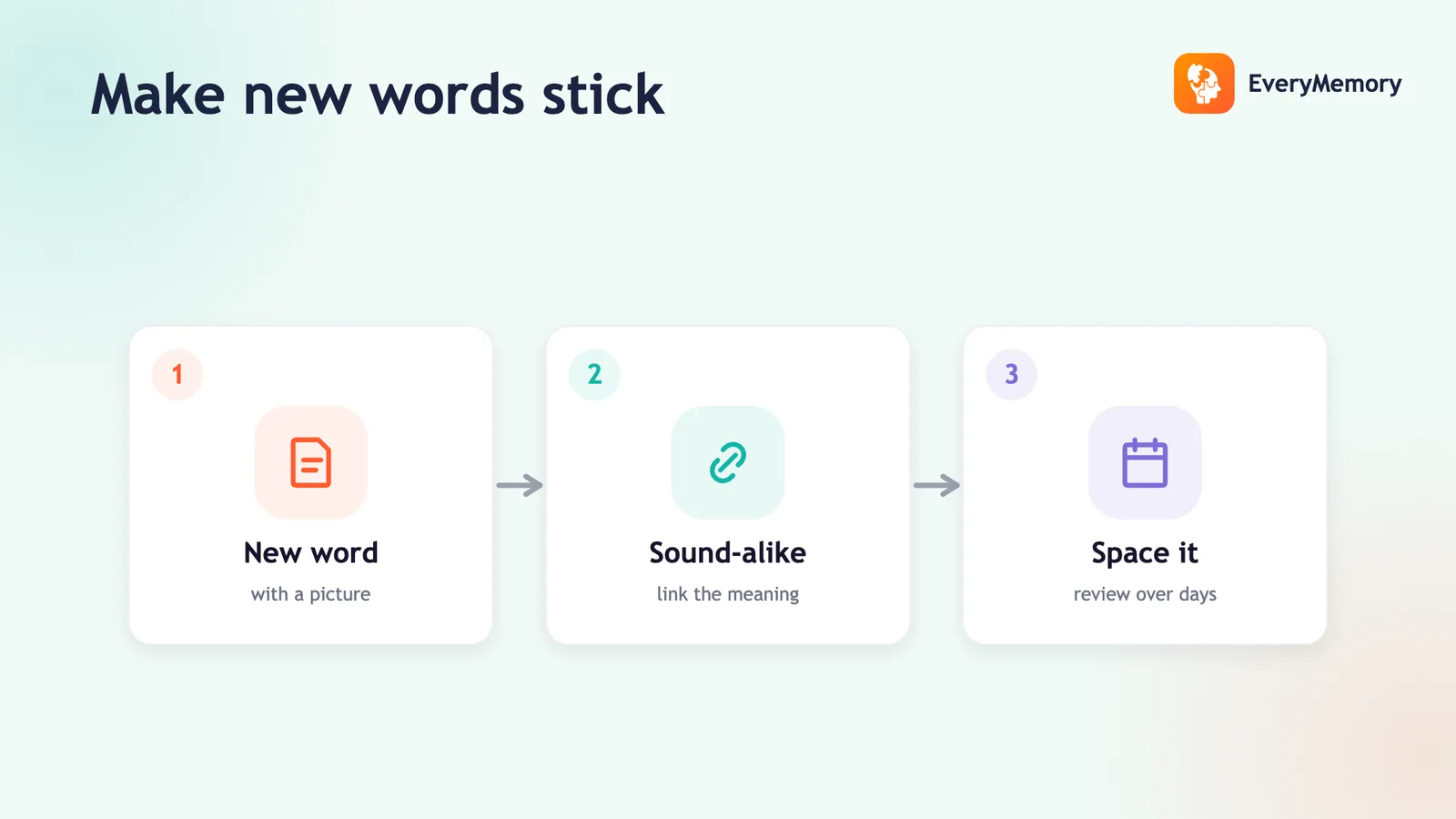
⚡ Quick answer
To memorize vocabulary, don't just reread lists. For each new word, build a vivid mental image that links its sound to its meaning (the keyword method), and learn it in a real sentence rather than alone. Then review with spaced repetition - day 1, day 3, day 7, day 14 - recalling each word from memory before checking. Association makes it memorable; spacing makes it permanent.
Key takeaways
- Use the keyword method: a sound-alike image linking each word to its meaning.
- Learn words in real sentences, not as bare translations.
- Review with spaced repetition on a day 1, 3, 7, 14 schedule.
- Always recall from memory before checking - never just reread the list.
Most people try to memorize vocabulary by reading a list over and over. It feels like work, but it barely sticks - staring at a word doesn't make the brain do anything with it.
The words that stick are the ones you've encoded with meaning and reviewed at the right moments. Two techniques do almost all the heavy lifting: vivid association at the moment you learn a word, and spaced repetition to lock it in. Here's how to use both.
Encode with sound-alike images
The keyword method turns an abstract foreign word into a picture. Take the word's sound, find a familiar word it resembles, and build an image linking that to the meaning. The Spanish pato (duck) sounds like "pot" - picture a duck wearing a pot as a hat. The image fuses sound and meaning, so hearing pato calls up the picture, which calls up "duck."
This is association at work. The stranger the image, the better it sticks. A plain list gives the brain nothing to grab; an image gives it a hook.
Learn words in context, not alone
A word learned in a sentence carries its meaning, grammar, and feel - far more retrievable than a bare translation. Instead of "rápido = fast," learn "el coche es rápido" (the car is fast). The sentence gives the word something to attach to and shows you how it's actually used. Collect words from real reading and listening, not just textbook lists.
Review with spaced repetition
New vocabulary fades on a predictable curve unless you review it - and the trick is to review just as it's about to slip, then again later, with the gaps growing each time. This is spaced repetition, the single most effective tool for vocabulary.
| Review | When | What you do |
|---|---|---|
| 1st | Day 1 | Learn the word with an image and a sentence. |
| 2nd | Day 3 | Cover the answer, recall the meaning from memory, then check. |
| 3rd | Day 7 | Recall again; words you nail get longer gaps. |
| 4th | Day 14 | Recall once more; near-permanent at this point. |
Words you keep missing come back sooner; words you nail get pushed further out. That's exactly how flashcard apps like Anki schedule reviews - but you can run the same schedule by hand.
Always recall, never just reread
When you review, the active step is everything: see the prompt, force the answer from memory, then check. Recalling a word - even getting it wrong - strengthens the memory far more than reading the answer off the card. Two-sided cards that make you produce the word, not just recognise it, are worth the extra effort.
Keep the load small and steady
Twenty new words a day, reviewed steadily, beats two hundred crammed once. Vocabulary is a daily-habit task - small, consistent input builds a large vocabulary over months. Making review a daily habit matters more than any single marathon session.
✅ Try this today - Lock in five words with the keyword method
Pick five new words in your target language and try this now:
- For each word, find a familiar word it sounds like in your own language.
- Build a vivid, slightly absurd image linking that sound to the word's meaning, and say it in a short sentence.
- Cover the words. Recall all five from their images. Schedule a recall check for day 3 and day 7.