 EveryMemory
Memory Score: How to Read Your Progress
Your memory score shows how you're doing relative to yourself over time - not a ranking against others. Here's how to read it and what actually matters.
Part of the guide: Understanding Memory Loss and Forgetfulness: A Calm, Reassuring Guide →
⚡ Quick answer
Your memory score is a self-relative measure - it shows how you performed in this session compared to your own past sessions. A rising trend over weeks is meaningful. A single high or low score is not. Day-to-day variation of 10-20% is completely normal. What matters is the direction over four to eight weeks.
Key takeaways
- Your score is calibrated to your own starting point, so it measures progress relative to yourself, not other people.
- Day-to-day variation of 10–20% is completely normal and usually tracks to sleep, stress, or distraction.
- A rising four-to-eight-week average is the meaningful signal; a single high or low session is just noise.
- A training score is not a medical assessment - talk to a professional if changes are affecting daily life, not just your score.
When you finish a memory exercise and see a score, the natural reaction is to wonder: is that good? What does it mean? The honest answer is that the number means most when you compare it to your own previous scores - not to anyone else's, and not to some abstract benchmark.
This guide explains how to read your progress in a way that's actually useful: what the score reflects, why it changes from session to session, and how to spot genuine improvement versus normal day-to-day variation.
What Your Score Actually Measures
A memory training score captures how you performed on a specific set of tasks - recall speed, accuracy, pattern recognition, attention - at a specific moment. It's a snapshot, not a verdict.
Importantly, your starting score is calibrated to where you begin, not to a population average. This means a score of 650 for you and a score of 650 for someone else don't mean the same thing - they each reflect progress from a different starting point. That's by design. The goal is to track your own trend, not rank yourself against other people.
- Score goes up: you performed better than your recent average on these tasks
- Score goes down: you performed below your recent average - often linked to sleep, stress, or distraction, not a genuine decline
- Score stays flat: you're maintaining your current level - which is a positive result if you've been consistent
Why Scores Vary Day to Day
Your recall performance on any given day is shaped by a surprising number of factors that have nothing to do with underlying memory ability. Sleep quality is the biggest one - a single night of poor sleep can visibly affect recall speed and accuracy. Stress, hunger, how recently you exercised, even the time of day all play a role.
This is why a single session score is hard to interpret. One unexpectedly low score after a rough night tells you very little. A gentle upward trend over six weeks of consistent practice tells you quite a lot.
For a deeper look at why sleep affects scores so much, the sleep and memory connection is worth reading. And if scores vary sharply with stress levels, can stress make you more forgetful explains the mechanism.
How to Read Your Progress Chart
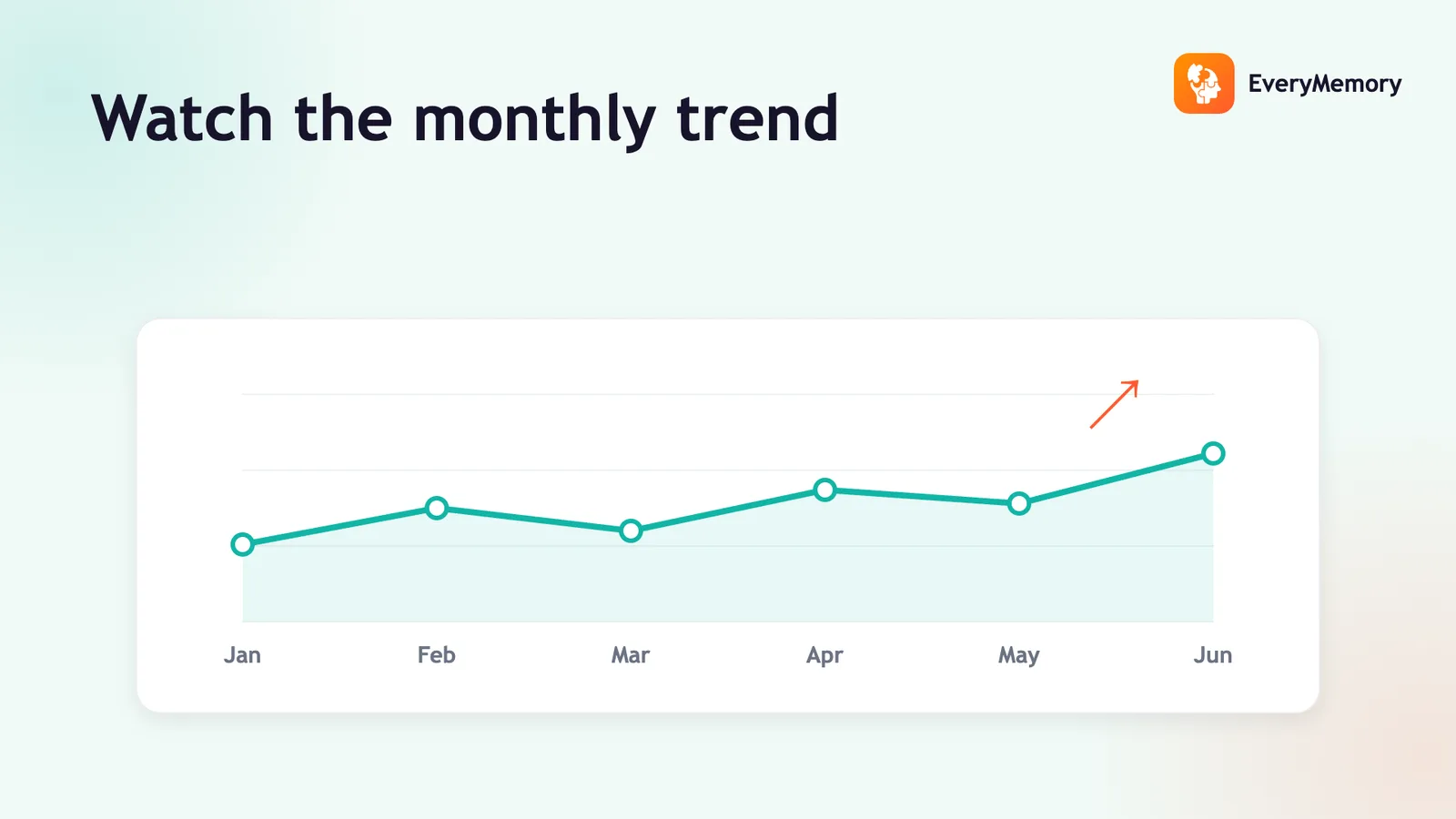
Look at the trend line, not the individual data points. Here's a practical way to read your chart:
- Ignore any single session that sits noticeably above or below the others - one outlier in either direction is noise, not signal.
- Look at the four-week moving average. Is it generally climbing, flat, or declining?
- Note whether the low-scoring sessions cluster around identifiable events (busy week, poor sleep, illness).
- Compare your current four-week average to where you started. That gap is your real progress.
A useful companion habit is keeping a brief monthly log alongside your scores - just a note about sleep and stress that week. That context makes the chart far more readable. The month-by-month tracking guide explains a simple way to do this.
What Counts as Meaningful Improvement
Meaningful improvement in a self-relative score looks like this: your four-to-eight-week average is consistently higher than it was when you started, and your floor (your worst sessions) is gradually rising even if your ceiling varies.
You don't need dramatic jumps. Gradual, steady improvement in recall and attention tasks - the kind that comes from building a regular practice - is the real goal. Think of it like fitness: weekly variation is normal; the long-arc trend is what counts.
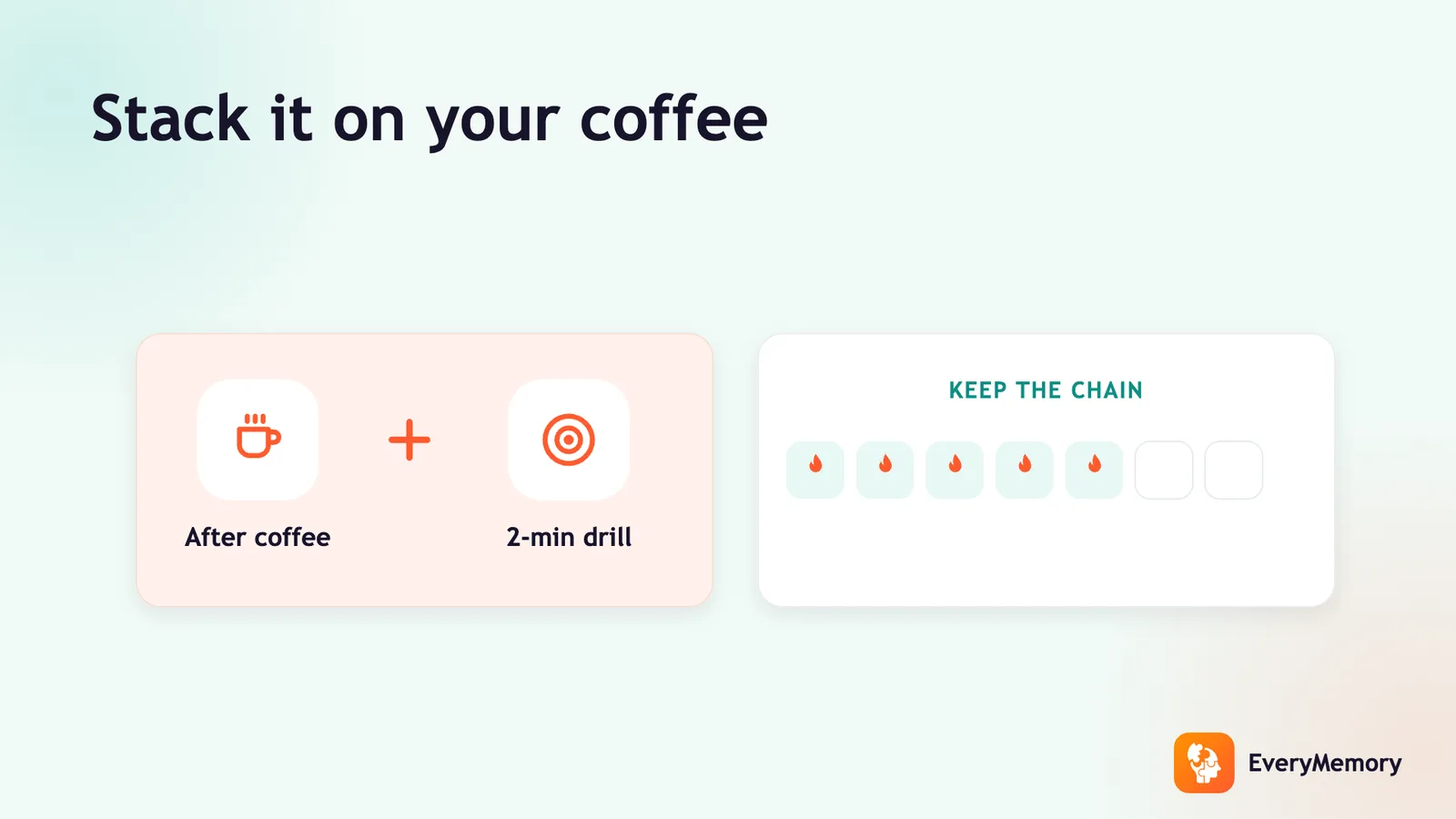
If you've been practicing for four weeks and see no upward movement at all, it's worth looking at consistency. Sporadic practice (three sessions one week, none the next) produces much flatter progress than regular short sessions. Building a memory training habit covers the consistency question in detail.
What a Score Cannot Tell You
A training score is not a medical assessment. It does not measure your overall cognitive health, it does not compare you to clinical norms, and it cannot identify or rule out any condition. It's a non-medical measure of how you're performing on specific recall and attention tasks in a specific app.
If you're tracking your score because you have concerns about memory changes - not just curiosity about progress - it's worth reading what a non-medical memory check actually is to get a clear picture of what these tools can and can't do.
And if you notice changes that are affecting daily life - not just a dip in a training score, but difficulty with everyday tasks - that's worth discussing with a healthcare professional, not just monitoring through an app.
When to Talk to a Healthcare Professional
If you're using memory training for general mental sharpness and enjoyment, your score is simply a motivational tool. No medical concern warranted.
If you started training partly because you were worried about your memory, and your score is showing a clear, sustained downward trend over weeks - especially alongside changes in daily life - that's worth mentioning to your doctor. Bring your score history with you. A visual record of trend over time is useful information for a healthcare professional to have.
Remember: a downward trend in a training score does not mean anything is medically wrong. Many things affect performance. But a professional can help you put it in context in a way an app score cannot.
✅ Try this today - Review Your Four-Week Trend
Take three minutes to do this right now:
- Look at your last eight sessions and find the average of the first four and the average of the last four.
- Note whether the second average is higher, lower, or about the same as the first.
- Check whether any very high or very low sessions correspond to unusual sleep or stress that week. Set those aside and see if the trend is clearer.
⚠ When to talk to a professional
A dip in your training score is almost always linked to sleep, stress, or other everyday factors - not a sign of something medically significant. This score is a non-medical self-relative progress measure and cannot diagnose anything. If you have genuine concerns about memory changes in daily life, please speak with a qualified healthcare professional.