 EveryMemory
Human Benchmark Alternatives
Looking for a Human Benchmark alternative? Here are the criteria that actually matter - adaptive difficulty, honest tracking, no fake percentiles - and how to pick well.
Part of the guide: How to Keep Your Brain Healthy: A Complete Lifestyle Guide →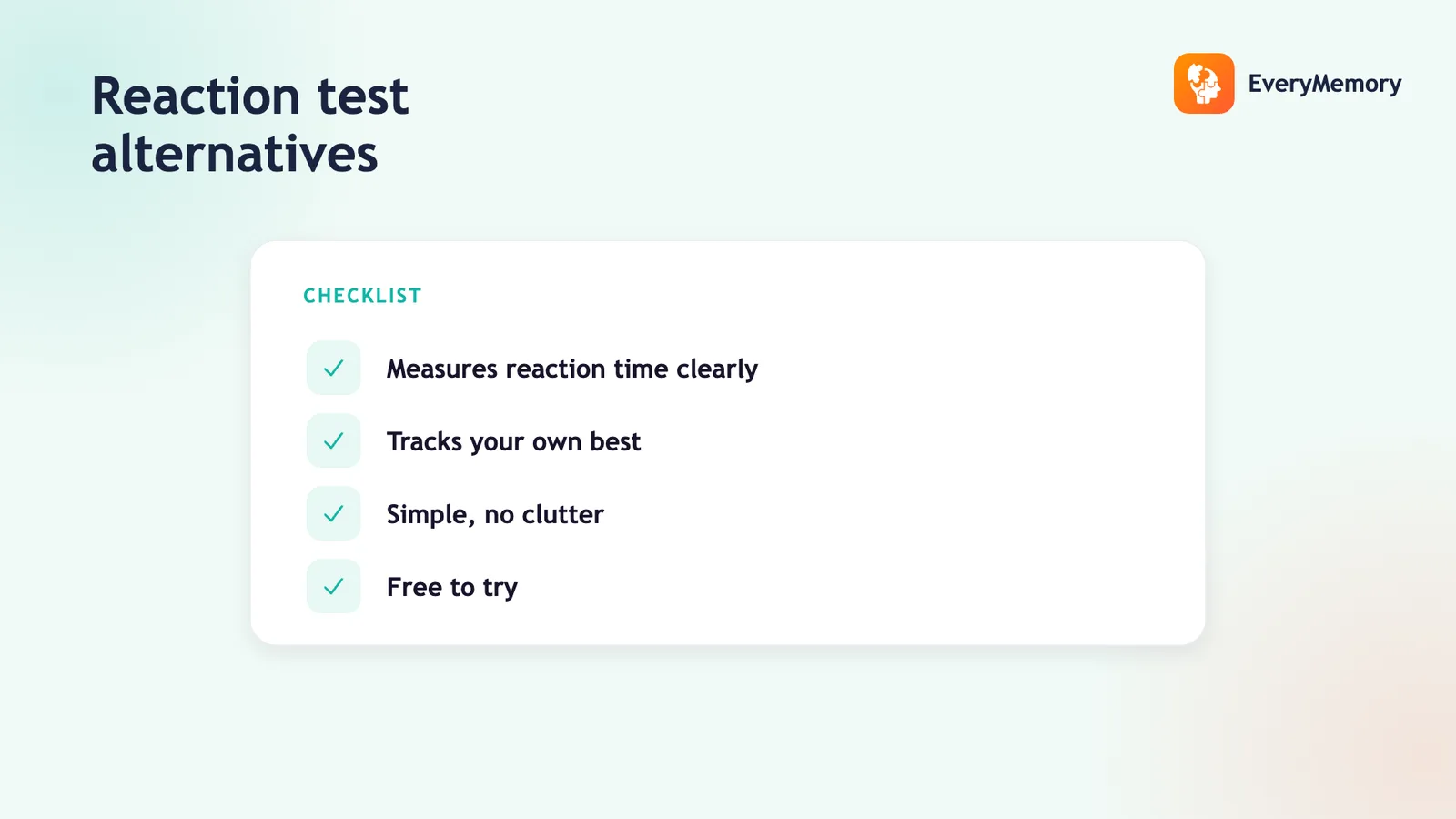
⚡ Quick answer
The best Human Benchmark alternatives keep the quick, single-skill tests but add adaptive difficulty, track your scores against your own past results rather than fake global percentiles, and make honest, non-medical claims. Look for free-to-try apps that measure reaction time, memory and processing speed without selling you a brain age.
Key takeaways
- Pick by criteria, not brand: adaptive difficulty, honest tracking, no fake percentiles.
- Global percentiles are noisy and self-selected - distrust single-attempt ranks.
- Self-relative tracking (you vs your own past) is the honest comparison.
- EveryMemory keeps quick tests but adds adaptivity and self-relative tracking; free to start.
Human Benchmark is a popular set of quick browser tests - reaction time, sequence memory, number memory, typing speed and the like. It's fast, free and oddly addictive, which is exactly why people go looking for alternatives: they want something that does a bit more than score a single attempt, or they want it on their phone, or they've grown suspicious of comparing themselves to an anonymous global average.
Rather than hand you a brand-by-brand teardown with invented prices and feature counts, this guide gives you the criteria that separate a genuinely useful alternative from a flashy one. Judge any app against these and you'll choose well, whatever ends up on your home screen.
What people actually want from an alternative
Human Benchmark's appeal is its simplicity, but its limits are the same: each test is a one-off score, difficulty is fixed, and the headline number is your rank against strangers. Most people seeking an alternative want at least one of these fixed - repeatable tracking, difficulty that grows with them, or a mobile-first experience.
Before downloading anything, get clear on which of these you care about. A tool that's perfect for casual reaction-time bragging is the wrong tool for tracking how your focus changes over a fortnight.
- Repeatable tracking over time, not just a single attempt.
- Difficulty that adapts as you improve, so it stays challenging.
- Comparison against your own baseline rather than anonymous averages.
- Honest, non-medical framing - no 'brain age' or decline claims.
The criteria that separate good from gimmicky
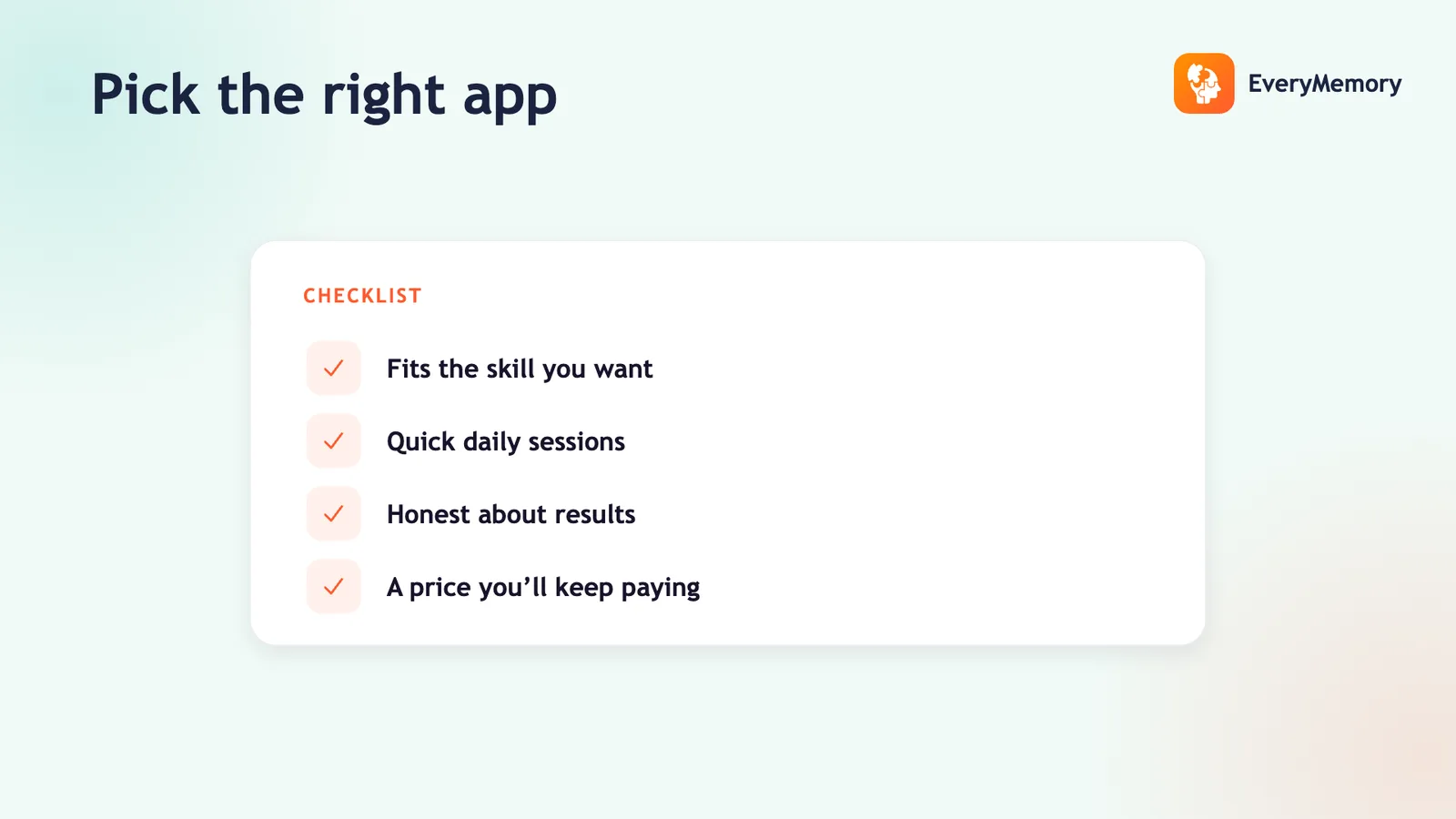
Use this checklist on any candidate. The ones that fail the right-hand column tend to be the ones selling a story rather than a workout.
| Criterion | Green flag | Red flag |
|---|---|---|
| Difficulty | Adapts to your level | Fixed forever, gets boring |
| Tracking | Compares to your own past scores | Fake global percentiles |
| Claims | Improves the trained skill only | 'Boosts IQ' / 'reverses ageing' |
| Pricing | Free to try before paying | Paywall before any value |
| Health framing | Explicitly non-medical | Implied diagnosis or 'brain age' |
For a wider field of apps assessed the same way, see brain training apps compared, and for a step-by-step method use how to choose a brain training app.
Why fake percentiles are the thing to avoid
A global percentile feels scientific but usually isn't. The pool of people taking an online test self-selects heavily, the conditions vary wildly, and a single attempt is noisy. Being told you're 'in the top 8%' on a random Tuesday tells you almost nothing reliable about you.
Self-relative tracking is the honest alternative: measure yourself today, measure yourself in two weeks, and watch your own trend line. That removes the meaningless comparison and keeps the signal that actually matters - your direction of travel. It's the same reason a good reaction time test should let you beat your own previous score, not chase a stranger's.
Where EveryMemory fits
EveryMemory keeps the quick-test feel - short games for reaction time, processing speed and memory - but builds in the three things a single benchmark page can't: difficulty that adapts as you improve, tracking that's measured against your own baseline, and deliberately non-medical, no-fake-percentile framing. It's free to start, so you can judge it against this checklist yourself.
If you mainly want a one-off reaction test in the browser, a simple benchmark page is fine. If you want something that grows with you and tells you an honest story about your own trend, that's the gap an adaptive app fills.