EveryMemory
Learning New Skills and Brain Health
Picking up a language, an instrument, or a craft in your 50s, 60s, or beyond does more than keep you occupied - it engages the very mechanisms that support a resilient brain.
Part of the guide: How to Keep Your Brain Healthy: A Complete Lifestyle Guide →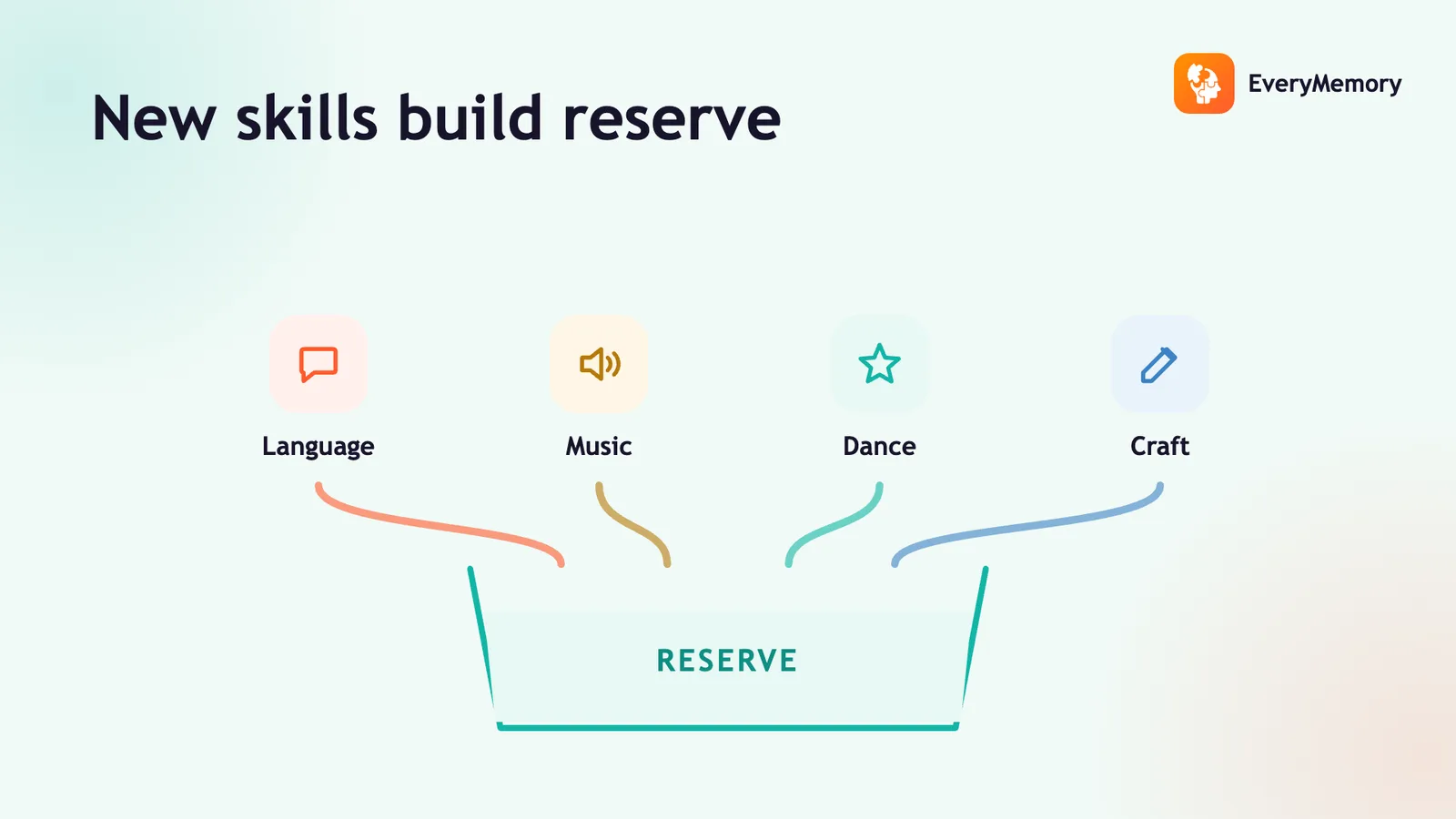
⚡ Quick answer
Learning genuinely new and challenging skills - a language, an instrument, dancing, a craft - is linked with neuroplasticity and the building of cognitive reserve, the brain's resilience to the effects of aging. Research suggests it is never too late to start, and that real challenge, not easy repetition, is what activates these benefits.
Key takeaways
- Genuine challenge - not easy repetition - is what activates neuroplasticity and supports brain health.
- Learning new skills is linked with building cognitive reserve, the brain's resilience to the effects of aging.
- It is never too late: older adults in their 70s and beyond show real learning and measurable cognitive benefit.
- Activities that combine mental, physical, and social elements - like dancing or a language class - engage the most ground at once.
There is a particular satisfaction in learning something genuinely new as an older adult - the first time a phrase in a new language lands correctly, the moment a tune you've been working on finally flows, the afternoon a piece of pottery comes out the way you intended. What most people don't know is that the challenge itself, the effortful stretch of acquiring something unfamiliar, is also doing something measurable for the brain.
This article looks at the research on learning new skills and brain health - what it shows, why genuine difficulty matters more than easy repetition, and what kinds of activities tend to be most engaging for adults 55 and older. The picture is encouraging, and the barrier to entry is lower than most people assume.
What happens in the brain when you learn something new
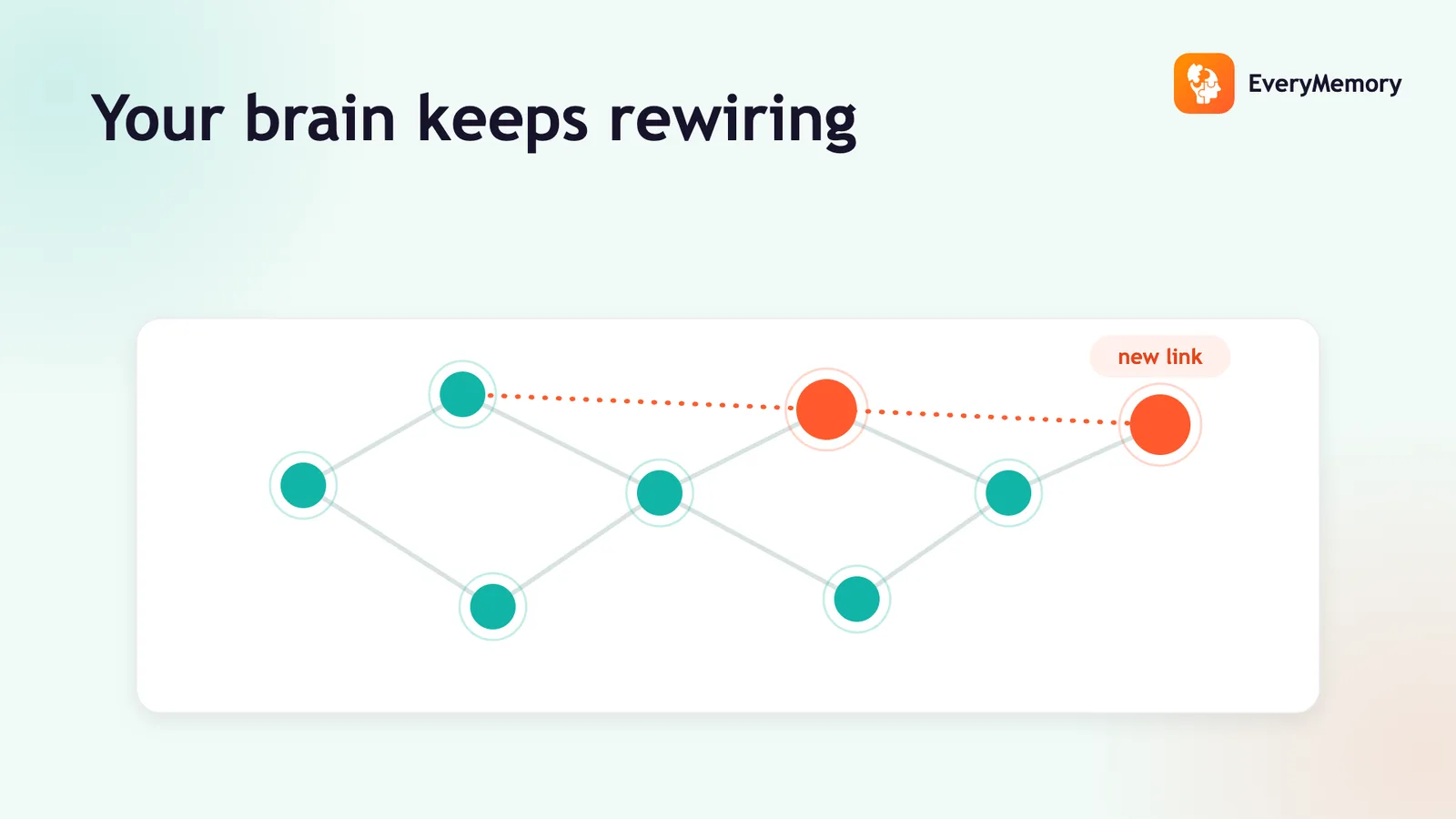
The brain is not a fixed structure. Throughout life it retains the ability to form new connections between neurons, strengthen pathways that are used repeatedly, and adapt to new demands. This capacity is called neuroplasticity, and while it is most vigorous in childhood, it does not simply switch off in adulthood.
When you encounter something genuinely unfamiliar - a foreign grammar, a new chord shape, the footwork of a dance style you've never tried - the brain is forced to build new patterns rather than retrieve existing ones. That construction process is metabolically active: neurons fire in new combinations, synaptic connections are strengthened, and in some cases structural changes in brain tissue follow over time.
What activates this process is not repetition of things you already know well. It is the stretch of grappling with something you don't yet know. This is an important distinction, and one worth keeping in mind when choosing what to pursue.
Cognitive reserve: why building it matters
Researchers use the term "cognitive reserve" to describe the brain's capacity to keep functioning well even as some natural changes occur with age. Adults with higher cognitive reserve tend to cope better with the normal effects of aging on the brain, and the activities linked with building it include education, mentally stimulating work, and - notably - sustained learning throughout life.
One of the most cited studies in this area is Denise Park's Synapse Project (2014), which had older adults spend 15 or more hours a week for three months learning demanding new skills - quilting or digital photography. Participants in the skill-learning groups showed meaningful improvements in episodic memory compared to control groups doing familiar, low-demand activities. The key finding was that sustained, challenging engagement drove the benefit - not mere activity or socialisation alone. You can explore the research behind this in our Library.
Cognitive reserve is built over years, not weeks. That is a compelling reason to start something new now rather than wait.
Why genuine challenge is the key ingredient
Not all mental activity is equally useful. The brain adapts most when it is genuinely challenged - when it must struggle, make errors, correct them, and try again. Easy repetition of familiar tasks, however enjoyable, tends to reinforce existing pathways rather than build new ones.
This matters practically. Doing a crossword puzzle you've been doing for twenty years may be pleasant and moderately stimulating, but it is unlikely to offer the same cognitive stretch as beginning a new language from scratch. The relevant question is not "am I doing something mental?" but "am I doing something I can't yet do well?"
- A new language: even basic conversation requires holding words, grammar, and sound patterns simultaneously.
- A musical instrument: reading notation, coordinating two hands, and interpreting rhythm engages memory, motor control, and attention in parallel.
- Dancing: following a sequence, moving in time with music, and responding to a partner is cognitively complex in ways that practice makes visible.
- A craft skill like weaving, pottery, or woodworking: precise motor learning combined with visual and spatial demands offers real cognitive engagement.
It is never too late - the research is clear
One of the most persistent myths about learning in later life is that the window has closed. The research does not support this. Adults in their 60s, 70s, and 80s show genuine learning and measurable cognitive benefits from sustained skill acquisition. A 2024 study of older adults who took up a musical instrument found improvements in memory and cognitive flexibility after just ten weeks of practice.
What does change with age is the speed of acquisition - older adults typically learn more slowly and may need more repetition to consolidate new material. But slower is not the same as impossible, and the cognitive benefits of the process appear to accrue regardless. The goal is sustained engagement, not competitive achievement.
For more context on what kinds of mental activity have the strongest research support, our article on whether brain games really work covers related ground.
Combining skill learning with other brain-healthy habits
Skill learning doesn't exist in isolation. The research on cognitive reserve consistently suggests that multiple reinforcing factors - social engagement, physical activity, mental stimulation - work together rather than separately. A dance class that requires you to learn new sequences, move physically, and interact with others is engaging several of these at once.
A solo pursuit offers real cognitive benefit. But an activity with a social dimension - a language class, a choir, a dance group - adds the well-documented benefits of connection described in our article on social activity and memory. Choose something you find genuinely interesting, that involves real challenge, and that ideally brings you into contact with others.
Getting started: practical first steps
Most communities offer low-cost or free options for beginners - adult education classes, library programmes, community orchestras, and local craft groups. Online platforms make language learning and instrument practice available at almost no cost. And beginning means beginning: five notes a day, ten new words a week, one class a month - these are all genuine starting points.
- Choose one thing that genuinely interests you. Sustained engagement requires real motivation, not obligation.
- Find a structured context - a class, a group, a teacher - rather than learning alone. Structure provides accountability and social reward.
- Expect it to feel difficult early on. That difficulty is the mechanism, not a sign you're doing it wrong.
- Measure progress in months, not days. Give any new pursuit at least three months before evaluating whether it's working.
✅ Try this today - The new-skill audit
Set aside 15 minutes to do this exercise honestly:
- Write down one thing you have always wanted to learn but never started. Not the most practical option - the one that genuinely interests you.
- Find one concrete first step you could take this week: a local class to enquire about, a free introductory lesson online, or a library book to borrow.
- Commit to 20 minutes of practice three times in the next two weeks. At the end, ask yourself: was it genuinely challenging? If yes, you've found the right zone. If it felt easy, increase the difficulty slightly.
⚠ When to talk to a professional
This article contains general, non-medical information about lifestyle and learning. If you notice sudden, rapid, or significantly worsening changes in your memory or thinking, it is worth discussing these with a qualified healthcare professional rather than attributing them to normal aging.