 EveryMemory
What Is Neuroplasticity? Keep Learning at Any Age
The brain keeps forming new connections throughout life. Here's what neuroplasticity actually means and what it suggests about learning and memory after 60.
Part of the guide: How to Keep Your Brain Healthy: A Complete Lifestyle Guide →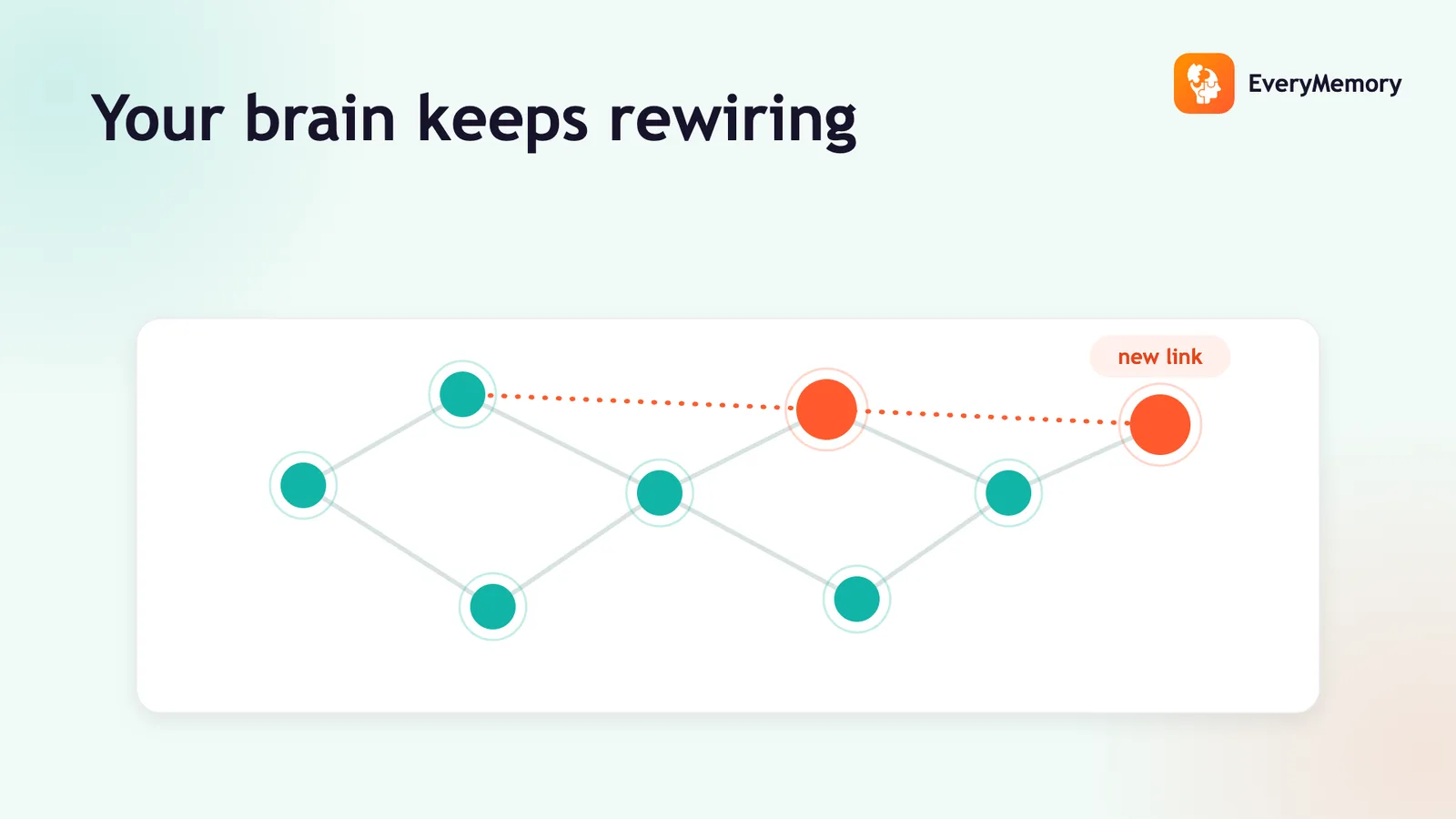
⚡ Quick answer
Neuroplasticity is the brain's capacity to form and strengthen connections between neurons in response to learning, practice, and experience. It doesn't stop at a particular age - the adult brain retains meaningful plasticity throughout life. This means that learning new things, practising skills, and building mental habits genuinely changes the brain's wiring in ways that support memory and recall.
Key takeaways
- Neuroplasticity is the brain's ability to form and strengthen connections between neurons in response to learning and practice, and this capacity continues meaningfully throughout life.
- The brain changes most in response to tasks that require genuine effort - familiar, easy activities done on autopilot do not drive the same adaptive response.
- Actively retrieving a memory (testing yourself) strengthens the neural pathway more than passively re-reading, which is why recall practice is more effective than review alone.
- Learning anything new - a language, a craft, a game - counts, and adults in their 70s and 80s show meaningful brain changes when they take up new challenges.
For a long time, the conventional wisdom was that the adult brain was essentially fixed - that once you passed a certain age, no new growth was possible and you were working with what you had. We now know that picture was incomplete in important ways.
Neuroplasticity - the brain's ability to change its structure and strengthen connections in response to experience - continues throughout life. That's genuinely good news, particularly for anyone who assumed that the window for learning and mental growth had closed. This article explains what neuroplasticity actually means, in plain language, and what it suggests for everyday memory habits after 60.
What neuroplasticity actually means
The term sounds technical, but the underlying idea is straightforward. Your brain is made up of billions of neurons - nerve cells - that communicate with each other across connections called synapses. Every time you learn something, practise a skill, or form a memory, the connections between relevant neurons are used. Used connections are strengthened; unused ones gradually weaken.
This is what neuroplasticity describes: the brain physically changing its wiring based on what you do with it. The old saying "neurons that fire together, wire together" captures the core mechanism accurately. Repeated activation of a connection makes that connection faster, more reliable, and more durable.
The original understanding was that this process was largely complete by adulthood - that the brain's structure was essentially fixed after a certain age. Research over the past few decades has substantially revised that view. While the brain does change with age, its capacity to form and strengthen connections in response to experience persists meaningfully into later life.
The adult brain is more adaptable than we thought
One of the areas where this has been most clearly demonstrated is in studies of learning. Adults who take up a new skill - a musical instrument, a new language, a craft that requires precise hand-eye coordination - show measurable changes in brain structure that correspond to their practice. These aren't small effects and they've been observed in adults well into their 70s and 80s.
What seems to drive plasticity most effectively is challenge combined with repetition. The brain doesn't change much in response to easy, familiar tasks done on autopilot. It changes in response to tasks that require genuine effort - where you're stretching slightly beyond what you can already do.
This has direct implications for how to think about building a memory training habit. The goal isn't to repeat comfortable exercises indefinitely - it's to keep introducing a degree of novelty and challenge that keeps the brain actively adapting.
Why novelty and variety matter so much
Neuroplasticity is driven by new demands. When a task becomes automatic, the brain has essentially optimised for it - which is efficient, but no longer produces the same kind of adaptive change. This is why doing crosswords every day for years doesn't necessarily produce broad cognitive benefit: the brain has learned how to do crosswords, and the challenge has become routine.
Variety and novelty - new types of challenges, unfamiliar material, skills you haven't tried before - keep presenting the brain with demands it hasn't yet optimised for. Learning a new card game, starting a new hobby, trying a different type of memory exercise, taking a different route on a familiar walk: these aren't just pleasant diversions. They're the kinds of small novelties that keep the brain's adaptation process active.
Our overview of whether brain games work goes deeper on what kinds of mental activity actually produce benefits - and what the evidence shows about different approaches.
Practice, repetition, and memory
For everyday memory specifically, the most useful application of neuroplasticity is this: the connections that support a memory get stronger every time that memory is actively retrieved. This is why repeatedly re-reading something is a less effective study strategy than testing yourself on it - retrieval practice actively strengthens the neural pathway, while passive re-reading doesn't require the brain to reconstruct the connection.
This is the basis of spaced repetition: reviewing information at increasing intervals over time, so that each review happens just as the memory is beginning to fade. Each retrieval strengthens the connection further. Over time, the memory becomes genuinely durable.
You don't need a formal system to put this into practice. Simply trying to recall information before looking it up - a person's name, what was said in a conversation, what you were planning to do - is a small act of retrieval practice that supports memory consolidation. Our guide on a beginner's 10-minute memory workout shows how to build these practices into a short daily routine.
What this means for learning after 60
The practical implication of neuroplasticity research for older adults is genuinely encouraging: it's never too late to learn something new, and learning new things actively supports the brain. The caveat is that the brain's speed of adaptation does change - learning a new skill takes longer, and more repetition is needed to consolidate it firmly. That's different from being unable to learn.
Patience and consistency matter more than intensity. Short, regular practice sessions typically produce better results than occasional long efforts, both because spaced repetition is more effective for memory consolidation and because the brain adapts through steady use over time.
- Learning anything new counts: a language, a game, a craft, a type of music.
- Physical skills are as valuable as purely cognitive ones - the brain areas involved in motor learning overlap significantly with those involved in memory.
- Social learning (taking a class, joining a group, learning with another person) tends to be more engaging and produces better retention.
- Difficulty is the signal that adaptation is happening. If something feels effortful, that's a good sign.
A realistic view: what neuroplasticity can and can't do
It's worth being clear about what neuroplasticity means in practice. It means that the brain responds to experience, learning, and practice throughout life - and that consistent mental engagement supports cognitive health. It does not mean that any particular activity prevents, reverses, or cures any condition. The research on brain training and aging is promising and ongoing, but it does not support bold claims about disease prevention.
What you can genuinely say is this: an engaged brain - one that is regularly presented with challenges it has to work to meet - is a brain that is actively maintaining and strengthening the connections it uses. That's a meaningful thing. Building habits of practice, variety, and learning is worth doing on those grounds, without needing to promise anything more. If you want to read the science for yourself, the books and studies in our library are a careful, non-hyped place to go deeper.
Getting started: small steps, consistent practice
The most common obstacle to putting neuroplasticity to work is the sense that you need to do something significant to make a difference. In fact, small, consistent daily practice outperforms sporadic intensive effort for memory and learning.
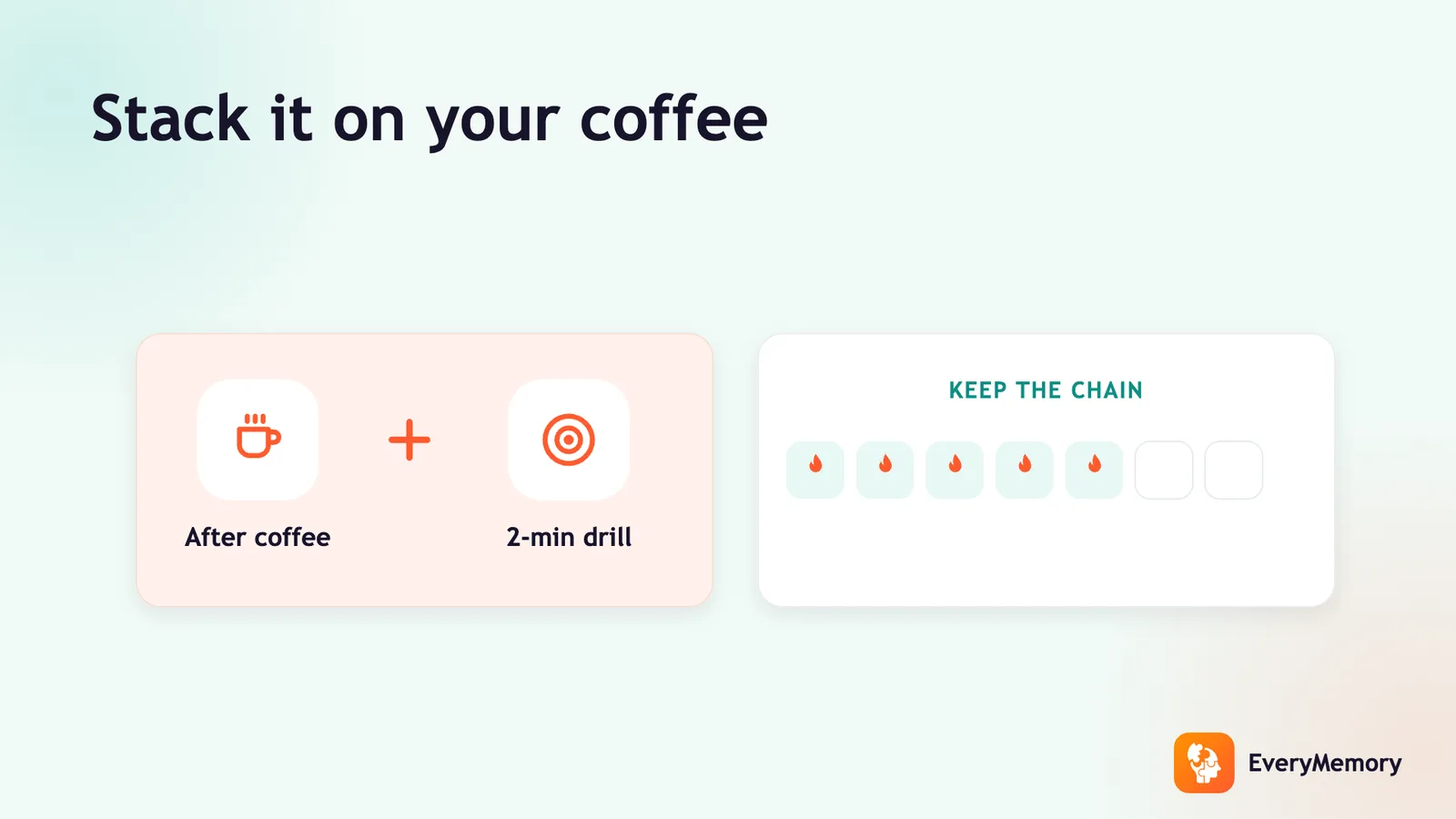
Starting with something genuinely interesting to you - something that motivates you to return to it - is more important than choosing the theoretically optimal activity. Consistency requires motivation. If you want a structured way to begin, our simple daily memory routine is designed to take around 10 minutes and introduces the principles of challenge, variety, and retrieval practice in an approachable form.
✅ Try this today - The beginner's mind experiment
For one week, try doing one familiar thing in an unfamiliar way. The point is to engage the brain with something slightly new.
- Choose something you do on autopilot: a walk, a meal you cook often, a hobby you know well. Add one small novelty - a different route, a new ingredient, a different approach.
- Alternatively, spend 5 minutes each morning on something you've been meaning to learn but haven't started: a few words of a language, a basic piece on an instrument, the rules of an unfamiliar game.
- At the end of the week, notice whether the effort felt easier. The slight discomfort of novelty is the signal that your brain is working - and that's exactly what you're after.