EveryMemory
Lumosity Alternatives: How to Choose a Brain-Training App
Looking for an alternative to Lumosity? The choice comes down to what you want to train and what you'll keep using. The criteria that matter, and where EveryMemory fits.
Part of the guide: Brain Exercises for Seniors: The Complete Guide →
⚡ Quick answer
If you're looking for an alternative to Lumosity, the choice comes down to what you want to train and how you like to practise. Good brain-training apps share a few things - varied games that make you actively recall, difficulty that adapts as you improve, short daily sessions, and progress tracking. EveryMemory is one option, focused on memory and attention with short non-medical daily sessions; the best pick is whichever you'll actually keep using.
Key takeaways
- Choosing a Lumosity alternative comes down to what you want to train and what you'll actually keep using.
- Good brain-training apps share: active recall (not just reaction), adaptive difficulty, variety, short daily sessions, and progress tracking.
- EveryMemory is a memory- and attention-focused, non-medical option built around those qualities.
- Shortlist two or three on the criteria, try each for a week, and keep the one you open daily.
Lumosity is one of the best-known brain-training apps, so it's a natural starting point - but plenty of people go looking for an alternative, whether for a different focus, a different feel, or a different price.
Rather than rank a list that changes constantly, here's how to choose any brain-training app well, and an honest note on where EveryMemory (which we make) fits.
Why people look for a Lumosity alternative
Common reasons: wanting a narrower focus (say, memory specifically rather than a broad mix), preferring a different style or simpler interface, looking for a free option, or simply wanting to try something new. None of those make Lumosity bad - they just mean a different app might suit you better.
What to look for in any alternative
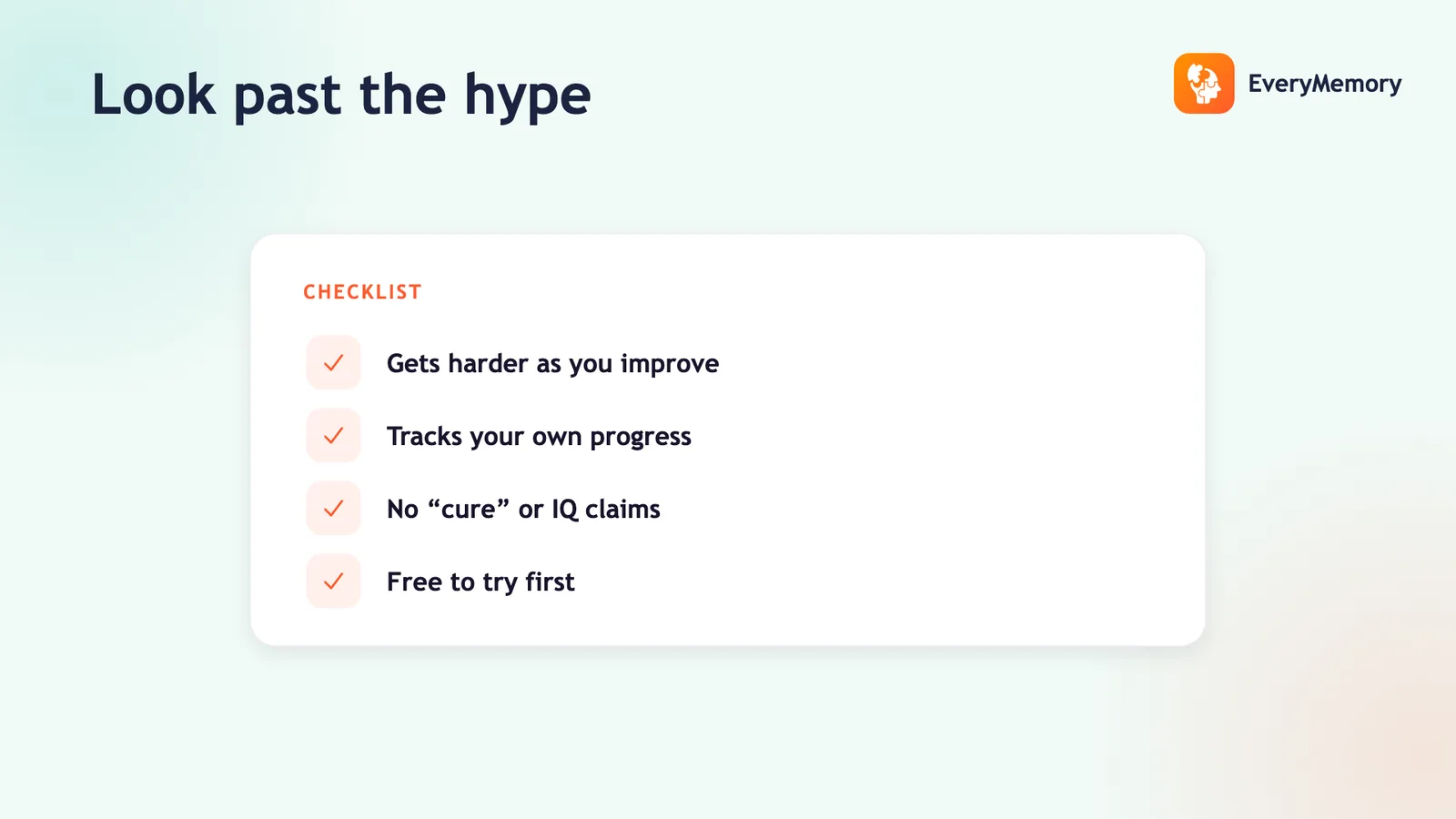
Judge any brain-training app on the things that actually matter, not the marketing:
- Active recall, not just reaction - it makes you retrieve from memory, not only tap fast.
- Adaptive difficulty - it gets harder as you improve, so it keeps stretching you.
- Variety - it rotates skills (memory, attention, reasoning) rather than one repeated game.
- Short daily sessions - a few minutes you'll repeat beats a long one you won't.
- Progress tracking - your trend against your own past, not a stranger's score.
The same checklist applies to any memory or brain app.
Where EveryMemory fits
Full disclosure: EveryMemory is ours. It's built around exactly those qualities - short daily sessions of retrieval-based games across memory, attention, flexibility, and speed, with difficulty that adapts and a self-relative score you can track. It's deliberately focused (memory and attention) and non-medical. You can start with a free memory self-check to set a baseline.
Set honest expectations
Whatever you pick, keep expectations grounded: brain-training apps reliably make you better at their games and are an enjoyable way to stay mentally active, but no app is a medical fix - see do brain games really work? Pair any app with sleep, movement, and learning new things.
How to decide
Don't overthink it. Shortlist two or three on the criteria above, try them for a week each, and keep the one you actually open daily - consistency matters far more than which app you chose. A free option lets you test without commitment.