 EveryMemory
Memory Test: How to Do a Simple Non-Medical Self-Check
What a memory test measures, the three kinds you'll run into, and a 5-minute non-medical self-check you can do at home to track your own recall over time.
Part of the guide: Understanding Memory Loss and Forgetfulness: A Calm, Reassuring Guide →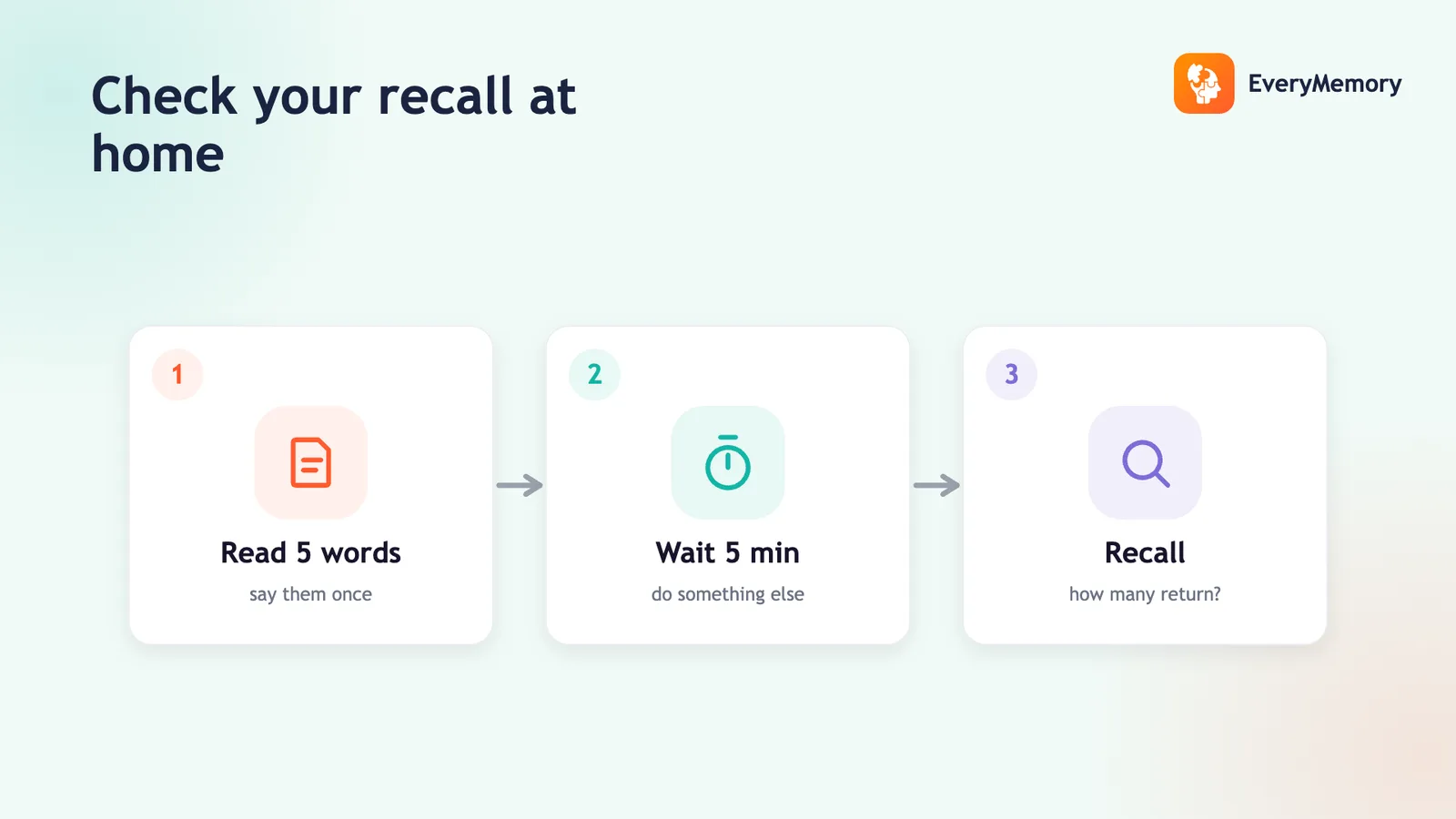
⚡ Quick answer
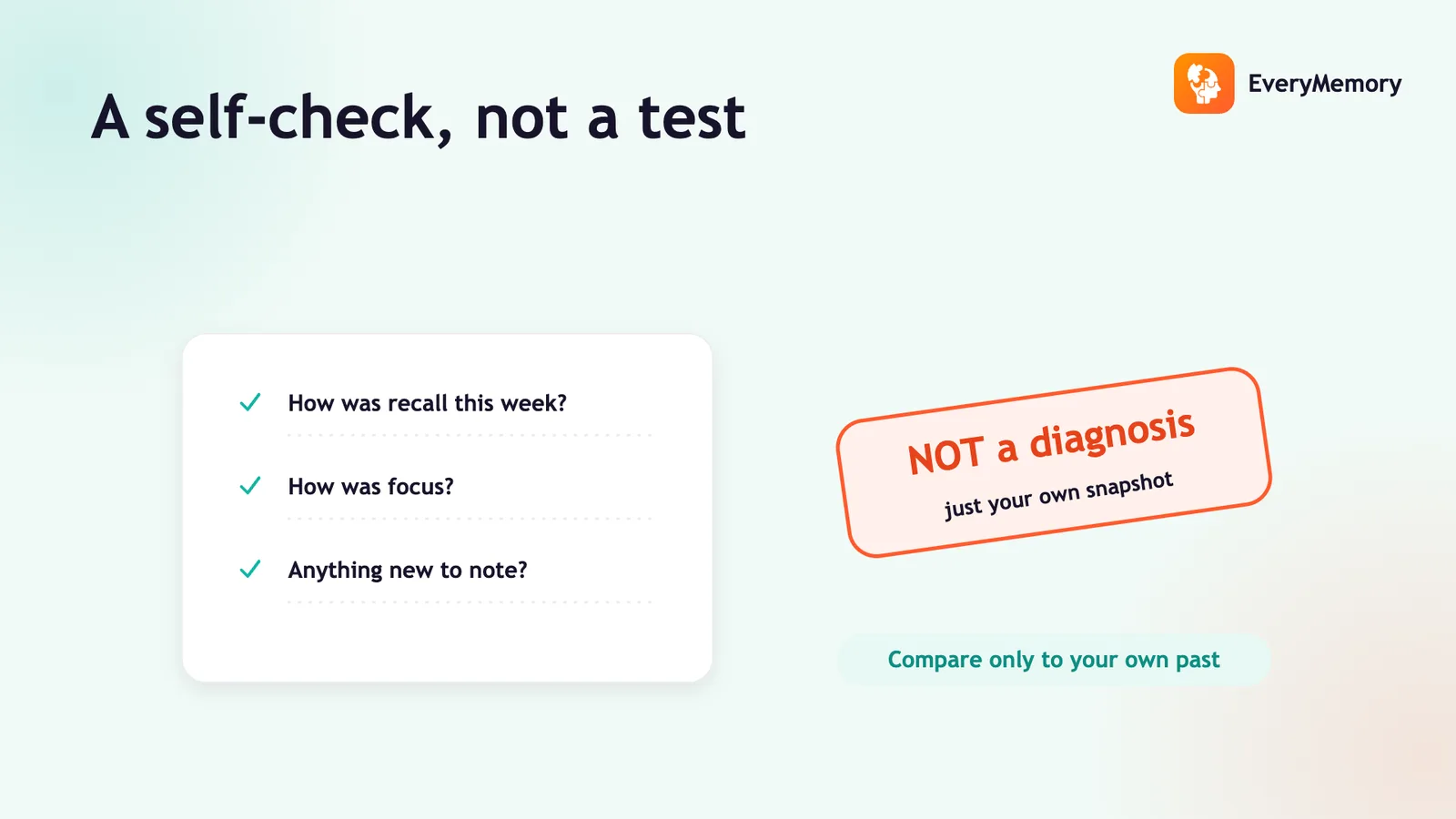
A memory test measures how well you take in and recall information. Online quizzes and at-home self-checks are non-medical - they give a self-relative snapshot, not a diagnosis. A clinical cognitive assessment is a separate thing done by a professional. Use a simple home check to spot your own trends over weeks, not to label yourself.
Key takeaways
- A non-medical memory test gives a self-relative snapshot, not a diagnosis - you compare your results to your own past, not to anyone else.
- A useful check separates immediate recall, delayed recall, working memory and retrieval speed, rather than producing a single score.
- Delayed recall - remembering a short word list 10 minutes later - is usually the most informative part of an at-home self-check.
- Scores swing with sleep, stress and time of day, so a single low result means little; a consistent downward trend over weeks is what matters.
- Only a qualified professional using validated assessments can diagnose anything - at-home and online tests are awareness tools only.
A memory test can mean three very different things: a 60-second quiz online, a self-check you do at your kitchen table, or a formal assessment run by a professional. They are not interchangeable, and treating one like another is where people scare themselves unnecessarily.
This guide stays with the first two - the non-medical kind. You'll get a 5-minute self-check you can repeat, a plain way to read the results, and a clear line for when it's worth talking to someone qualified.
What a memory test actually measures
Memory isn't one thing, so a useful test looks at a few separate abilities rather than a single "score":
- Immediate recall - repeating a short list back the moment you hear it.
- Delayed recall - remembering that same list 5–10 minutes later, after a distraction. This is usually the most telling part.
- Working memory - holding and juggling information, such as repeating numbers in reverse order.
- Recognition - spotting something you've seen before, which is easier than recalling it cold.
- Processing speed - how quickly you can take information in and respond.
Most everyday slips are about retrieval being slow, not information being gone. A good self-check separates "I couldn't recall it" from "it surfaced a minute later" - those mean different things. For the bigger picture of which changes are ordinary, see memory loss vs normal aging.
Three kinds of memory test - and what each is for
| Type | What it is | Use it for |
|---|---|---|
| Online quiz | A quick, gamified web test - fun, but unstandardised and easy to game. | A bit of curiosity. Don't read anything serious into the result. |
| At-home self-check | A short, repeatable routine (below) you score against your own past results. | Tracking your own trend over weeks and months. |
| Clinical assessment | A validated cognitive test administered and interpreted by a professional. | Any genuine concern. Only this kind can inform a diagnosis. |
The self-check is powerful for one reason: it's self-relative. You're not compared to a stranger's benchmark - you're compared to last month's you, under similar conditions. That's where a real signal shows up.
How to run a 5-minute self-check at home
Do this rested, in a quiet room, at roughly the same time of day each time. You'll need paper and a timer.
- Word list (immediate). Read this list once, slowly: apple, river, candle, doctor, garden, pencil, window, music, copper, ticket. Cover it and write down every word you remember. Note the count out of 10.
- Reverse digits (working memory). Read a number aloud, then say it backwards. Start with 4 digits (e.g. 7-2-9-4 → 4-9-2-7) and add one digit until you slip. Note the longest you got.
- Category fluency (retrieval speed). Set 60 seconds and name as many animals as you can out loud, tallying them. Note the total.
- Word list (delayed). After all of the above - about 10 minutes since step 1 - write the original 10 words again from memory, with no peeking. Note the count.
Keep the four numbers in a simple log. One sitting tells you almost nothing; the pattern across several is the point. A structured non-medical self-check follows the same idea with a printable sheet.
How to read your results without scaring yourself
Scores swing day to day for ordinary reasons. Before reading anything into a low result, account for the obvious:
- Poor sleep the night before - the single biggest swing factor.
- Stress, worry, or doing the check while distracted.
- Time of day - most people are sharper mid-morning than late evening.
- Caffeine, alcohol, or feeling unwell.
A single off day is just an off day. What's worth noticing is a consistent downward trend over several weeks under the same conditions - especially on delayed recall. Track it; don't react to one number.
When a memory test result is worth a professional's input
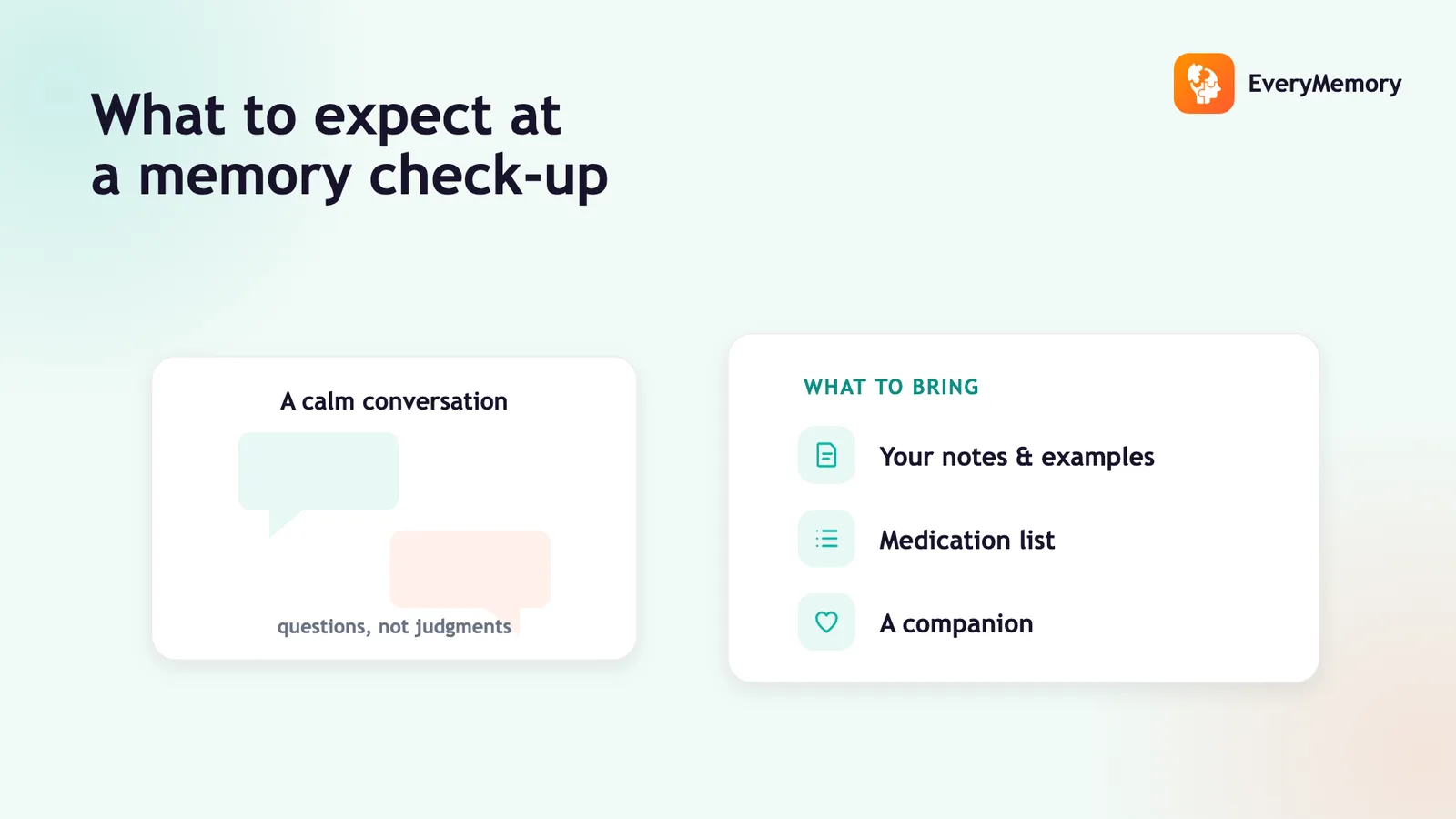
A self-check is an awareness tool, never a verdict. It's reasonable to speak with a qualified professional if, over a period of weeks, you notice memory changes that are clearly worsening, that start to affect everyday tasks, or that other people point out before you do - particularly alongside confusion about familiar people or places. Bringing a few specific, dated examples (and your log) makes that conversation far more useful. What to expect at a memory check-up walks through it.
✅ Try this today - the 60-second animal test
A quick retrieval-speed snapshot you can repeat weekly:
- Set a timer for 60 seconds.
- Name as many animals as you can out loud, counting on your fingers or tallying.
- Write down the total and the date.
- Repeat next week under the same conditions and compare - you're racing only yourself.
⚠ When to talk to a professional
A non-medical memory test cannot diagnose anything, and no honest online tool will claim to. If memory changes are getting steadily worse over weeks, affecting daily life, or being noticed by others, talk to a qualified professional rather than an app or quiz.