 EveryMemory
Memory Changes Families Often Notice in a Parent
A gentle, non-diagnostic guide to the everyday memory changes adult children sometimes notice in an aging parent - and how to respond with care.
Part of the guide: Helping a Parent With Memory Changes: The Complete Family Guide →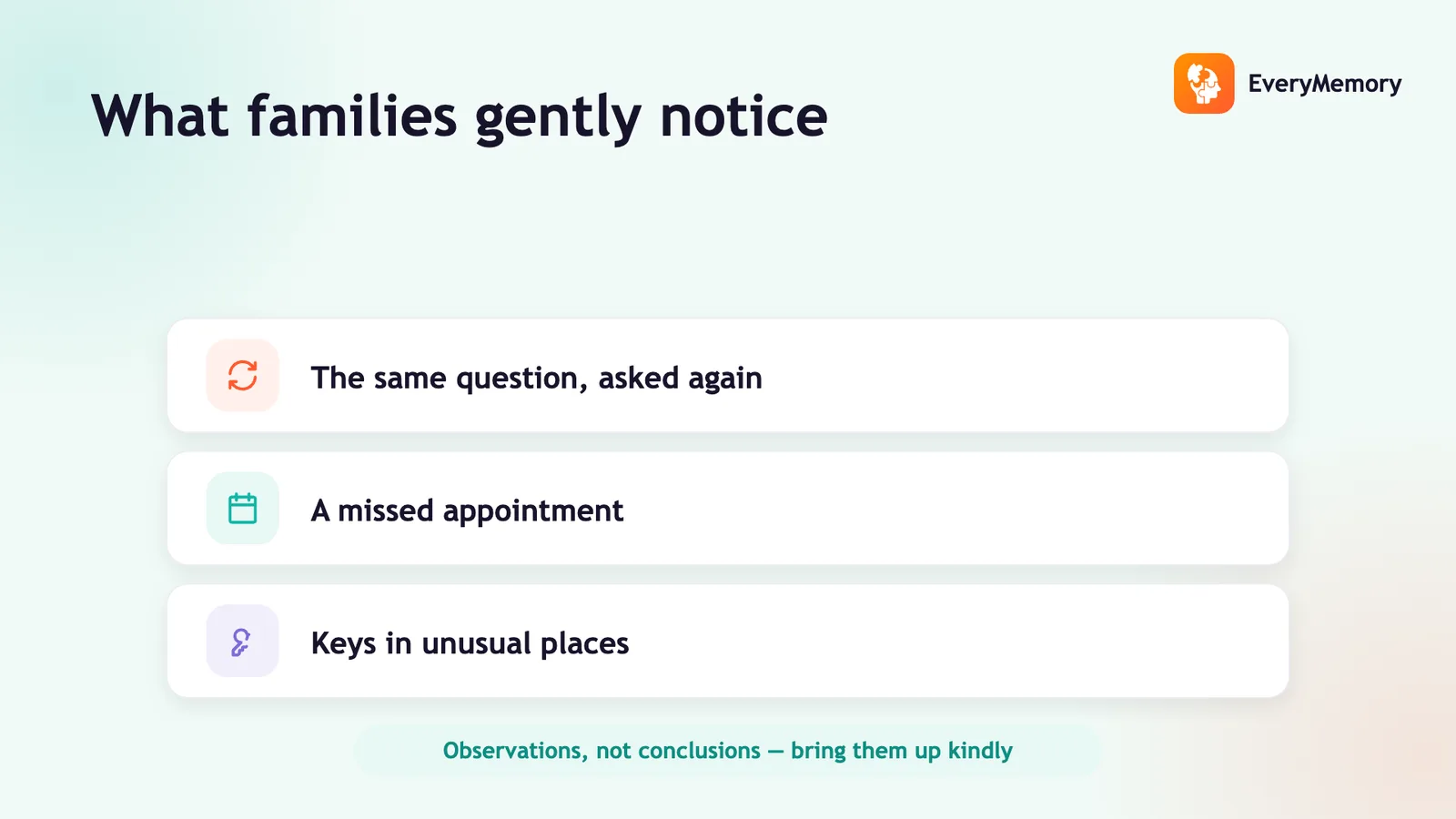
⚡ Quick answer
Many memory changes in older adults - occasional word-finding pauses, needing reminders for appointments, misplacing familiar items - are ordinary parts of ageing. Things that are newer, more frequent, or beginning to affect everyday life are generally worth a gentle conversation and, if they persist, a view from a qualified professional. The key is calm observation rather than alarm.
Key takeaways
- Many memory changes in older adults are ordinary - word-finding pauses, occasional missed appointments, and mild forgetfulness affect most people as they age.
- What is worth watching is a clear change from a person's own previous pattern, especially if it is new, consistent, and affecting everyday tasks.
- Brief, factual notes over two weeks give you something real to work with if a professional conversation becomes useful.
- Raising the subject kindly means leading with care, sharing one specific observation, and giving the conversation time to unfold gradually.
It often starts quietly. A parent asks the same question twice in one afternoon. They pause mid-sentence searching for a word they have used a thousand times. They mention an appointment they had forgotten. You notice it - and then you are not sure what to do with the noticing.
This guide covers the everyday memory changes families sometimes see in an aging parent, what tends to be a natural part of getting older, and how to raise the subject in a way that feels caring rather than alarming. Nothing here is a diagnostic tool - it is a thoughtful starting point.
Why families often notice things first
Memory changes tend to be gradual, which means the person experiencing them often adapts without fully registering the shift. Family members who have the long perspective of decades of knowing someone are often better placed to notice a change. That does not mean every observation signals something serious - it means your attentiveness matters.
The value in noticing is not in drawing conclusions - it is in having something real to work with if a conversation becomes useful. Our guide on how to help an aging parent with memory concerns offers practical things to put in place before any formal conversation is needed.
Repeated questions: what it usually means
One of the most commonly noticed changes is a parent asking the same question again within a short space of time - sometimes within the same visit. For the person asking, it often does not register as repetition: the earlier conversation simply did not stick.
In ordinary aging, occasional repetition usually involves things heard distractedly or when someone was tired. A question asked twice in a week, or a story retold at the next family dinner, falls within the normal range for many people as they age.
What is worth noting is very frequent repetition within a single conversation, or a parent unaware the exchange already happened. If that is consistent over several weeks, it might be gently mentioned to a professional. The guide on what to track before talking to a doctor shows how to log observations simply.
Missed appointments and lost track of tasks
Forgetting an occasional appointment is something most adults experience at any age. As people get older, keeping track of multiple commitments can require more active effort - writing things down, checking a calendar - and many manage this well with simple systems.
What families sometimes observe is a shift in pattern - a parent who prided themselves on reliability beginning to miss things, or losing track of tasks they started. Change from their own baseline is more telling than any comparison to others.
- Occasional missed appointments are common at any age, especially during stressful periods.
- Difficulty tracking multiple commitments can reflect normal age-related changes in working memory.
- A new pattern of forgotten arrangements or unfinished tasks is worth noting over time.
- Shared systems - a kitchen calendar, a whiteboard - can quietly reduce the load.
Word-finding pauses: when the word won't come
Almost everyone has experienced the frustration of a word sitting just out of reach - a familiar name, a term used for years. This tip-of-the-tongue moment becomes somewhat more common as people age, and many older adults notice it without it affecting daily life. Families often observe this as a parent pausing mid-sentence, or substituting a description for a word they cannot retrieve ('the thing you use for - you know, the opener'). This is a widely shared part of normal aging and, on its own, is generally not cause for concern.
What tends to feel different is when word-finding difficulties make conversations frustrating for the person themselves, or come alongside other communication changes. If the pattern is new and sustained, it is worth a professional's view. Our guide on memory loss vs normal aging goes deeper into how ordinary age-related changes differ from patterns worth professional attention.
What tends to be ordinary versus what is worth a professional's view
It is genuinely difficult to draw a clean line here, and that is part of why this guide avoids offering a checklist. No written list can substitute for the full picture a qualified professional can build through conversation and context.
The general principle: occasional, mild memory slips that do not disrupt daily life tend to sit within the range of what happens as people age. Changes that are clearly new, more frequent, beginning to affect tasks the person used to manage without difficulty, or raising safety concerns - those are worth discussing with someone who can properly evaluate them.
The guide on how to talk about memory without scaring a parent offers practical language for when you decide to raise what you have been noticing, including how to frame a professional check-up as reassurance rather than alarm.
How to raise it kindly
Many families sit on their observations for months, uncertain how to begin. Raising the subject can feel like opening a door that cannot be closed. The way a conversation starts shapes everything.
The approach that tends to work best is leading with the relationship. Something like: 'I've been thinking about you - not to worry you, but because I care.' That places you alongside your parent rather than across from them.
- Choose a calm, private moment - not during a family gathering.
- Lead with care, not evidence: 'I care about you and wanted to check in' lands differently from 'I've been noticing things'.
- Share one gently described observation. Avoid a list.
- Ask whether they have noticed anything themselves - most people have, and being invited to share can be a relief.
- Frame any mention of a professional as routine: most check-ups end with reassurance or a simple explanation.
✅ Try this today - A two-week observation practice
You do not need to do anything dramatic. Start here:
- Keep a brief note on your phone for two weeks. When you notice something - a repeated question, a missed arrangement, a word-finding pause - jot down what happened, the date, and any context (tired, unwell?). Do not interpret; just record.
- After two weeks, look at your notes as a whole. Is there a consistent pattern of change, or do the observations feel scattered and occasional? A pattern over time is more meaningful than any single event.
- If you decide to raise the subject, prepare one calm, specific thing to say and choose a relaxed moment. You are opening a conversation, not presenting a case.
⚠ When to talk to a professional
This article is general, non-medical information only. If you notice sudden, rapid, or significantly worsening changes in a parent's memory, thinking, or orientation - or any change that raises a safety concern - please speak with a qualified healthcare professional promptly.