 EveryMemory
Names and Faces Memory Exercise
Remembering names is a skill, not a gift - and it responds remarkably well to practice. Here's a step-by-step exercise to make new names stick by linking them to faces.
Part of the guide: Brain Exercises for Seniors: The Complete Guide →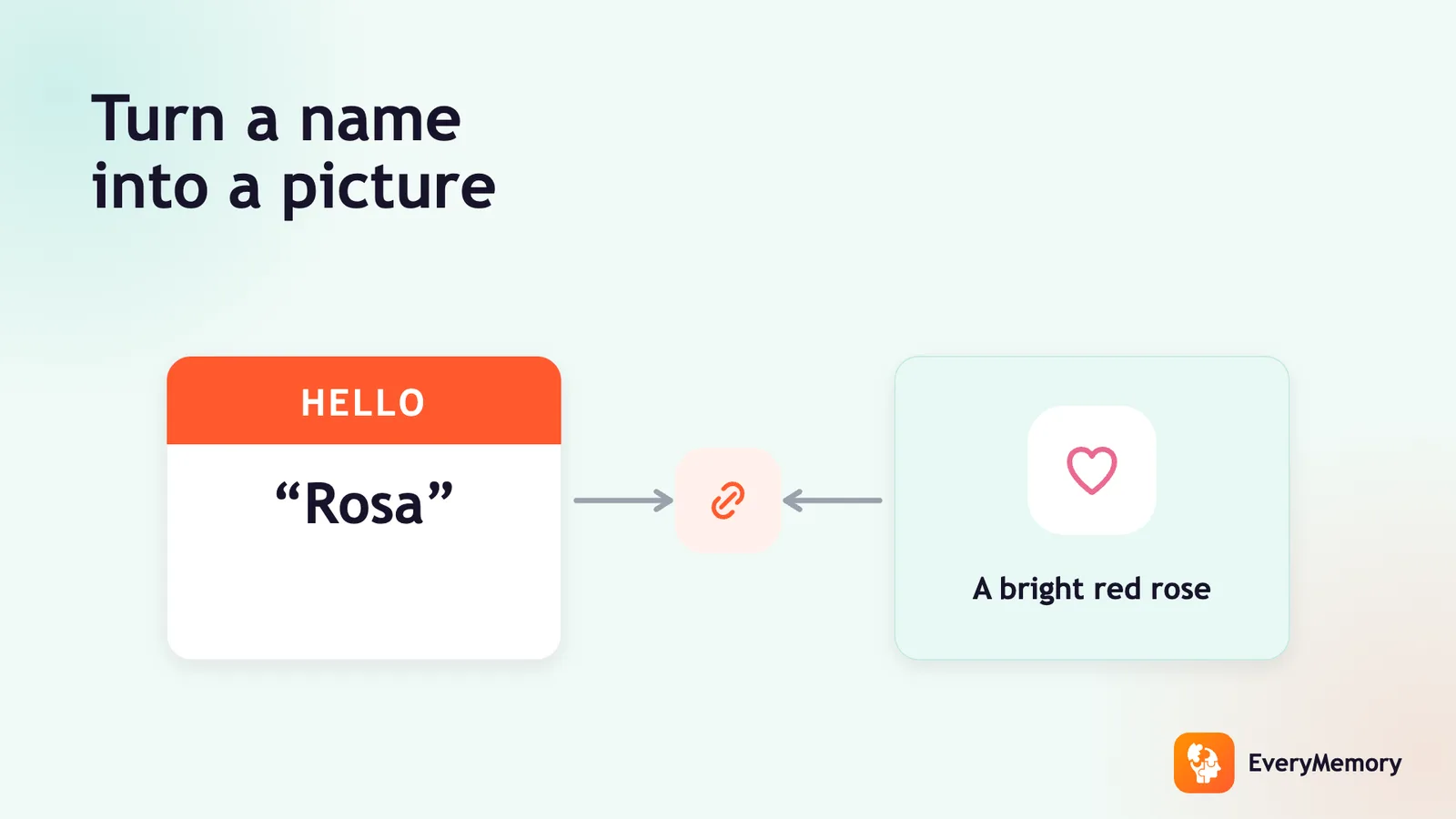
⚡ Quick answer
To remember a name, do three things: pay full attention and repeat the name the moment you hear it, build a vivid mental link between the name and one distinctive facial feature, and review the pairing after a short delay. Attention and association do the heavy lifting; reviewing on a delay moves the name into longer-term memory. Practising with photos first makes it feel automatic in real life.
Key takeaways
- Most names are lost at the introduction because attention is elsewhere - hearing and repeating the name aloud is the single most important step.
- Linking a name to a vivid, even absurd, mental image of a distinctive facial feature gives memory something concrete to hold.
- Two quick spaced reviews - a few minutes after meeting someone, then once more before parting - move a name from fragile to remembered.
- Practising with five photos a day for a week or two makes the attention-association-review loop feel automatic in real conversations.
Almost everyone believes they are "bad with names." It's one of the most common things people say about their own memory. But here's the thing: people who are genuinely good with names rarely have superior memories. What they have is a method - usually without realising it - and that method is entirely learnable.
The reason names are so hard is that they're arbitrary. A face is rich with detail your brain loves; a name is a meaningless label with nothing to hold it in place (we explore this more in is it normal to forget names after 60?). This exercise fixes that by giving the name something concrete to attach to.
It comes down to three steps - attention, association, and review - and a simple daily drill to make them automatic. Practise for a week or two and you'll feel the difference in real conversations.
Watch the guided session
Step 1 - Attention: catch the name before it's gone
Most names are lost at "hello," before any memory technique gets a chance. In the instant of introduction, your attention is usually racing ahead - what to say, whether to shake hands, where you know the face from - and the name slides straight past, never encoded.
So the first move is simply to slow down and actually hear it. Then repeat it back immediately: "Nice to meet you, Maria." Saying the name out loud forces your brain to process the sound rather than let it wash by, and on its own this roughly doubles how often a name sticks. If you didn't catch it, ask - "Sorry, was it Maria or Mariah?" People are happy to be asked; it signals you care.
Step 2 - Association: give the name a hook
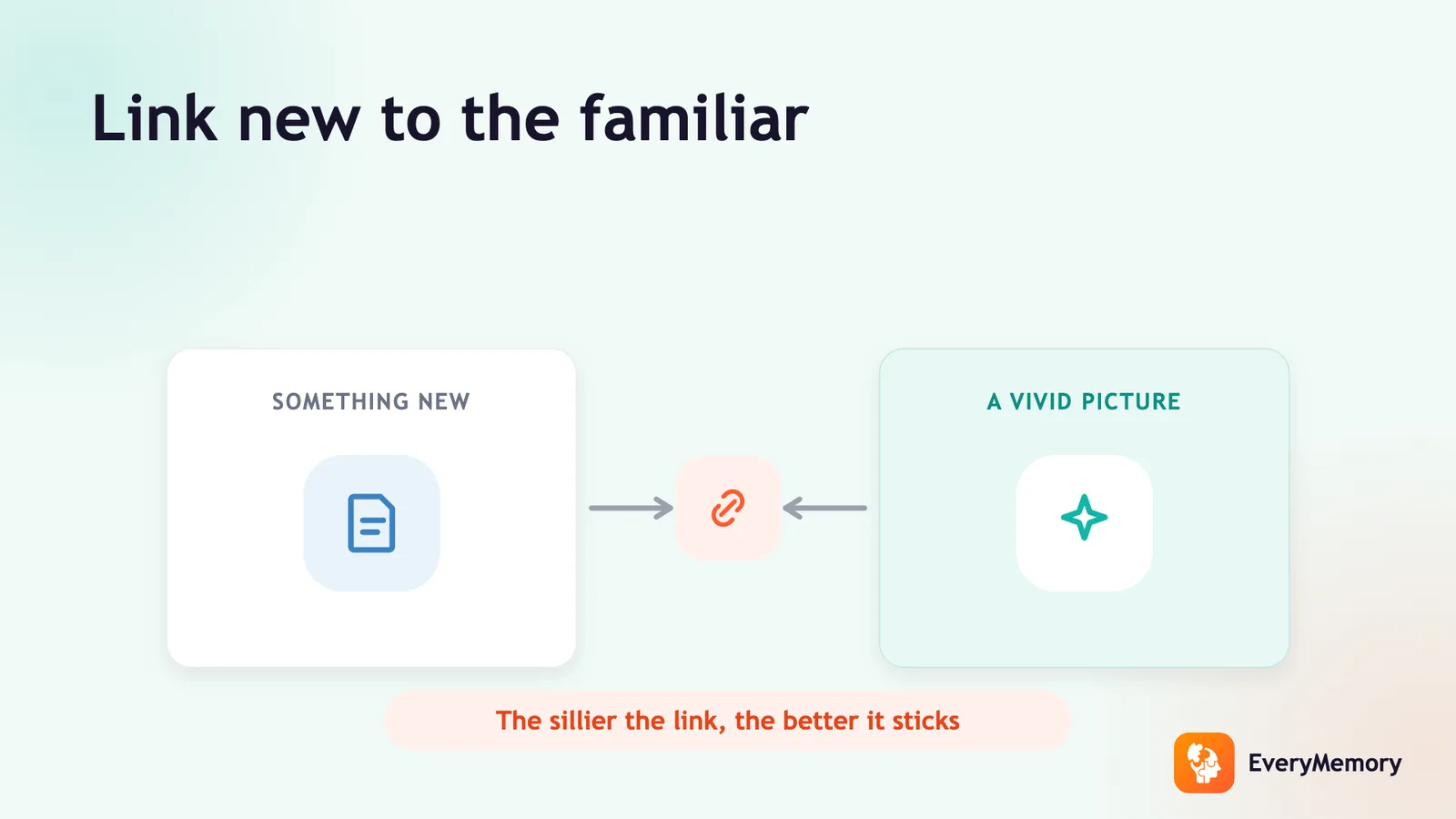
Now make the name mean something by tying it to one distinctive feature of the face with a vivid mental image. The more exaggerated, unusual, or even silly the image, the better it sticks - your brain remembers the strange far better than the bland.
- "Rosa" → notice rosy cheeks, and picture roses blooming on them.
- "Mark" → spot a freckle or feature and imagine it as a bold mark.
- "Bill" → picture a duck's bill where the nose is.
- "Grace" → imagine the person moving with exaggerated, balletic grace.
It doesn't matter that the image is absurd - no one sees it but you, and absurd is exactly what memory clings to. This is the same principle of vivid linking that powers most memory techniques, explored further in how to use association to remember more.
Step 3 - Review: lock it in with a delay
A name you encode well can still fade if you never revisit it. The fix is one or two quick, spaced reviews. A few minutes after meeting someone, silently recall their name while glancing their way. Then use it again before you part: "Good talking with you, Maria."
This is the principle of spaced retrieval - each successful recall after a delay pushes the memory further into long-term storage. Two tiny reviews are enough to take a name from "gone in five minutes" to genuinely remembered.
The daily drill: practise with photos
Real introductions are high-pressure, so build the skill in low-pressure practice first. You need five to ten photos of people with names - a magazine, a book of portraits, or the contacts in your phone all work.
- Take each photo in turn. Say the name, choose one feature, and build a vivid name-to-feature image.
- After working through all of them, shuffle and test yourself: cover the names and try to recall each one from the face.
- Repeat any you miss, strengthening or changing the association until it holds.
Five minutes of this a day, and within a week or two the attention–association–review loop starts happening automatically when you meet real people. It pairs naturally with the recall and focus drills in our 10-minute memory workout.
Handling a whole room of new people
Events and gatherings are the real test. Two things make them manageable. First, don't try to bank everyone at once - anchor each new name to a feature as you go, in the moment. Second, review in small clusters: after meeting three or four people, take a beat to mentally run through their names and faces together before moving on.
And give yourself grace. Even with a method, you won't catch every name in a crowded room - nobody does. Catching most of them, and recovering the rest with a friendly "remind me of your name?", is a genuine win.
✅ Try this today - The 5-photo practice drill
Five minutes, five faces. Do it daily for a week.
- Gather five photos of people whose names you know (magazine, book, or phone contacts).
- For each: say the name, pick one distinctive feature, and form a vivid name-to-feature image.
- Shuffle, then test yourself - recall each name from the face alone.
- Repeat any you miss, adjusting the association until it sticks.