 EveryMemory
How to Use Association to Remember More
Association is the foundation of almost every memory technique. Here's how to use it deliberately to make new information stick.
Part of the guide: How to Improve Your Memory: The Complete Beginner's Guide →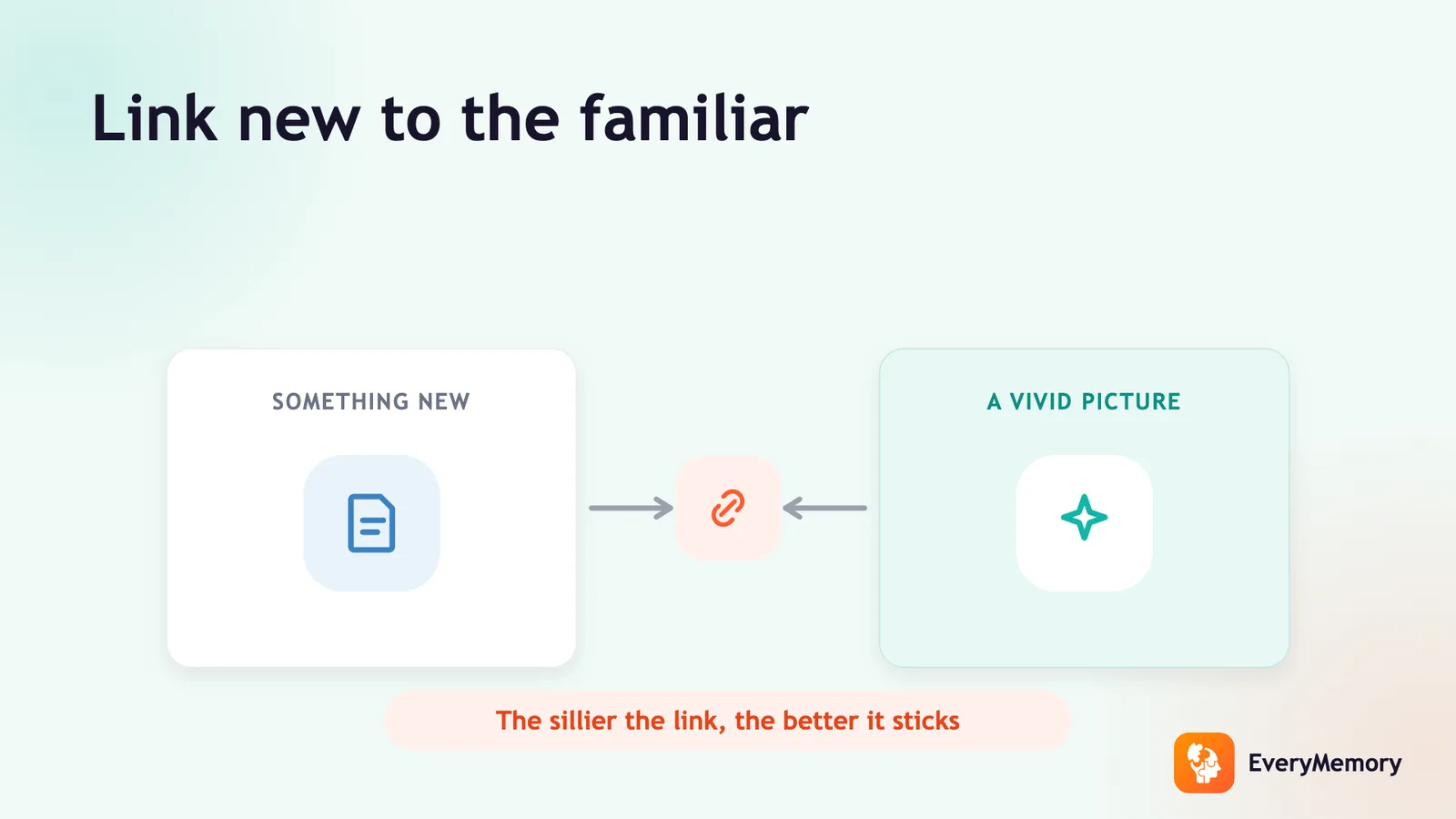
⚡ Quick answer
Association means deliberately linking new information to something you already know well, through a concrete image, a story, a rhyme, or a personal connection. The stronger and more vivid the link, the easier it is to retrieve the new information later. This works because memory retrieval follows connections - the more connections a piece of information has, the more paths lead back to it.
Key takeaways
- Link new information to something you already know well - an image, a story, a rhyme, or a personal connection.
- Spend ten to fifteen seconds actively building a concrete, vivid link rather than waiting for one to appear on its own.
- Absurd or exaggerated associations stick better than logical ones because unusual details are processed more deeply.
- Retrieve the association at least once the same day, then again the next day, to reinforce the connection over time.
Your memory is not a filing cabinet where facts are stored in isolation. It is a vast network of connections, and every time you remember something, you are following a chain of links from one thing to another. This is why smelling a particular food can bring back a childhood summer in vivid detail, or why hearing an old song instantly recalls the specific time and place you first heard it. Memory is built on association.
The good news is that you can use this same principle deliberately. Rather than hoping new information will stick on its own, you can give it strong, deliberate links to things you already know - and make it far more likely to be there when you need it. This article shows you exactly how to do that.
Why association works: how memory is structured
Every time you learn something new, your brain forms connections between that new information and existing knowledge. The more connections a piece of information has - to emotions, images, personal experiences, other facts - the more reliably it can be retrieved. Think of it like a spider web: a fact in the centre of a dense web is held firmly in place, while an isolated fact with a single thread breaks easily.
This is why rote repetition of unconnected facts is inefficient. You are strengthening a single thread by repeating it, rather than building the web. Association changes the underlying structure - and retrieval follows structure. You'll find the same principle at the heart of the memory palace technique, where spatial associations do the connecting work.
Four types of association - and when to use each
There are several specific forms association can take, and each suits different kinds of information:
- Visual image. Convert the information into a concrete mental picture, the more vivid and unusual the better. Best for nouns, names, places, and individual facts. Example: to remember that your new neighbour Nora is a retired nurse, picture her at your front gate wearing a nurse's uniform, holding a stethoscope.
- Story or narrative. Link several pieces of information by weaving them into a short story, even an absurd one. Best for sequences of steps, lists, or a series of related facts. Example: to remember to take your pills, water the plant, and put out the bins on Tuesday, build a quick mental story: you take your pills, then walk to water the plant, but the watering can spills and you slide into the bins, which roll down the drive.
- Rhyme or sound pattern. Link the new information to a word or phrase that sounds similar. Best for names, technical terms, and words in another language. Example: to remember the name "Elena", link it to "a loner" if she has a quiet, self-contained quality.
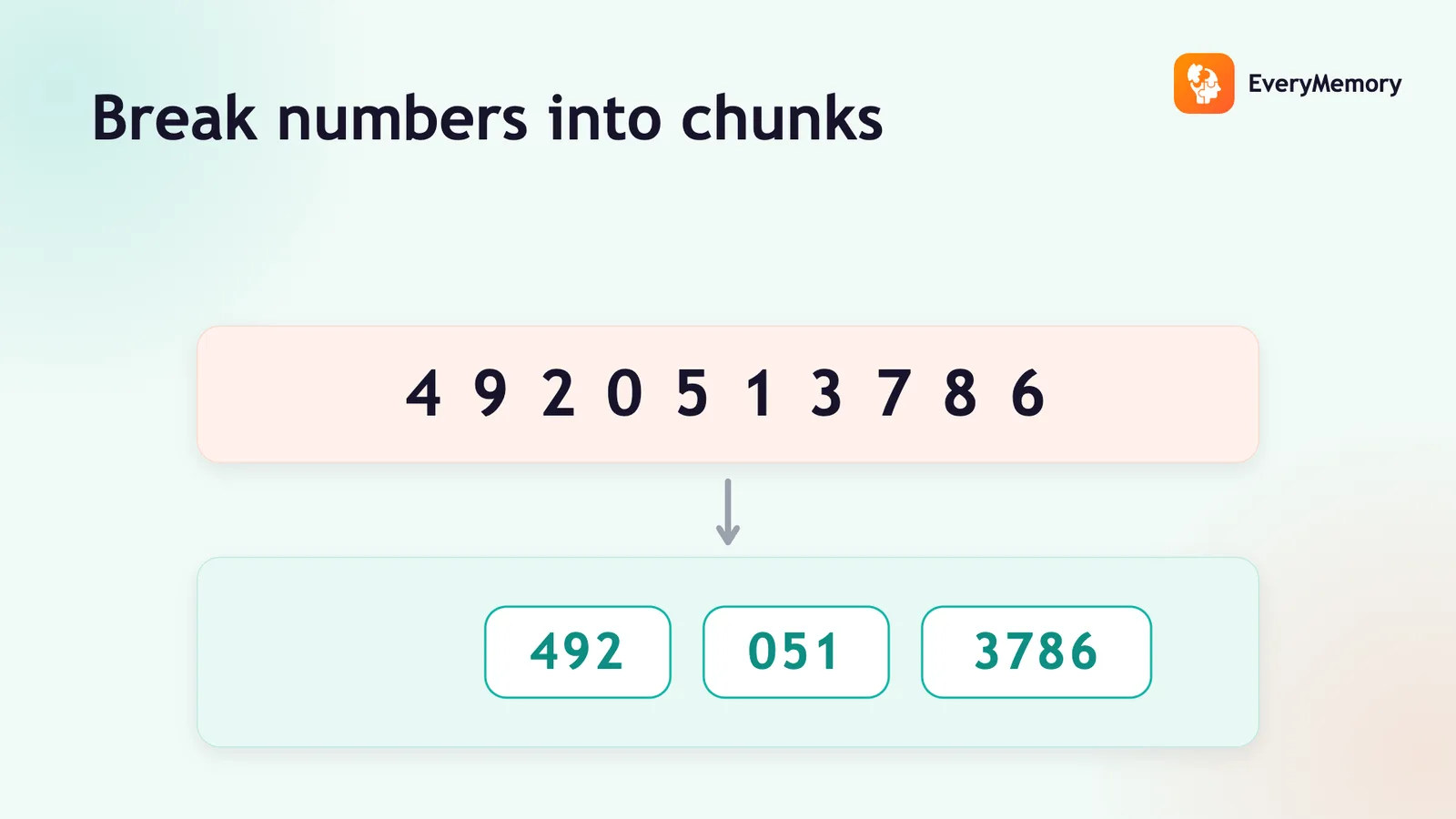
- Personal connection. Link the new information to something in your own life - a date that matches a birthday, a name that matches someone you already know, a place that reminds you of somewhere familiar. Best for numbers, dates, and any information with no natural visual content.
How to build a strong association: the three-step method
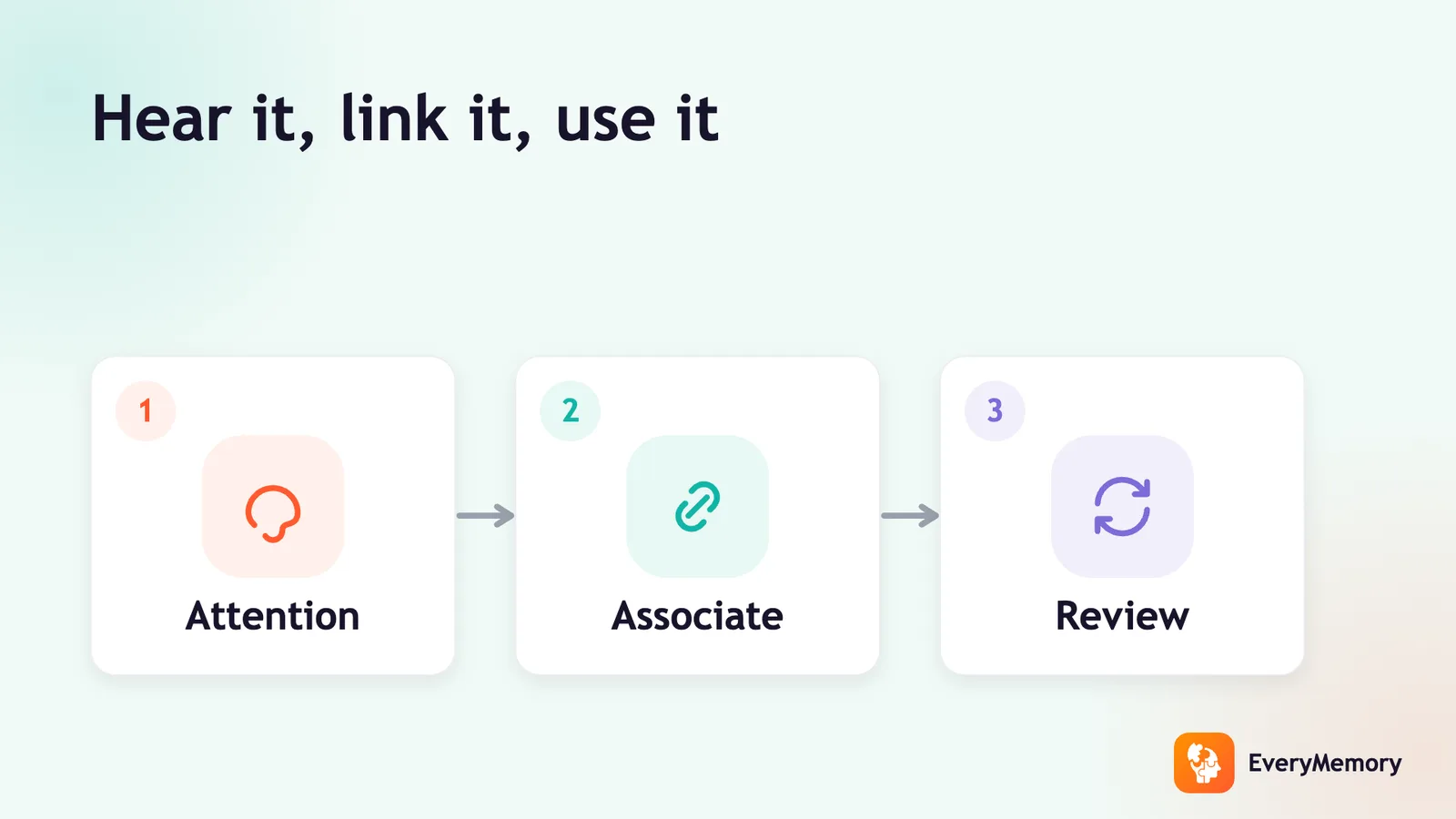
Any association works better when it is concrete, vivid, and personal:
- Identify exactly what you want to remember. Vague intention produces weak encoding.
- Find a hook in something you already know. Ask: what does this remind me of? What sounds like it? What does it connect to in my life? Spend ten seconds actively searching - don't wait for a link to appear.
- Make the link vivid and concrete. Transform it into an image, a brief story, or a sensory detail. Unusual details are processed more deeply than ordinary ones.
The whole process takes fifteen to thirty seconds. Done consistently, it becomes fast and automatic.
Worked examples
Here are three concrete examples across everyday situations:
- A medication name. You need to remember "Amlodipine". It sounds like "I'm low and pine" - picture yourself feeling low, leaning against a pine tree, the pill bottle at the roots. Odd, but retrievable.
- A name and face. You meet Gerald, who has a strong square jaw. "Gerald" sounds a bit like "giraffe" - picture a giraffe standing behind him, its long neck framing that jaw. The next time you see Gerald, the image fires before you have consciously tried.
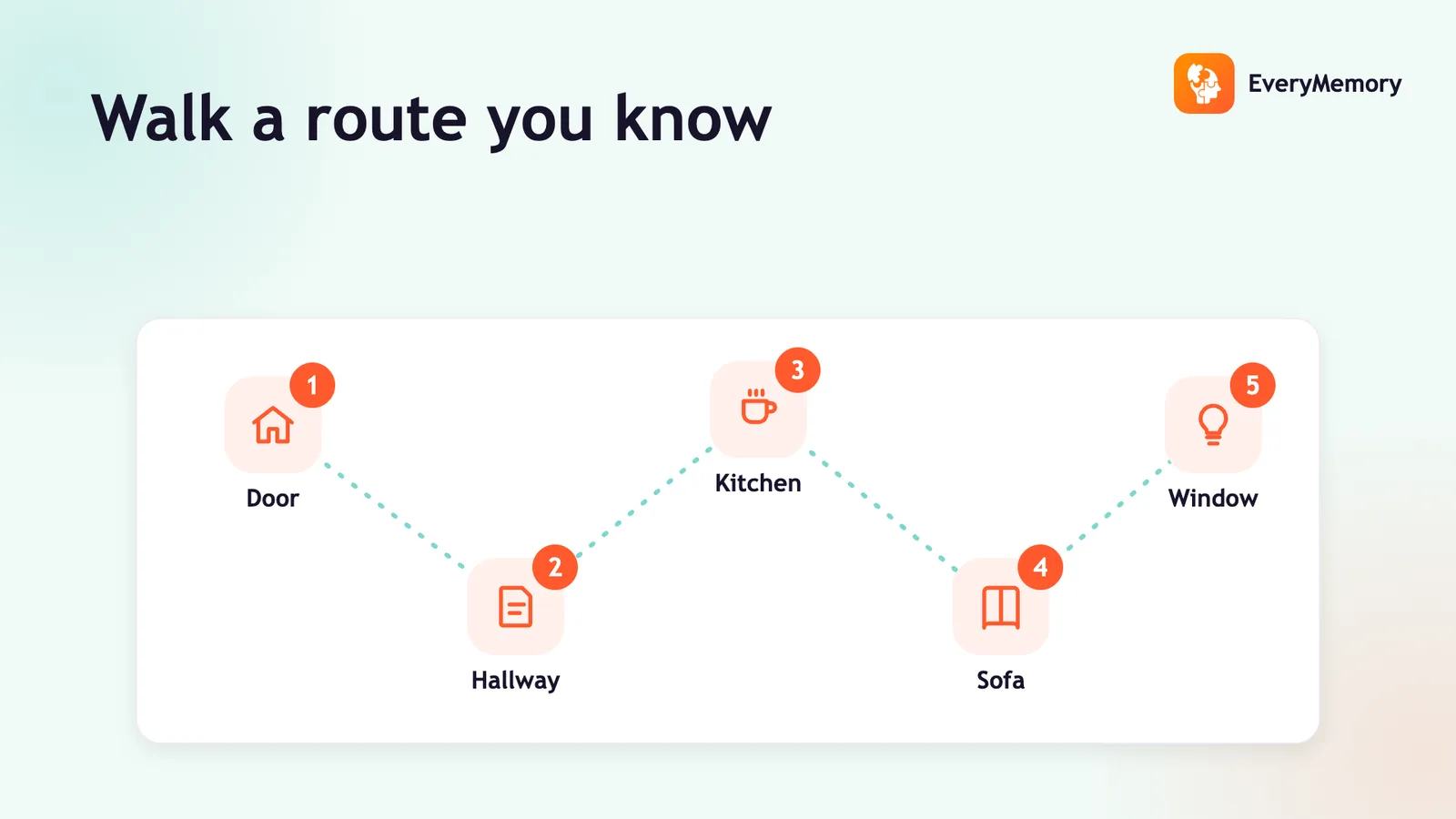
- A task linked to a location. You need to call your dentist when you get home. Picture a giant toothbrush propped against your front door. When your hand reaches for the handle, the image surfaces. This location-cue method also underpins remembering where you put things.
Common mistakes that weaken associations
A few patterns consistently undermine the technique:
- Links that are too abstract. "It starts with A" is not a vivid association. The link needs to be a concrete image, story, or sensory detail - not a logical rule.
- Rushing past the step. The encoding happens in the moment of building the image. Telling yourself "I should associate this" without actually doing it produces nothing.
- Using the same generic image for everything. Each association should be specific and individual. If all your links lead to the same image, they become useless.
- Never retrieving deliberately. Retrieve a new association at least once that day - start from the hook and follow the link back. Use spaced repetition for longer-term retention: once that day, once the next day, once a few days later.
Bringing association into daily routine
You don't need a special session to use association - use it as a default habit whenever new information arrives. At an introduction, spend three seconds linking the name to a face feature. At a doctor's appointment, turn each instruction into a quick image before you leave. When parking somewhere unfamiliar, note a distinctive detail and build a small mental anchor.
Built into a memory training habit, these small practices compound into a noticeably better ability to retain what matters. The visual memory training guide shows how to sharpen the image-making skill at the heart of association.
✅ Try this today - The 5-item association drill
Once today, practise building deliberate associations:
- Choose five things you need to remember in the next 48 hours - appointments, names, tasks, anything.
- For each one, pause for fifteen seconds and build a vivid, concrete link to something you already know well. Make it an image, a story, or a personal connection - not a logical note.
- Write the five 'hooks' (not the items - just the hooks) on a piece of paper.
- In three hours, look at the hooks only and try to retrieve each original item from memory.
- Note which links worked and which didn't. The weak ones usually needed a more vivid or unusual image. Build a stronger one now and test again tomorrow.