 EveryMemory
Optical Illusions and Attention
Optical illusions are less a brain workout than a window into how attention and perception work. Here's what they actually reveal - and why they don't "train" your brain.
Part of the guide: How to Keep Your Brain Healthy: A Complete Lifestyle Guide →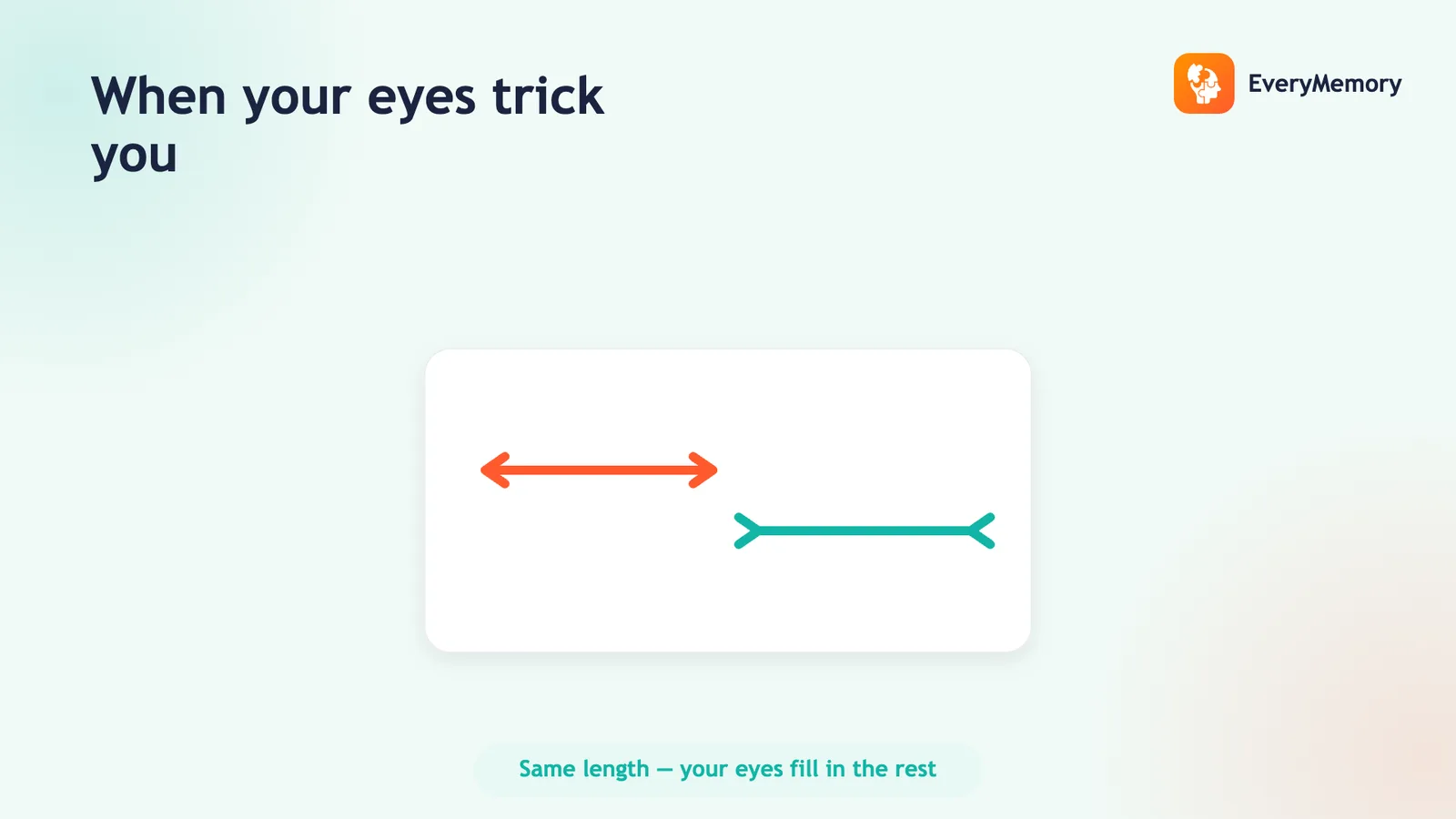
⚡ Quick answer
Optical illusions don't train your brain so much as reveal how it works - exposing the shortcuts your visual system and attention use to build reality fast. They're fascinating and a great way to understand perception, but they're a demonstration, not a workout. Enjoy them as insight, not as a brain-training exercise.
Key takeaways
- Reveal how perception and attention work, not train them
- Demonstration, not a workout - no transfer
- Inattentional blindness shows attention is a spotlight
- Genuine value is humility about what you 'see'
Optical illusions are irresistible: a still image that seems to move, two faces that are also a vase, an arrow that bends a line that's perfectly straight. They feel like a brain test, and they get shared as one. But illusions are doing something more interesting than testing you - they're showing you the machinery of perception with the cover off.
That distinction matters, because illusions are often sold as "attention training" when they're really attention demonstration. Understanding the difference tells you what they're genuinely good for.
What illusions reveal about attention
Your brain doesn't passively record the world; it predicts and fills in, using assumptions about light, depth, and motion to construct a stable scene from messy input. Illusions work by feeding those assumptions input they handle wrongly - so you see motion that isn't there, or a colour shift the pixels don't contain. The illusion is your perceptual shortcuts caught in the act.
Attention is part of the show. Many illusions, and especially "inattentional blindness" demos like the famous gorilla you miss while counting passes, prove that you simply don't perceive what you don't attend to. That's a profound fact about attention - and it's the honest reason illusions are worth your time. For the wider topic, see attention span.
Demonstration, not training
Here's the honest core. Watching illusions doesn't strengthen your attention any more than watching an optical-physics demo improves your eyesight. They reveal how perception works; they don't drill it. You can stare at the spinning-snake illusion a thousand times and your real-world attention won't improve.
- Illusions expose perceptual shortcuts - they don't remove or train them.
- Most illusions fool you even when you know the trick - proof they're automatic.
- Inattentional-blindness demos teach a lesson about attention, once.
- There's no transfer: enjoying illusions won't sharpen everyday focus.
Illusions versus attention puzzles
| Activity | What it does | Honest label |
|---|---|---|
| Optical illusions | Reveal perceptual shortcuts | Demonstration |
| Spot the difference | Demands active visual search | Light attention task |
| Where's-Waldo search | Sustained scanning under load | Attention task |
| Counting-passes demo | Shows inattentional blindness | One-time lesson |
If you want something that actually exercises visual attention rather than just revealing it, search tasks are closer - see spot the difference and attention.
The genuine value
None of this makes illusions pointless. Understanding that your perception is a construction - that you can be confidently, vividly wrong about what you see - is genuinely useful humility. It's the same lesson behind eyewitness errors and clever marketing. Treat illusions as a fascinating tour of your own mind, not a gym for it.
For activities that do build attention with deliberate practice, see how to improve focus and concentration.
⚠ When to talk to a professional
This is general educational information, not medical advice, and optical illusions are not a test, treatment, or screening for any condition. If you have a genuine or persistent concern about your vision, memory, or thinking, please speak with a doctor or qualified professional.