 EveryMemory
Signs of High Intelligence
Forget the flattering listicles. Here are the traits researchers actually find correlate with high intelligence - along with honest caveats about why no single sign proves anything.
Part of the guide: How to Keep Your Brain Healthy: A Complete Lifestyle Guide →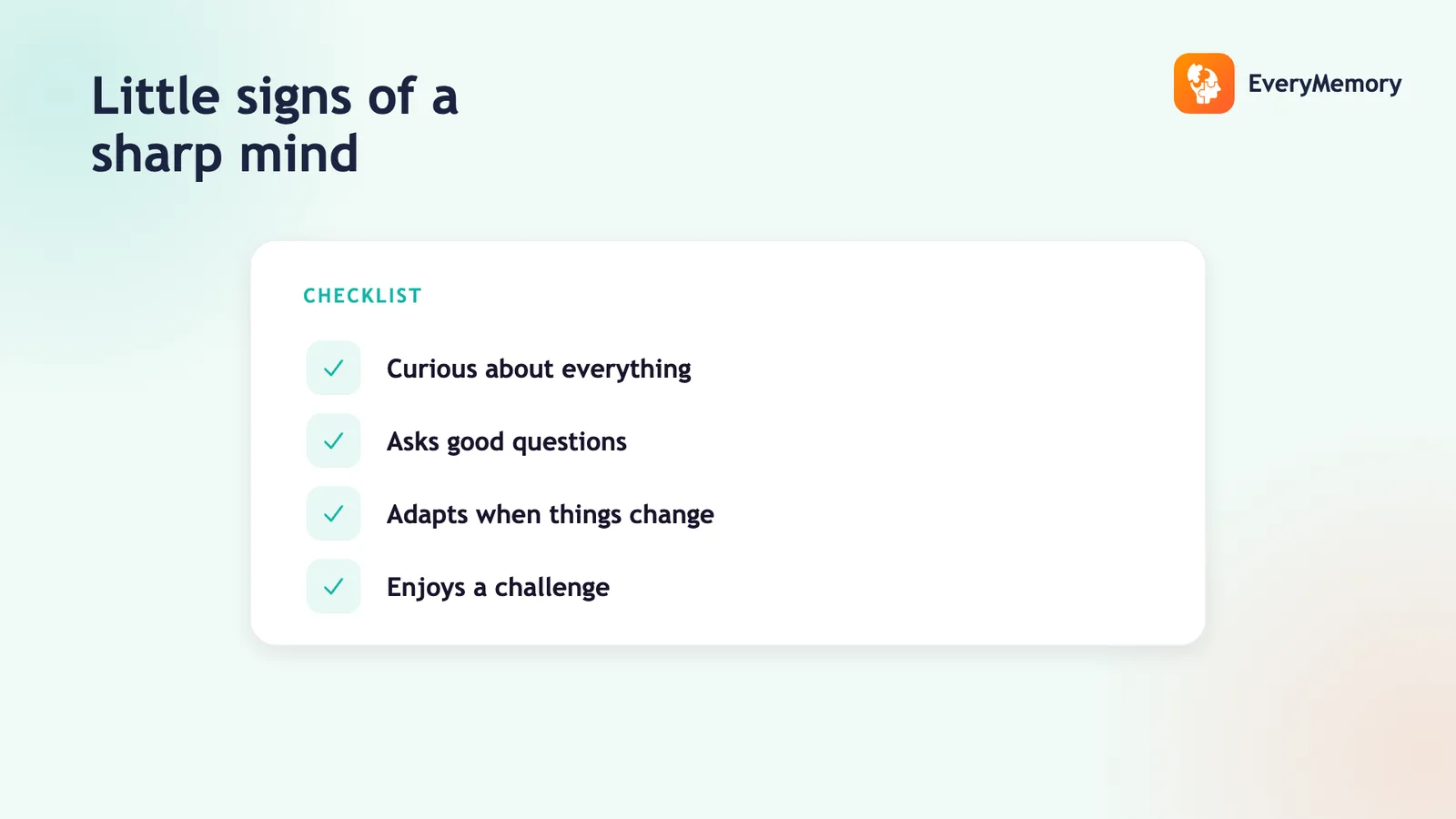
⚡ Quick answer
Some traits do correlate with higher measured intelligence - curiosity, strong working memory, quick learning, comfort with abstraction, and intellectual humility. But these are population-level tendencies, not proof in any individual. No single "sign" reliably identifies a smart person, and many viral signs are flattering myths.
Key takeaways
- Reasonable correlates: curiosity, strong working memory, fast learning, abstraction, humility.
- These are population-level tendencies, not proof in any individual.
- Intellectual humility tracks with good reasoning; overconfidence often signals the opposite.
- Many viral 'signs' are flattering myths - no single behaviour reliably indicates IQ.
Search for "signs of high intelligence" and you'll drown in flattering lists: if you talk to yourself, stay up late, or feel like an impostor, congratulations, you're secretly a genius. It's enjoyable to read and almost entirely unreliable. These lists are built to make you feel clever, not to inform you.
There are, however, traits that genuinely tend to correlate with measured intelligence. The key word is tend - these are statistical patterns across populations, not personal proof. This guide separates the reasonable correlates from the pseudoscience, with the caveats kept firmly in view.
Correlates that hold up reasonably well
A handful of traits show a modest, real association with higher intelligence in research. None is decisive on its own, but as a group they're more grounded than the viral lists.
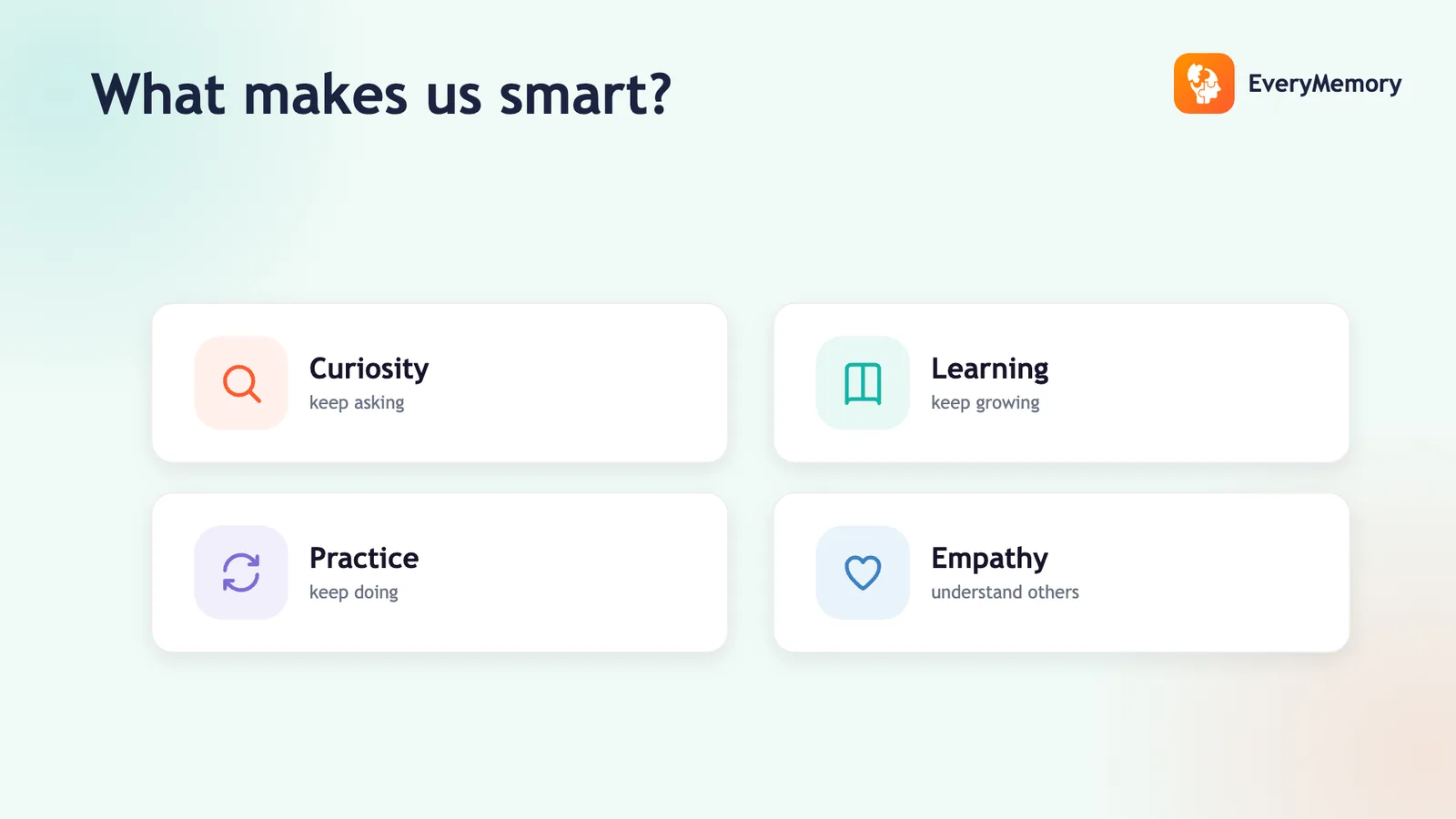
- Curiosity - a persistent drive to understand how things work.
- Strong working memory - holding and juggling information well.
- Quick learning - picking up new concepts and patterns with less repetition.
- Comfort with abstraction - reasoning about ideas, not just concrete examples.
- Open-mindedness - updating views in light of new evidence.
Even here, the honest framing is "associated with," not "caused by" or "proof of." A curious person isn't necessarily high-IQ, and an incurious one isn't necessarily low.
The humility paradox
One of the more robust patterns is counterintuitive: people who reason well often hold their conclusions more tentatively. They're aware of what they don't know, comfortable saying "I'm not sure," and quick to revise. Overconfidence, by contrast, frequently signals the opposite.
This is the practical version of a well-known effect - the less someone understands a domain, the more they tend to overestimate their grasp of it. Genuine intellectual humility is one of the more honest signals worth watching for, including in yourself.
Why no single sign is proof
The reason to distrust any one "sign" is statistical. Even real correlates are weak-to-moderate, which means plenty of intelligent people lack a given trait and plenty of less analytical people have it. Reading intelligence off a single behaviour is like guessing someone's height from their shoe size - loosely informative, frequently wrong.
It's also worth remembering that measured intelligence is just one slice of being capable. Judgement, creativity, and emotional skill don't show up on these lists at all - see what makes someone intelligent for the fuller picture.
A healthier way to think about it
Hunting for signs of your own intelligence is mostly a way to feel reassured, and it can quietly become a fixed label that limits you. A more useful stance is to treat curiosity, learning, and clear reasoning as habits to build rather than badges to verify.
If you want to act on that, focus on practice rather than self-assessment. How to be smarter and how to improve logical reasoning are more rewarding directions than another diagnostic listicle.
⚠ When to talk to a professional
This is general educational information, not medical or psychological advice. These traits are loose statistical tendencies, not diagnostic signs, and no list can assess anyone's intelligence. Consult a professional for any genuine concern.