EveryMemory
Social Connection and Memory
Conversation is one of the most demanding mental workouts there is, and regular social contact is consistently linked with sharper thinking and better mood.
Part of the guide: How to Keep Your Brain Healthy: A Complete Lifestyle Guide →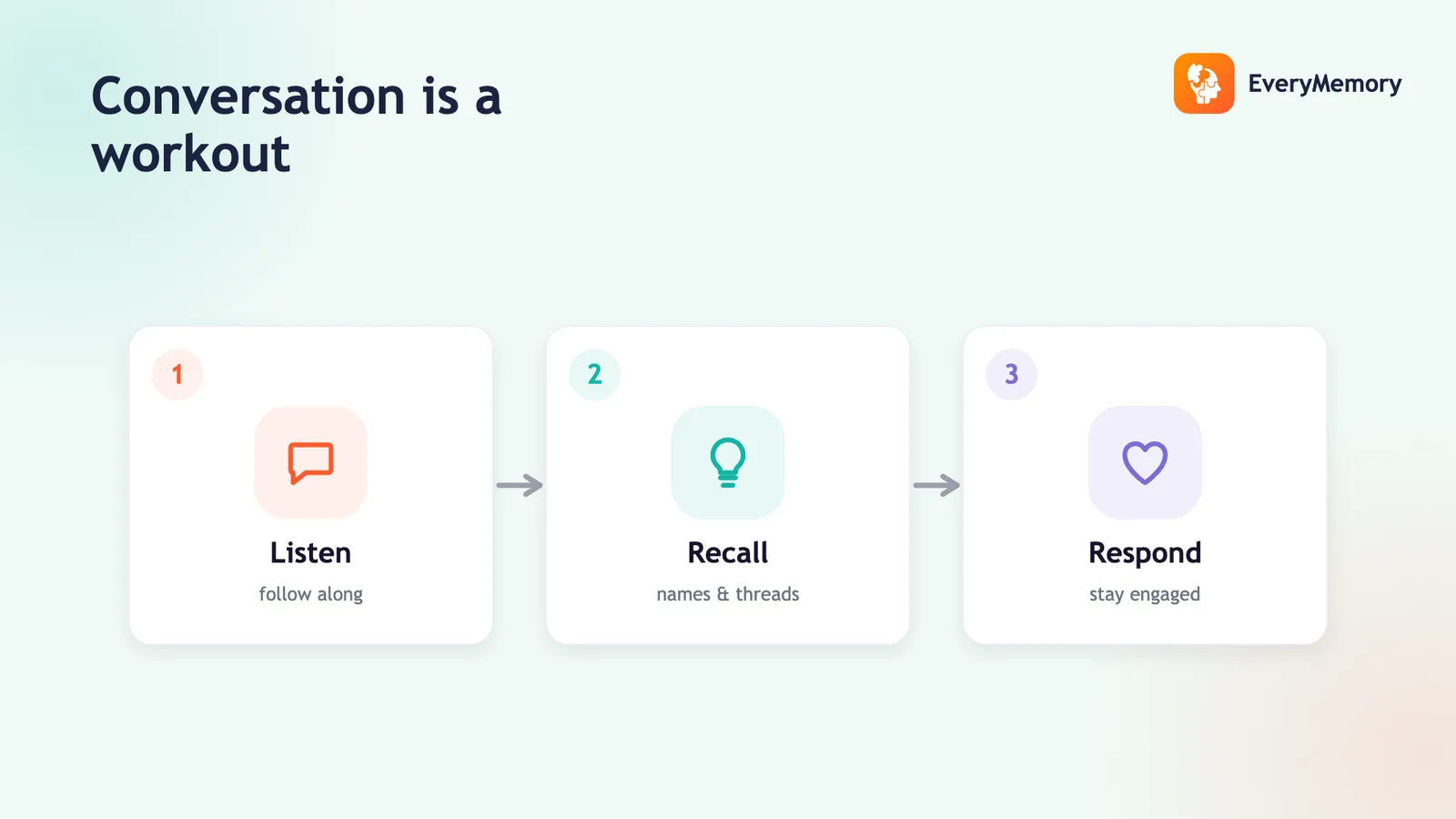
⚡ Quick answer
Social connection supports memory because conversation is a demanding real-time mental workout - listening, recalling, choosing words, and reading tone all at once. Regular, meaningful contact is consistently linked with better mood and sharper thinking, while isolation is linked with the opposite. Quality and regularity of contact matter more than the size of your circle.
Key takeaways
- Conversation is a demanding real-time mental workout drawing on several memory systems at once.
- Regular, meaningful contact is linked with better mood and sharper thinking.
- Isolation cuts the other way and tends to drag down mood and sleep too.
- Quality and regularity of contact matter far more than the size of your circle.
Of all the brain habits, social connection is the most underrated. It doesn't feel like exercise for the mind, which is exactly why people overlook it - but a good conversation works the brain harder than most puzzles.
The research is consistent: people with regular, meaningful social contact tend to have better mood and sharper thinking, while isolation is linked with the opposite. You don't need a wide circle - a few real connections, used often, is what counts.
Conversation is a full-brain workout
Think about what a real conversation demands. You hold the thread of what's been said in working memory, retrieve facts and words on the fly, read the other person's tone and expression, and plan your response - all in real time, with no pause button. Few deliberate brain exercises ask for that much at once.
That's why talking with people engages memory and attention so thoroughly. It draws on several of the systems described in types of memory explained simultaneously.
Isolation cuts the other way
The flip side is well documented. Loneliness and isolation are linked with lower mood, poorer sleep, and worse performance on thinking tasks. Some of that is the missing mental workout; some is the way isolation tends to drag mood and sleep down, which then dull memory further.
This matters most at life stages where a social world can quietly shrink - after retirement or bereavement, or with reduced mobility. It's a recurring theme in brain health after 60.
Quality over quantity
You don't need a packed calendar. The benefit comes from contact that's regular and genuinely engaging, not from the sheer number of acquaintances. A standing weekly call with a friend who makes you think does more than a hundred passive scrolls past other people's lives.
| Lower value for the brain | Higher value for the brain |
|---|---|
| Passively scrolling social media | A real back-and-forth conversation |
| Sitting silently in a crowd | A small group where you actively take part |
| One-word text exchanges | A proper phone or video call |
| Rarely, in a big burst | Regularly, in modest doses |
Building connection into the week
Connection responds to structure, like any habit. Set a recurring time - a weekly walk with a friend, a regular call, a class or club that meets often. Shared activities are doubly useful: they combine social contact with the novelty and learning of mental stimulation.
Joining something that meets regularly tends to outlast relying on motivation to reach out, which fades.
✅ Try this today - Add one recurring connection
Make social contact a habit, not an intention:
- Pick one person you enjoy talking to but rarely do.
- Set a recurring time to connect - a weekly call or walk on the same day each week.
- For a bonus, choose a shared activity that's a little new for both of you, so the contact comes with learning too.
⚠ When to talk to a professional
This is general, non-medical information about lifestyle and memory, not a treatment for any condition. If you're struggling with persistent low mood or isolation, or worried about memory changes, please speak to a professional.