 EveryMemory
Speed Reading Techniques: What Works
Most speed-reading claims fall apart under testing, but a few honest techniques genuinely help you get through reading faster without losing the parts you need.
Part of the guide: Brain Exercises for Seniors: The Complete Guide →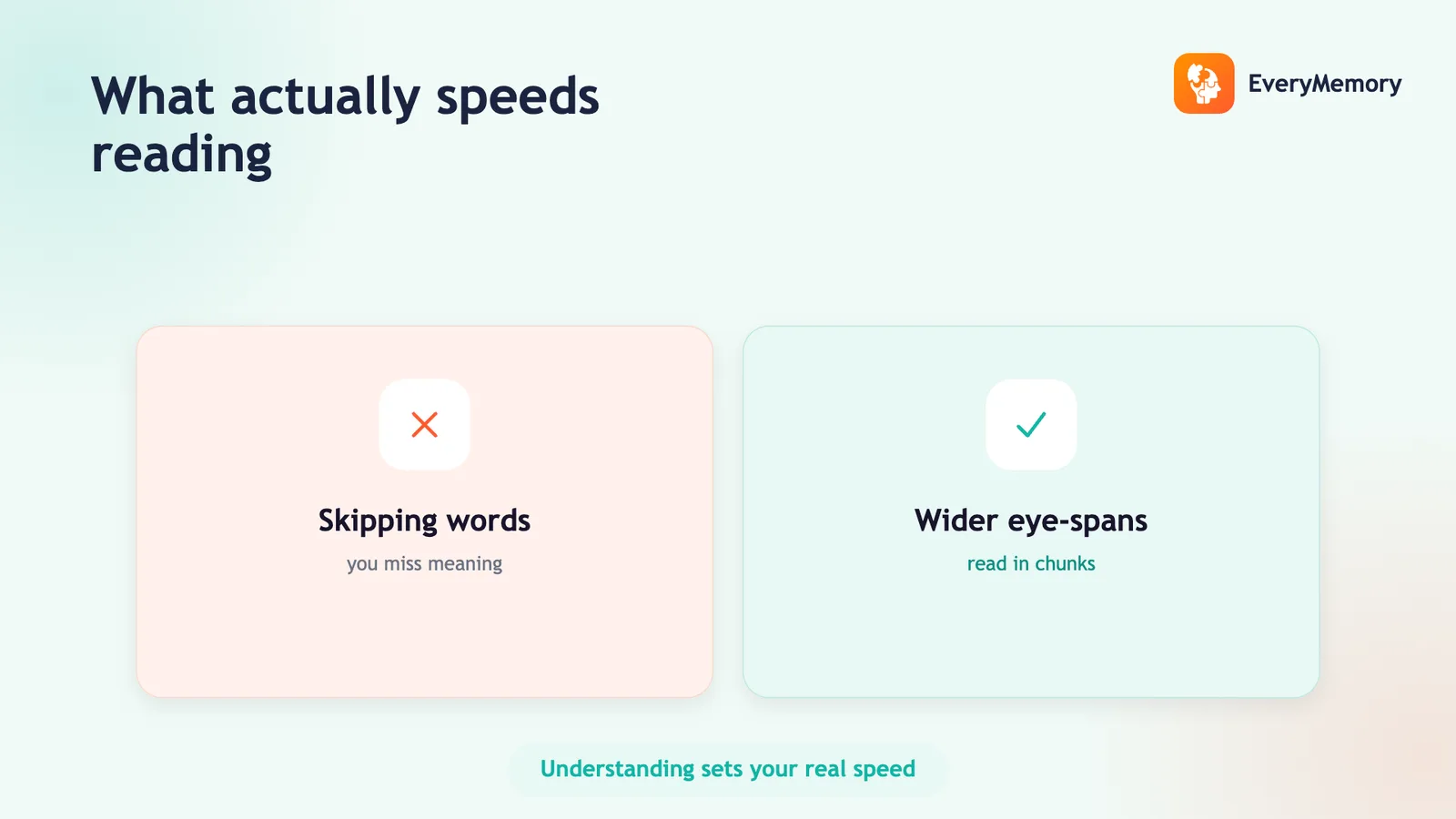
⚡ Quick answer
Genuine speed reading isn't reading every word faster - it's reading more efficiently. Preview a text before reading to build a mental map, reduce subvocalization (silently pronouncing every word) on easy material, and match your pace to your purpose: skim for gist, slow down for material you must retain. The 1,000-words-per-minute claims don't survive comprehension testing.
Key takeaways
- The 1,000-wpm claims don't survive comprehension testing - they're skimming.
- Previewing structure before reading is the single most effective technique.
- Reduce subvocalization only on easy text; it carries meaning on hard text.
- Match pace to purpose: skim for gist, slow down for what you must retain.
Speed reading is sold with dramatic promises - 1,000 words a minute, whole pages absorbed at a glance. Tested honestly, those numbers collapse: beyond a point, faster reading just means worse comprehension, and the famous "absorb a page instantly" claims are essentially skimming with a recall penalty.
That doesn't mean you're stuck at your current pace. A few real techniques help you cover ground faster without the comprehension cost - mostly by cutting wasted effort and matching your speed to what you actually need from each text.
What doesn't work - and why
There's a hard ceiling on how fast you can read while still understanding, set by how quickly your brain processes language, not how fast your eyes move. Above roughly 400–500 words per minute, comprehension falls off sharply. The techniques that claim to break this ceiling are really teaching skimming, which is a useful skill but not the same as reading.
| Popular claim | Reality |
|---|---|
| Read 1,000+ wpm with full comprehension | Comprehension collapses well below this; it's skimming |
| Use a finger or pacer to triple your speed | Modest help on regression, not a multiplier |
| Stop subvocalizing entirely | Reduce it on easy text; you can't fully remove it without losing meaning |
| Absorb whole paragraphs at a glance | Peripheral vision can't resolve enough text for real reading |
Preview before you read
The single most effective technique is to spend a minute building a map before you start. Read the title, headings, first and last paragraphs, and any summary or bold terms. Now your brain knows the structure and the destination, so the full read goes faster and sticks better - you're filling in a frame instead of meeting every idea cold.
This is also how to decide what not to read in full. Much of what crosses your desk only needs the gist; previewing tells you which texts deserve a slow, careful pass and which you can skim.
Reduce subvocalization on easy material
Subvocalization is the inner voice that pronounces words as you read. You can't eliminate it without losing comprehension - that inner speech is part of how you process meaning. But on familiar, easy material you can quiet it, letting your eyes group words into chunks rather than sounding each one out.
Don't force this on dense or unfamiliar text, where the inner voice is doing real work. The goal is to stop reading a simple email at the same effortful pace as a contract.
Match your speed to your purpose
Skilled readers aren't fast - they're flexible. They change pace constantly depending on what a text is for. This single habit does more than any eye-movement drill.
- Skim (very fast) when you only need the gist or to decide whether to read at all.
- Read at a normal pace for material you want to understand but not memorize.
- Slow down and reread for anything you must retain - and use recall, not speed, there. See remembering more of what you read.
✅ Try this today - The preview-then-read drill
Test how much previewing helps on a real article:
- Pick a medium-length article you haven't read.
- Spend 60 seconds on the title, headings, first and last paragraphs, and any bold terms.
- Now read it fully and notice how much faster it goes - you already know where it's headed.
- Afterwards, write the three main points from memory. Previewing usually improves both speed and recall.