 EveryMemory
Attention Span by Age: What's Normal?
Children's focus lengthens with age; adult attention varies far more by task and environment than by years. A realistic guide - and why the famous numbers are myths.
Part of the guide: Brain Exercises for Seniors: The Complete Guide →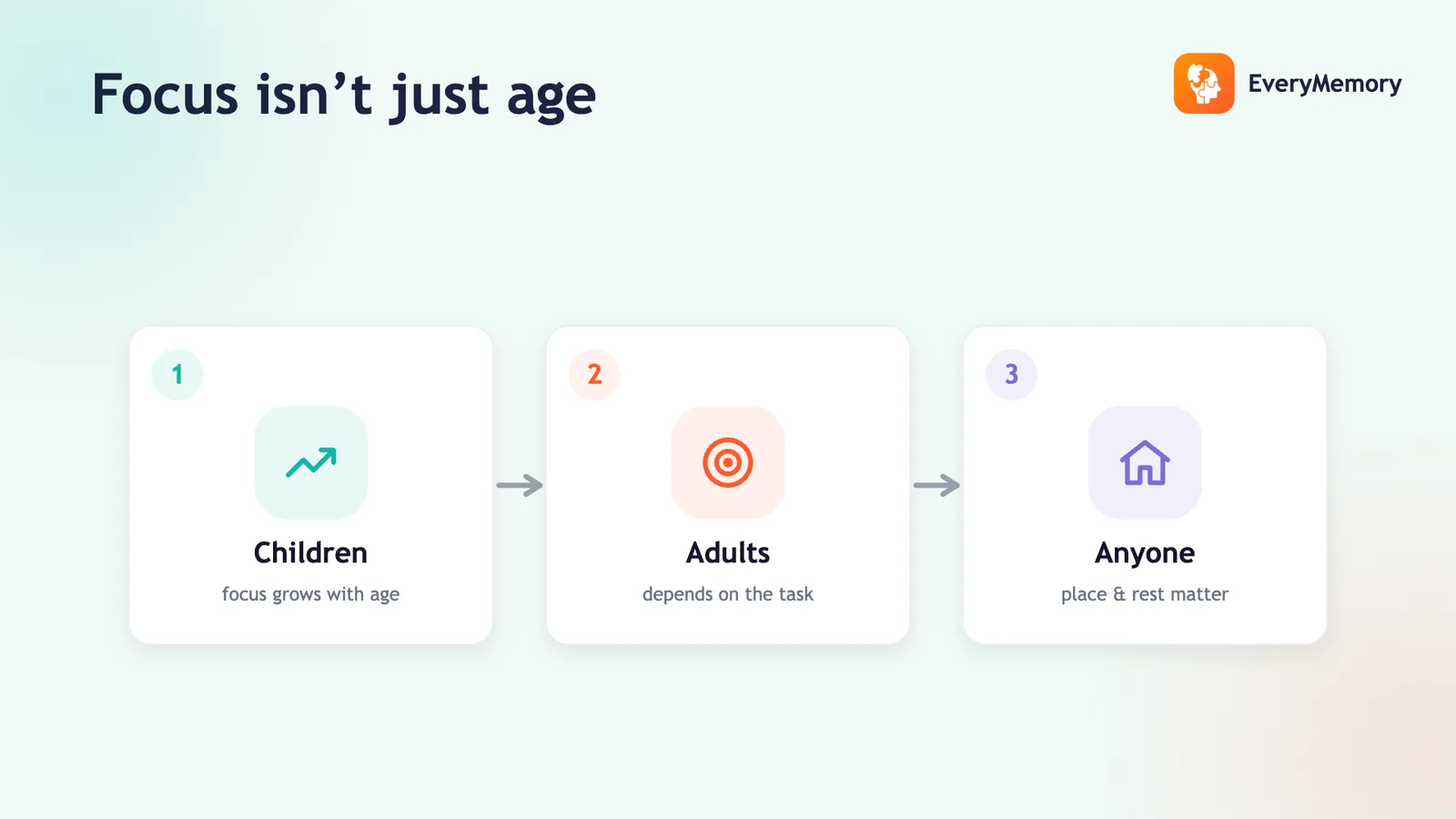
⚡ Quick answer
There's no exact 'attention span by age' chart, but as a rough guide, young children sustain focus for only a few minutes, lengthening through childhood into the teens, while adult attention varies far more by task, interest, sleep, and distractions than by age. The famous shrinking-attention-span figures are myths; attention is shaped more by environment than by a number.
Key takeaways
- There's no exact attention span per age - children's focus lengthens through childhood; adult attention varies by task, not years.
- The '8-second attention span, shorter than a goldfish' figure is a myth from a marketing report with no credible source.
- Across ages, attention is driven by distractions, interest, and sleep far more than by a built-in span.
- Attention lengthens with practice at any age by removing distractions and single-tasking.
People want a tidy chart of attention span by age, and you'll find plenty online. Most of the specific numbers are made up - attention simply doesn't work as one figure per age.
Here's the realistic picture: how children's focus grows, and why for adults it's about task and environment, not years.
Children: focus grows with age
Younger children sustain attention for only short stretches, and that lengthens steadily through childhood and into the teens as the brain matures. So a young child losing focus quickly on a task is usually normal, not a problem. Rather than chase an exact figure, expect short spans early and build them gently - see concentration exercises for kids.
Adults: it's about the task, not the age
For adults, attention varies enormously by what you're doing. The same person drifts after two minutes of a dull form and stays locked in for an hour on something absorbing. Sleep, stress, interest, and distractions shape adult focus far more than age does - the wider picture is in attention span.
The '8-second attention span' myth
You've likely read that the human attention span has fallen to eight seconds - shorter than a goldfish. It's a myth, traced to a marketing report with no credible source, and it isn't how attention works. Attention hasn't collapsed; our environment just interrupts it constantly.
What really drives attention
Across ages, focus depends less on a built-in span and more on conditions: how many distractions are nearby, how interesting and well-matched the task is, and how rested you are. Change those and the 'span' changes with them - which is why the same person can seem to have a tiny attention span one day and a long one the next.
Building attention at any age
Attention lengthens with practice at any age. Remove distractions, work in single-tasked blocks, and protect sleep - for students, see concentration exercises for students; for the general approach, how to improve focus and concentration.