 EveryMemory
Brain Fitness vs Physical Fitness
The fitness analogy is genuinely useful - consistency, progressive challenge, and recovery all carry over - but it has honest limits, the biggest being that training a skill mostly trains that skill.
Part of the guide: How to Keep Your Brain Healthy: A Complete Lifestyle Guide →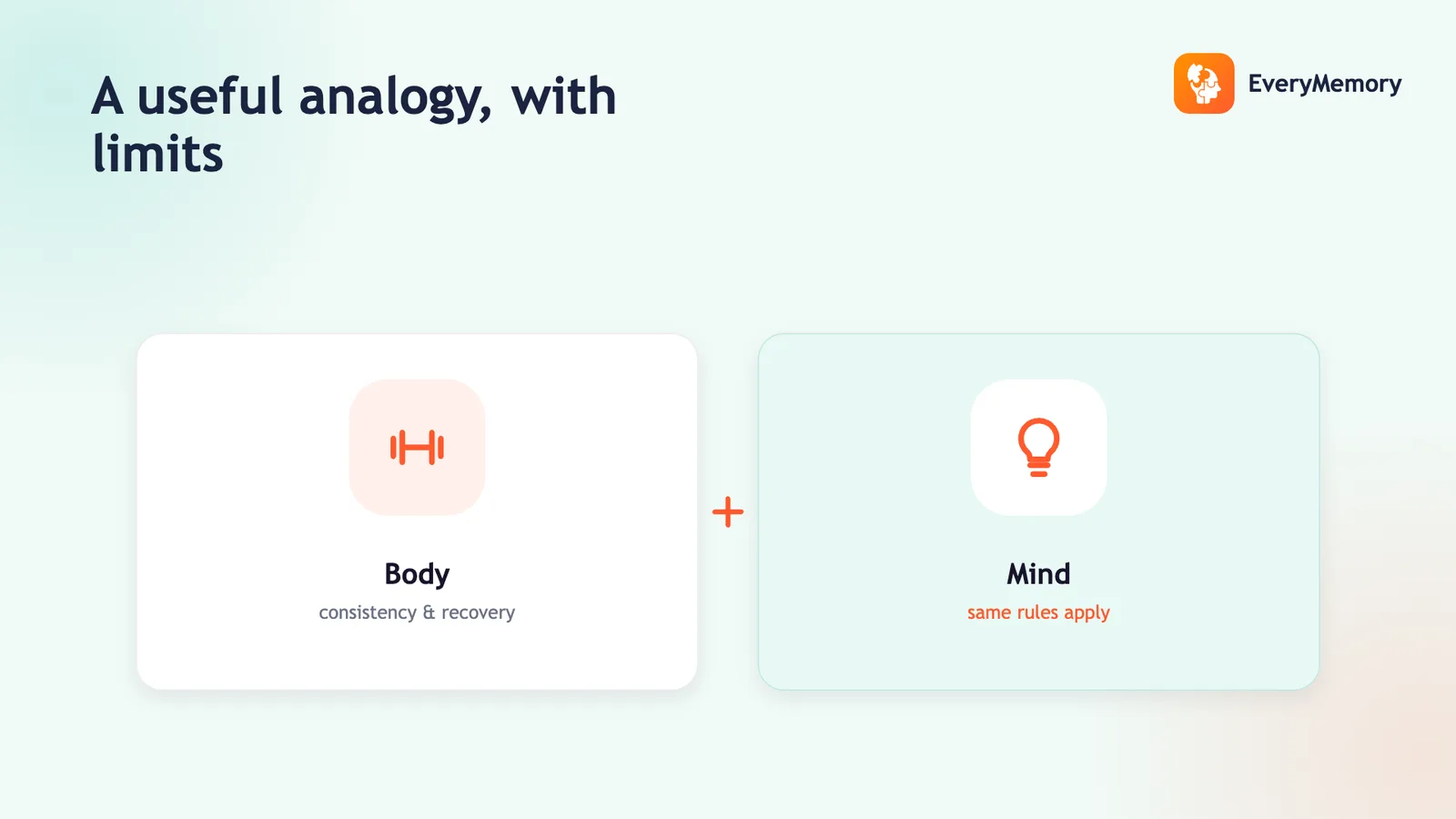
⚡ Quick answer
Brain fitness is genuinely like physical fitness in its principles: consistency beats intensity, progressive challenge drives improvement, and recovery matters. The key difference is transfer - lifting weights strengthens muscles you use for many things, but practising a mental skill mostly improves that skill and close relatives, not your intelligence overall. Useful analogy, with honest limits.
Key takeaways
- The analogy holds for principles: consistency, progressive challenge, and recovery.
- The key limit is transfer - mental practice mostly improves the specific skill trained.
- Brain training won't raise your IQ; expect specific skills plus good habits.
- Track your own personal best over time, and see a doctor for persistent changes.
Comparing brain fitness to physical fitness is a popular shorthand, and for once the analogy mostly earns its keep. The training principles that build a fitter body - showing up consistently, nudging the challenge up, and allowing recovery - carry over surprisingly well to attention and memory.
But analogies leak, and this one has a specific limit worth stating plainly. Physical training transfers fairly broadly; mental practice transfers narrowly. Knowing where the comparison holds and where it breaks keeps your expectations honest and your effort well aimed.
Where the analogy holds
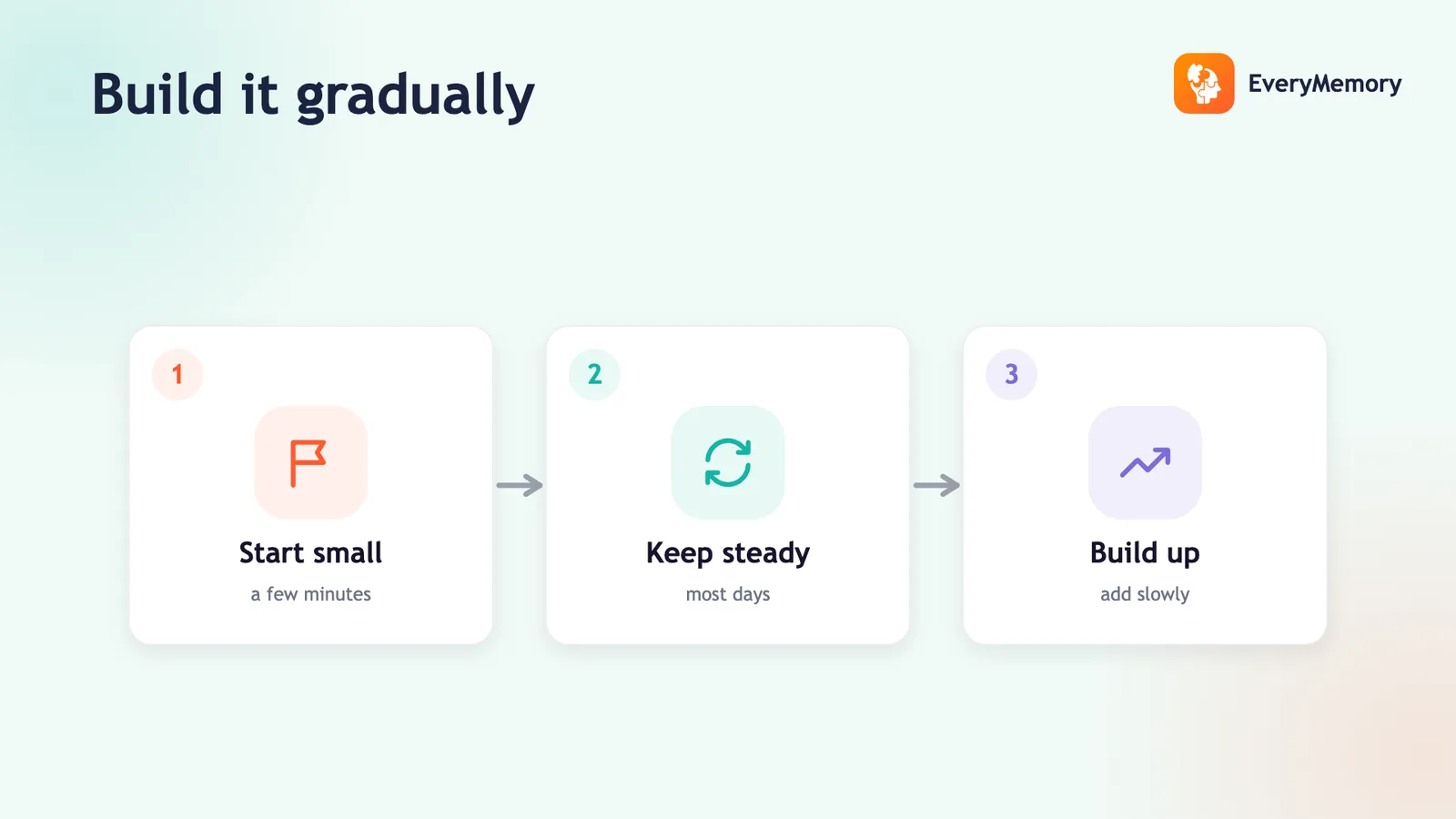
The core training principles really do carry across. Consistency beats cramming - a little most days outperforms a rare marathon, in the gym or at a focus exercise. Progressive challenge matters too: muscles and mental skills both adapt to what stretches them slightly, so a task that's always easy stops building anything.
Recovery is the third shared principle. Bodies grow during rest, not only during effort, and the brain consolidates learning during sleep and breaks. Push without recovery in either domain and performance stalls. For the recovery side, see habits for a healthy brain.
The parallels at a glance
Set side by side, the shared principles are easy to see - and easy to apply, since you may already know them from physical training.
| Physical fitness | Brain fitness parallel |
|---|---|
| Consistency beats the occasional huge session | A little daily practice beats rare long binges |
| Progressive overload - add challenge gradually | Mild, increasing difficulty keeps skills growing |
| Rest days and sleep for recovery | Sleep and breaks consolidate learning |
| Variety prevents plateaus | Varied tasks keep attention engaged |
| Warm-up and good conditions help | Sleep, mood, and calm set up better practice |
Where it honestly breaks down
Now the limit. Physical training transfers fairly broadly - a stronger core helps lifting, walking, and posture alike. Mental practice transfers narrowly: getting better at a focus game makes you better at that game and close cousins, not at unrelated thinking, and it won't raise your IQ.
So treat "brain fitness" as building specific, useful skills plus good habits - not a general upgrade to your mind. That's still worthwhile, just honestly bounded. Be wary of any program promising your whole intelligence will rise; that's the analogy oversold. For the grounded version, see mental fitness.
Training your brain like your body
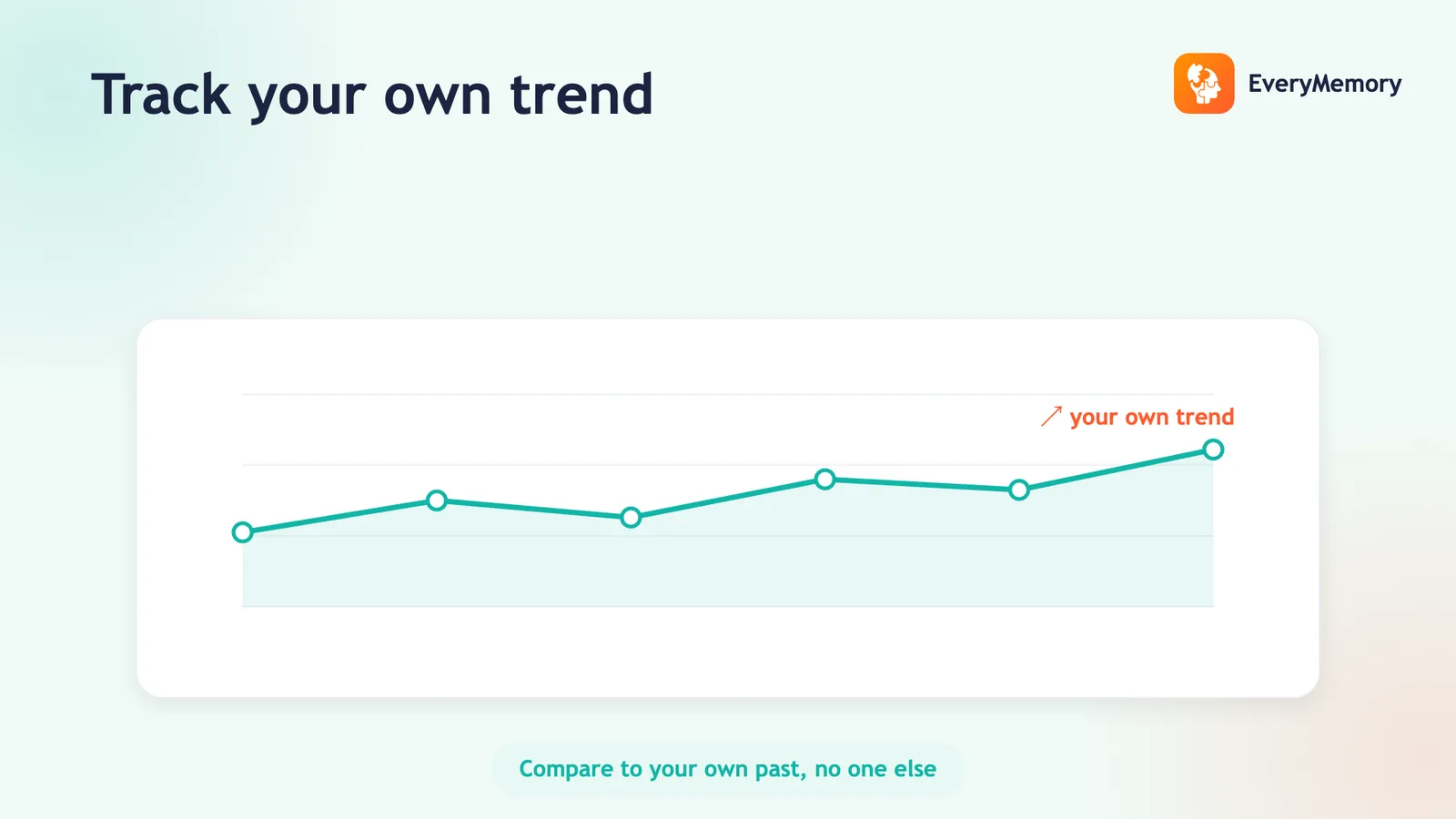
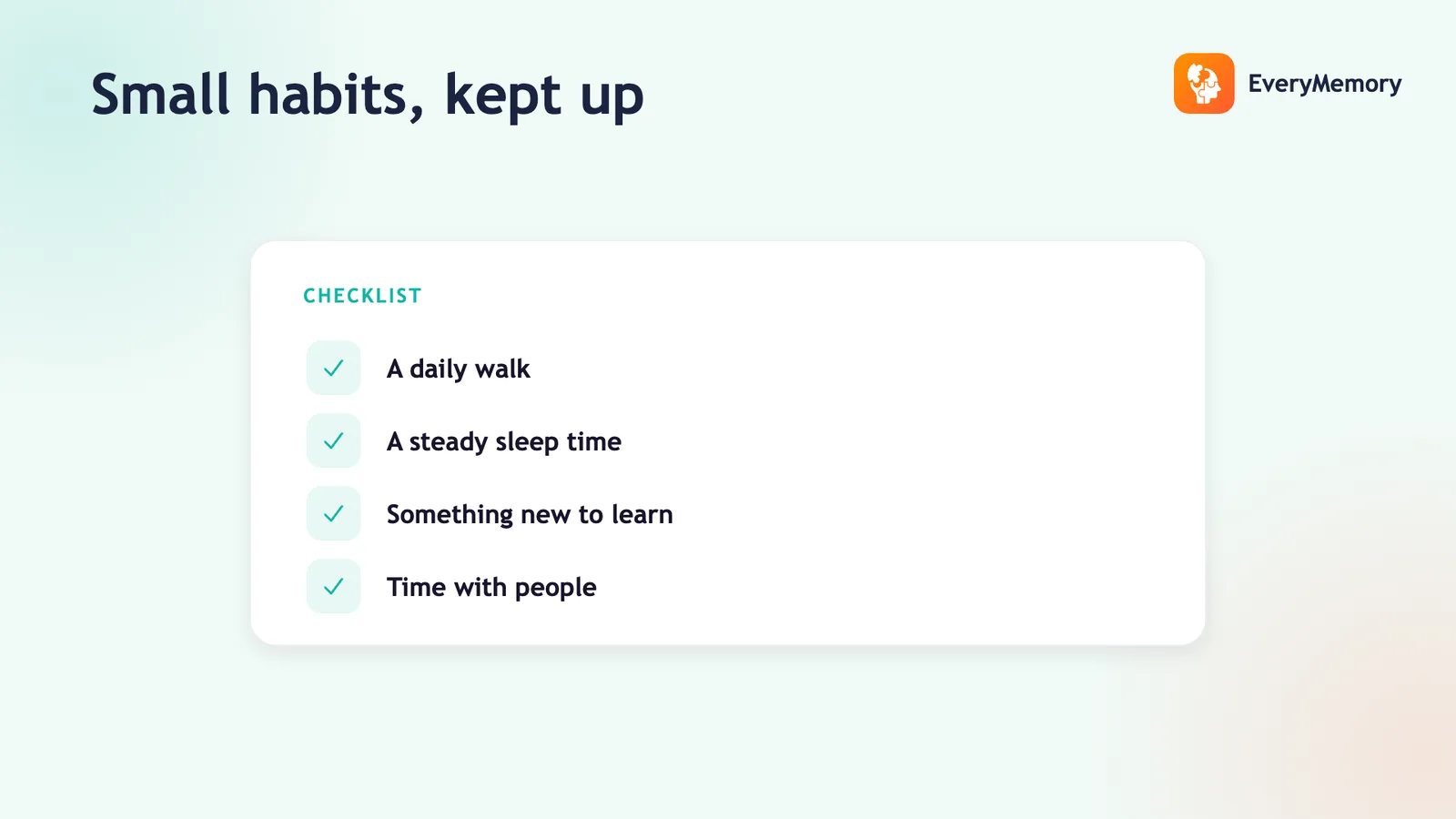
Used with its limits in mind, the analogy is a good coach. Build a small, consistent routine, nudge the difficulty up as things get easy, vary the tasks, and protect recovery with sleep and breaks. Track your own progress over time, the way you'd watch a personal best - against yourself, never against strangers.
And just as you'd see a doctor about a physical symptom that won't settle, a persistent, worsening change in memory or thinking is a reason to seek professional advice rather than train harder. For tracking your own trend, see how to track your memory.
⚠ When to talk to a professional
This is a general analogy for everyday wellbeing, not medical advice or a treatment for any condition, and mental practice is not a way to raise intelligence or prevent decline. If you have a persistent or worsening concern about your memory or thinking, please speak with a doctor or qualified professional.