 EveryMemory
Fun Learning Activities for Kids
Cooking, scavenger hunts, building, and story games turn everyday moments into real learning - fun activities that teach without a worksheet in sight.
Part of the guide: How to Improve Your Memory: The Complete Beginner's Guide →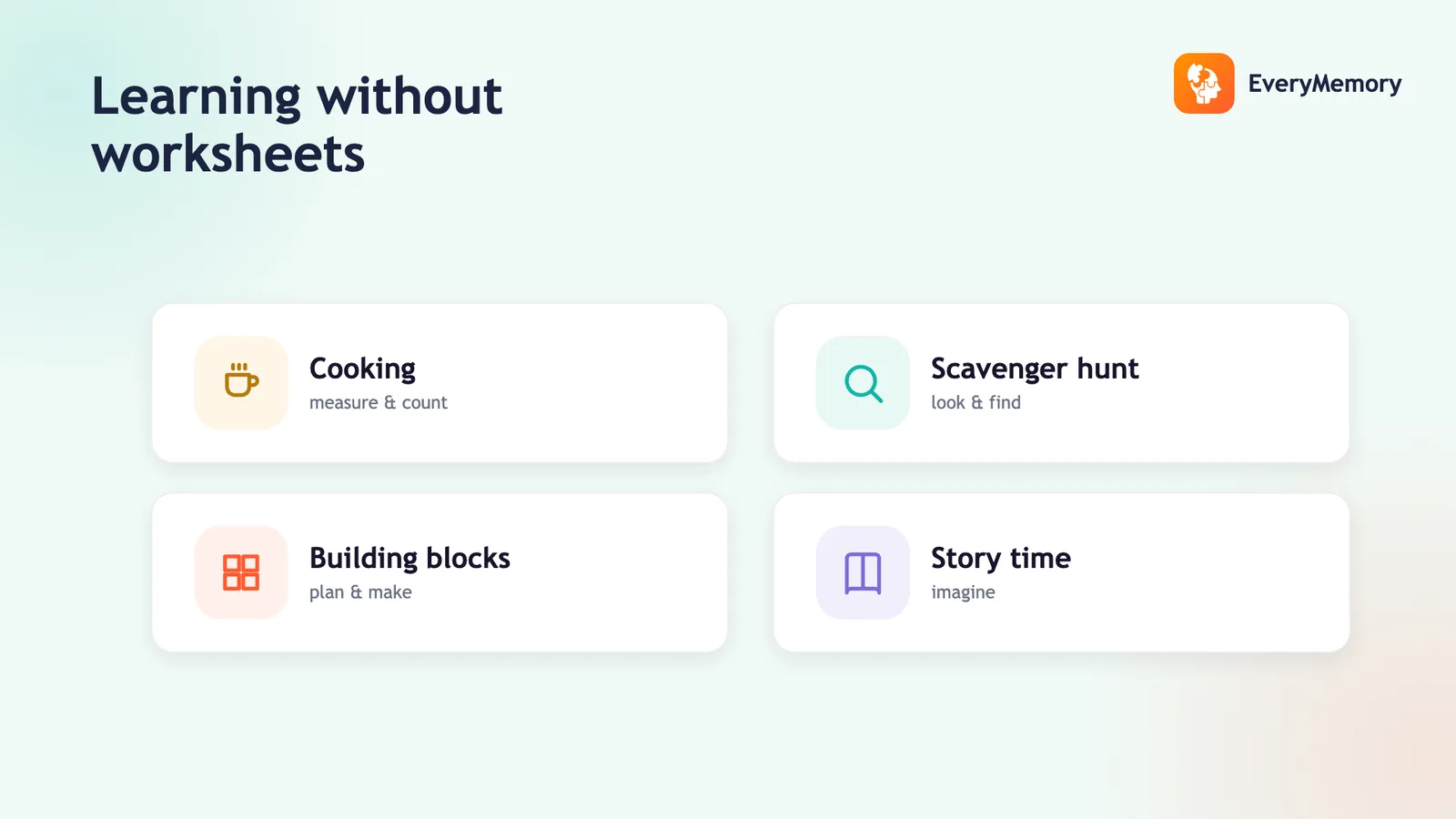
⚡ Quick answer
Fun learning activities for kids turn everyday moments into learning: cooking teaches maths and measuring, scavenger hunts build reading and observation, building with blocks teaches planning and physics, and story games grow language and memory. The trick is to let play lead and let the learning ride along, using what's already at home rather than worksheets or special equipment.
Key takeaways
- Cooking, scavenger hunts, building and story games teach real skills through play.
- Use what's already at home - kitchen, garden, cards - not special kits or worksheets.
- Let play lead and let the maths, reading or science ride along quietly.
- Adapt the difficulty to the child's interest more than their exact age.
Kids learn most when they don't realise they're learning. A scavenger hunt teaches reading and observation; baking sneaks in maths and measuring; building a den is physics and planning. The lesson lands because the child is having too much fun to notice it's a lesson.
None of this needs special kits or a teaching background. The best learning activities use what's already around - the kitchen, the garden, a deck of cards, a walk to the shops. Here are reliable favourites that teach real skills while staying firmly on the fun side.
Activities that teach without feeling like school
Each of these slips a real skill inside something a child already wants to do.
| Activity | What it teaches | Good for ages |
|---|---|---|
| Cooking & baking | Maths, measuring, sequencing | 4+ |
| Scavenger hunt | Reading, observation, planning | 5+ |
| Building (blocks, dens) | Physics, planning, problem-solving | 3+ |
| Story games | Language, memory, imagination | 4+ |
| Nature walk & collect | Science, sorting, curiosity | 3+ |
Kitchen learning
The kitchen is a classroom in disguise. Measuring, counting, doubling a recipe, and following steps in order all teach real maths and sequencing, with a snack as the reward.
- Have your child measure and count ingredients out loud.
- Double or halve a simple recipe together to practise fractions.
- Let them read or recall the steps in the right order.
- Talk about what changes when something cooks - early science.
- Set a timer and let them watch and manage it.
Out-and-about learning
A walk becomes a lesson with one small twist. A scavenger hunt - find something red, something rough, something that starts with B - turns observation into a game and sneaks in letters, colours, and categories.
Nature collecting works the same way: gather leaves or stones, then sort them by size, colour, or type back home. I-spy on the journey practises sounds and letters. For more attention-focused versions, see concentration exercises for kids.
Indoor and rainy-day learning
When you're stuck inside, story and building games carry the day. Build a story together one sentence at a time, repeating the whole thing before adding to it - pure language and memory practice dressed as silliness.
Building with blocks or boxes teaches planning, balance, and problem-solving, and asking "what could you try?" when a tower falls keeps the thinking going. Card games and puzzles round it out - see brain games for kids for a longer list.
✅ Try this today - Indoor scavenger hunt
A five-minute hunt that teaches reading, listening and categories.
- Call out a category - "something soft," "something round," "something blue."
- Send your child to find it and bring it back.
- Make it harder with two clues at once - "something soft AND blue."
- For readers, write clues on paper for them to decode.
- Let them set the next round and send you hunting.