 EveryMemory
5 Common Myths About Memory and Aging
Many fears about memory and aging are built on myths. Here's a clear, reassuring look at five of the most common misconceptions - and what's actually true.
Part of the guide: Understanding Memory Loss and Forgetfulness: A Calm, Reassuring Guide →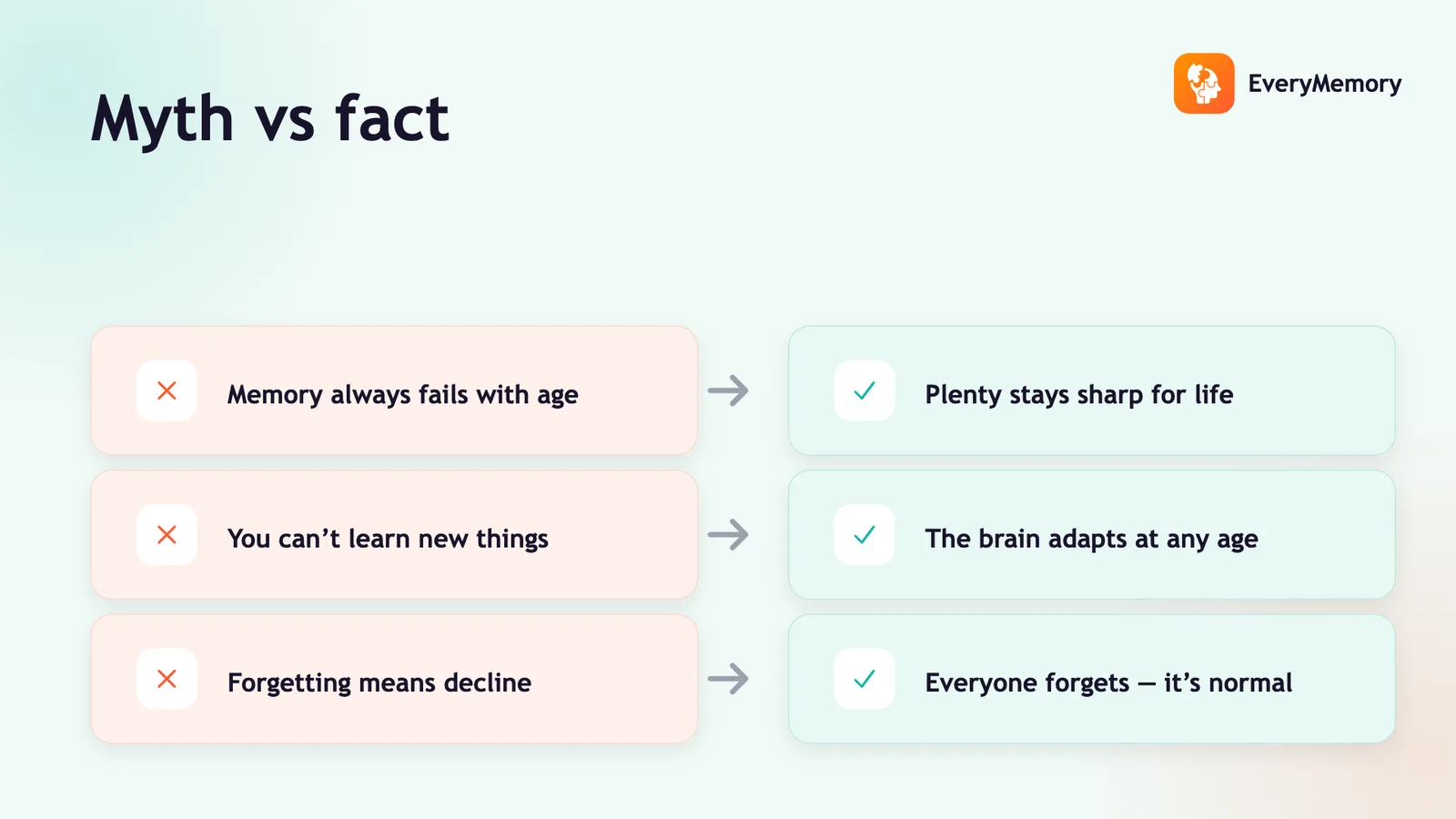
⚡ Quick answer
Most fears about memory and aging are rooted in myths rather than facts. Ordinary forgetfulness is not a sign of dementia. Older adults can and do learn new things. Memory does not inevitably decline sharply with age. The brain remains adaptable throughout life. And there are genuine habits that support memory at any age. Understanding these distinctions takes a lot of unnecessary worry off the table.
Key takeaways
- Occasional forgetfulness - blanking on names, misplacing keys, losing a train of thought - is common at every age and is not on its own a cause for concern.
- The brain retains a meaningful capacity for learning throughout life; older adults regularly acquire new skills when given time, repetition, and the right conditions.
- Memory changes after 60 are typically gradual and highly variable between individuals, not the sharp cliff-edge decline the popular myth suggests.
- Lifestyle factors including sleep, physical activity, social engagement, and stress management all influence how memory functions day to day and are largely within your control.
Myths about memory and aging are everywhere - in casual conversation, in the media, even in the way we talk to ourselves when we forget something. The problem is that many of these myths are simply wrong, and believing them can turn ordinary forgetfulness into unnecessary fear.
Here are five of the most persistent misconceptions about memory and aging - replaced, not with medical reassurances, but with a more accurate picture of what the evidence actually says.
Myth 1: Any memory slip means something is seriously wrong
This is probably the most anxiety-producing myth of all, and the most widespread. The reality is that forgetting names, misplacing objects, losing a train of thought, and walking into a room with no clear sense of why you went there are all experiences that happen to virtually everyone - at every age.
The kind of forgetfulness that is genuinely worth paying close attention to looks quite different: it is sudden in onset, noticeably progressive over weeks or months, or begins affecting concrete daily tasks like managing finances, navigating familiar routes, or following a conversation. Isolated lapses in a generally well-functioning system are not that.
If you're uncertain whether your level of forgetfulness falls within the normal range, our article on whether it's normal to forget names after 60 offers a grounded, practical perspective. The short version: occasional, mild forgetfulness is common, well-documented, and usually not a warning sign.
Myth 2: Older adults can't learn new things
This myth is particularly stubborn, and particularly damaging - because it discourages people from even trying. The belief that the brain becomes incapable of new learning after a certain age is not supported by what we know about how the brain works.
The brain retains a meaningful capacity for adaptation throughout life. This capacity is sometimes called neuroplasticity, and while it does change with age - learning may take a little longer and benefit more from repetition - it does not simply switch off. Adults in their 60s, 70s, and 80s regularly learn new skills, languages, instruments, and technologies when given the time and the right approach.
What does change is not the capacity for learning but sometimes the speed and the conditions that support it best. A quieter environment, more spaced-out practice, and connecting new information to existing knowledge all tend to help. Our article on what neuroplasticity actually means explains this in straightforward terms without the hype.
Myth 3: Memory always declines steeply and quickly after 60
The idea of a cliff edge - that turning 60 sets off an inevitable, rapid slide - is far from accurate. Memory changes with age are real, but they are typically gradual and highly variable between individuals.
Some aspects of memory show modest age-related change: processing speed tends to slow somewhat, and working memory capacity can narrow slightly. But other aspects of memory - general knowledge, vocabulary, long-term recall of well-learned information, pattern recognition built over decades - often remain stable or even improve with age.
The lived experience of memory in older adults is far more varied than the cliff-edge myth suggests. Lifestyle factors including sleep quality, stress levels, social engagement, and physical activity all interact with how memory functions day to day. None of these are fixed, and all of them are worth attending to regardless of age.
- Processing speed changes are real but typically gradual, not sudden.
- Vocabulary and general knowledge often stay strong well into later life.
- Variability between individuals is enormous - age alone is a poor predictor.
- Lifestyle factors have a meaningful influence on how memory functions at any age.
Myth 4: You only use 10% of your brain
This one has been circulating for decades and remains stubbornly popular. It is not true. Brain imaging research consistently shows that virtually all regions of the brain are active at some point during normal functioning, and that even during sleep, significant neural activity continues.
The myth likely persists because it's appealing - it suggests untapped potential waiting to be unlocked. But the brain doesn't work that way. There is no dormant 90% sitting idle, waiting for the right method to activate it. The brain is already in use.
What is accurate is that specific skills and types of thinking respond to practice - not because you're unlocking unused capacity, but because regular use strengthens the neural pathways associated with those skills. That's a more modest claim, but it's a real and genuinely useful one.
For a closer look at how that mechanism actually works, our piece on neuroplasticity covers the evidence in practical, non-hyped terms.
Myth 5: Nothing can be done about memory changes
Perhaps the most disempowering myth of all - and one that leads many people to simply accept unnecessary difficulty without taking any action. The fatalistic view that memory changes are beyond influence is not accurate.
While no lifestyle habit is a treatment for any medical condition, there is solid, consistent evidence that sleep, physical activity, stress management, social engagement, and deliberate mental practice all support how well memory functions day to day. These are not miracle cures - they are habits that create better conditions for your brain to do its job.
Actively practising recall, building a memory routine, and tracking your own patterns over time are all practical ways to engage with your memory rather than passively observe it declining. Our guide to non-medical memory self-checks and our piece on memory loss versus normal aging are good starting points for doing this thoughtfully.
What to take away from all of this
Myths about memory and aging tend to share a common thread: they are more frightening and more absolute than the evidence warrants. Real memory changes are gradual, variable, and influenced by many factors that are within your control. If you like to read the evidence yourself, the books and studies in our library are a good place to start.
If you notice changes that feel sudden, persistent, or are starting to affect daily life in concrete ways, speaking with a qualified healthcare professional is always the right step. But most everyday forgetfulness belongs firmly in the "common and normal" category - and understanding that clearly is itself a form of reassurance worth having.
| Myth | What's actually true |
|---|---|
| Any memory slip means something is seriously wrong | Occasional slips are a normal part of how recall works at any age |
| Older adults can't learn new things | The brain stays adaptable - neuroplasticity continues through life |
| Memory always declines steeply after 60 | Most age-related change is gradual and modest, not a cliff |
| You only use 10% of your brain | A myth - nearly all of the brain is active across a day |
| Nothing can be done about memory changes | Sleep, movement and daily habits are linked with sharper recall |
✅ Try this today - The myth-check reflection
Take two minutes with these questions:
- Think of the last time you forgot something and felt worried about it. Now ask honestly: was it sudden and new, or the kind of thing that happens to most people regularly?
- Identify one belief about your own memory that may be more myth than fact. Write it down and next to it write one thing that challenges it.
- Pick one small, practical memory habit from this site to try this week - not to "fix" anything, but to build a relationship with your memory rather than fear it.
⚠ When to talk to a professional
This article contains general, non-medical information. If you are experiencing memory changes that feel sudden, rapidly worsening, or that are affecting your ability to manage daily tasks, it's worth speaking with a qualified healthcare professional. This article is not a substitute for professional advice.