 EveryMemory
Hearing and Memory: Why It Matters More Than You Think
Struggling to hear clearly doesn't just make conversation harder - it quietly drains the mental resources you need to remember things, in ways that are easy to miss.
Part of the guide: How to Keep Your Brain Healthy: A Complete Lifestyle Guide →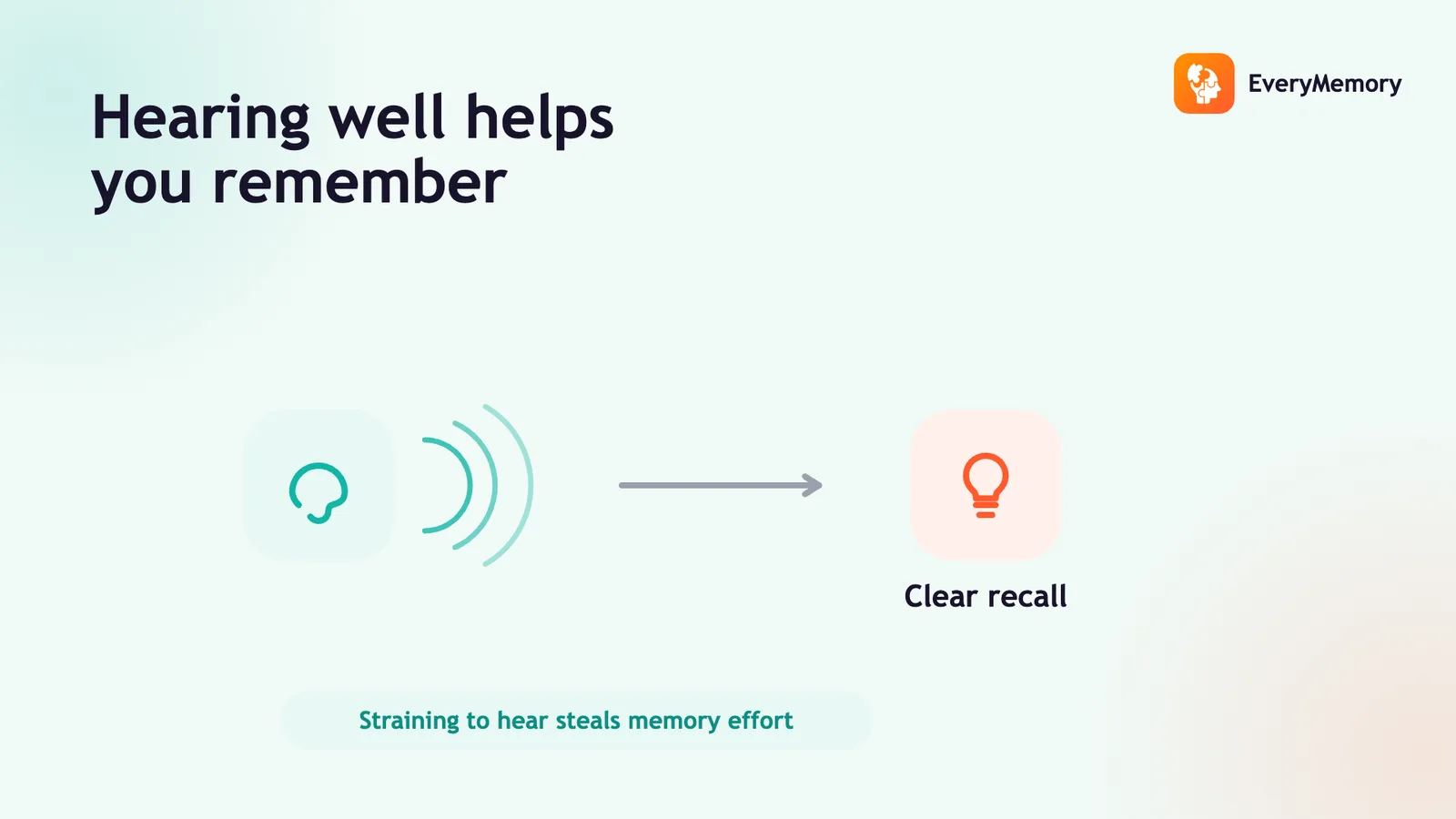
⚡ Quick answer
When hearing is reduced, the brain uses extra mental effort just to decode sound - effort that would otherwise support memory encoding. Less clear input also means less information reaches memory in the first place. Getting hearing checked is one of the most practical, underused steps for supporting cognitive clarity in older adults.
Key takeaways
- Straining to hear uses mental effort that would otherwise support memory encoding.
- Incomplete auditory input means less information enters memory - which can look exactly like forgetfulness.
- Untreated hearing loss is linked with social withdrawal, which reduces the cognitive stimulation that keeps memory sharp.
- Getting hearing checked is a practical, underused step for supporting cognitive clarity in older adults.
When people notice their recall becoming less reliable, hearing is rarely the first thing they consider. But hearing and memory are more tightly connected than most people realise - and in ways that go well beyond simply not catching what someone said.
This article takes a focused look at hearing specifically: the cognitive cost of straining to hear, why incomplete input leaves less to remember, and what the research says about addressing hearing as a step toward sharper thinking. If you want the broader picture including vision, see our piece on hearing, vision and memory - this one goes deeper on hearing alone.
The mental cost of straining to hear
When hearing is fully intact, listening feels effortless. But even mild hearing loss turns speech comprehension into active mental work - the brain fills in gaps, pieces together partial signals, and recruits working memory to make sense of degraded sound. Researchers call this "effortful listening," and its cognitive cost is well documented.
The problem is that attention and working memory are shared resources. When a significant portion of both is consumed by simply decoding speech, less is available for what you actually want to do - remember the name, follow the argument, hold the instruction in mind. Our article on how attention works explains this resource-sharing clearly.
This is why people with untreated hearing difficulties often describe feeling mentally fatigued after conversations, or finding that busy social environments - a dinner party, a family gathering - are exhausting in a way that goes beyond the noise itself. The fatigue is real: the brain has been running a demanding decoding process for hours, and that drain can spill over into the rest of the day.
Less input means less to remember
Memory cannot work with information it never received clearly. If a name is partially heard, or an instruction arrives muffled, the brain encodes something incomplete - or nothing at all. When this happens repeatedly across everyday conversations, what accumulates looks and feels indistinguishable from a memory problem.
This is why hearing loss is so often mistaken for cognitive decline - by the person experiencing it and by those around them. The forgetting is real; the cause is at the input stage rather than in memory itself. From the outside, both can look identical.
Getting a hearing assessment matters partly for this reason: it helps separate a sensory issue from something else. The broader picture of how to tell ordinary forgetting from something more significant is explored in our piece on memory loss vs normal aging.
Social withdrawal: the quiet downstream effect
There is a third, slower-moving mechanism. When conversation becomes consistently effortful or embarrassing, many people quietly start avoiding it - social gatherings feel less worthwhile, group settings are sidestepped, engagement narrows. Over months and years, this matters: social connection is one of the most consistently supported factors in healthy cognitive aging. Active conversation exercises memory, attention, and processing speed simultaneously.
Withdrawal from social life reduces that stimulation - and over the longer term, is linked with loneliness, lower mood, and their downstream effects on memory and focus. Our article on social activity and memory explores this connection in detail. Addressing hearing early can interrupt this self-reinforcing cycle before it takes hold.
What the research suggests about addressing hearing loss
Research into hearing and cognitive health has been building for over a decade. Frank Lin and colleagues at Johns Hopkins, tracking thousands of older adults over time, established a consistent association between untreated hearing loss and faster rates of cognitive change - explained by cognitive load, reduced social engagement, and changes in brain regions handling both sound and memory.
The most compelling recent evidence comes from the ACHIEVE study, a large randomised controlled trial published in The Lancet in 2023. In a pre-specified group at higher risk for cognitive decline, fitting hearing aids with proper audiological support was associated with approximately 48% slower cognitive change over three years. References to this work are in our Library.
It is important to frame this carefully. The overall ACHIEVE trial did not show a statistically significant difference across all participants - the benefit was clearest in those already at elevated risk. This is not a story of a simple fix. But it is a meaningful signal: addressing hearing may be one of the more accessible factors associated with cognitive health in older age, alongside sleep, exercise, and social engagement.
How to tell whether hearing may be affecting your memory
Hearing loss in older adults is almost always gradual - the brain adapts over years, and many people don't notice how much harder they've been working until an assessment reveals it. Some patterns worth noticing:
- Regularly asking people to repeat themselves, or saying "what?" several times in a conversation.
- Group conversations - at restaurants, family gatherings, on calls with background noise - feeling significantly harder than one-on-one exchanges.
- Turning the television up higher than others in the household find comfortable.
- Feeling mentally drained after social events in a way that seems disproportionate.
- Others commenting that you seem to mishear things regularly.
None of these requires waiting for a problem to become severe. A hearing assessment is a simple, non-invasive check - and the earlier any change is identified, the more options are available.
Getting hearing checked: the practical step
For adults over 60, a hearing assessment every two to three years is a reasonable baseline - sooner if any of the patterns above are familiar. An audiologist can identify which frequencies are affected and how that maps to everyday situations.
If a hearing aid is recommended, proper fitting and a few weeks of adjustment matter - many who find them unhelpful have skipped the formal fitting process. Cost can be a barrier, but NHS provision (UK), Medicare or Medicaid (US), and local charitable schemes have made access considerably wider in recent years.
Addressing hearing is not a guarantee of any particular cognitive outcome. What it does is remove a quiet, persistent source of cognitive strain - and that alone is worth the check.
✅ Try this today - The listening effort self-check
Over the next week, pay attention to one thing: your mental energy after conversations.
- After any social situation - a meal, a phone call, a group outing - notice how mentally tired you feel relative to what the activity should cost.
- Keep a simple tally: how many conversations this week required you to ask for repetition, or felt genuinely effortful to follow?
- If either pattern is familiar, book a hearing assessment. Treat it the way you'd treat an eye test - a routine check, not a crisis.
⚠ When to talk to a professional
This article contains general, non-medical information. If you notice sudden or rapidly worsening changes to your hearing, or new symptoms like dizziness or ringing that begins abruptly, seek prompt advice from a qualified healthcare professional - these are not typical patterns of gradual age-related hearing change.