 EveryMemory
How Attention Works (and Why It Matters for Memory)
Attention is the gatekeeper of memory. Understand how your brain filters the world - and why you can't remember what you never truly noticed.
Part of the guide: How to Keep Your Brain Healthy: A Complete Lifestyle Guide →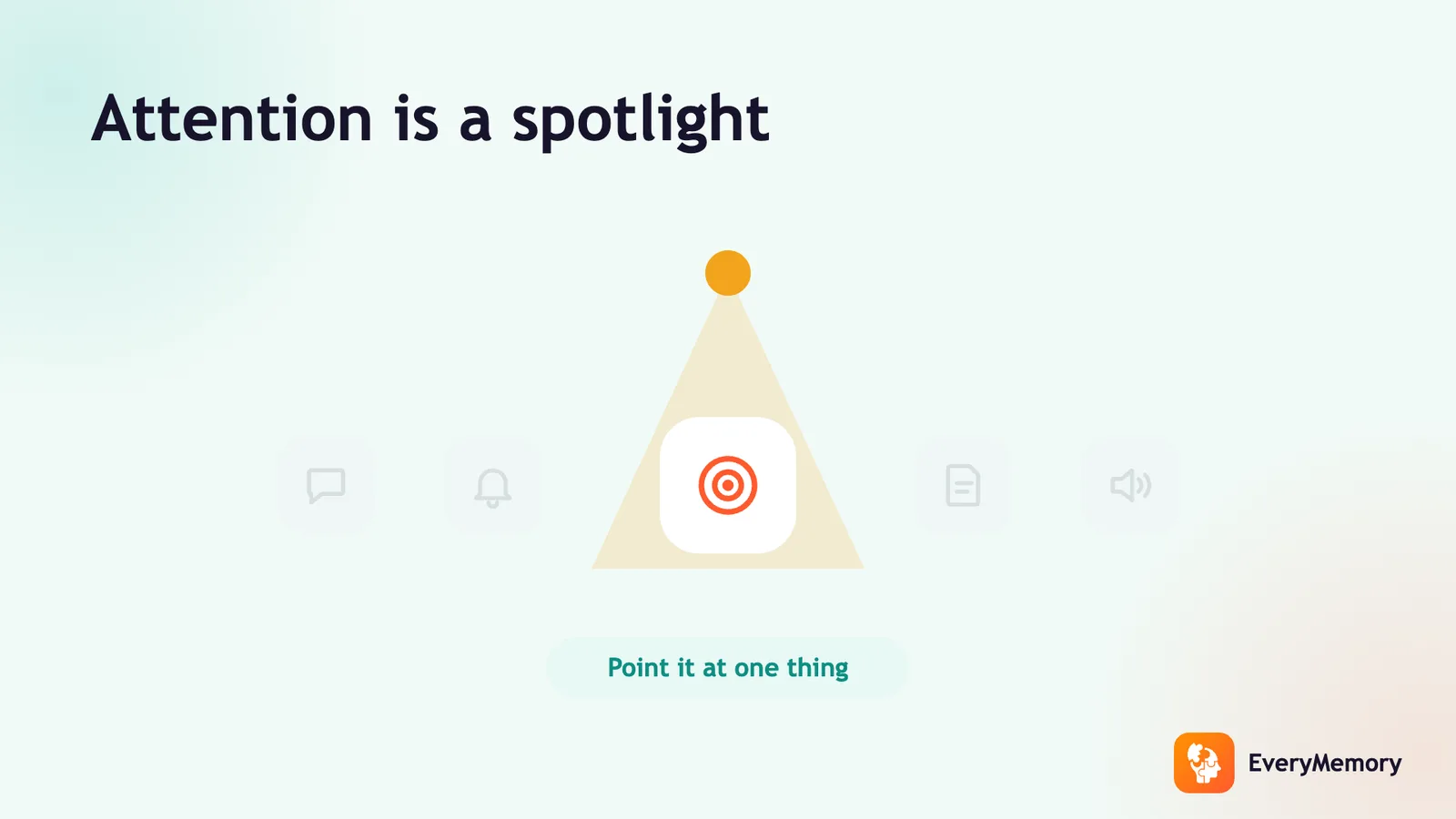
⚡ Quick answer
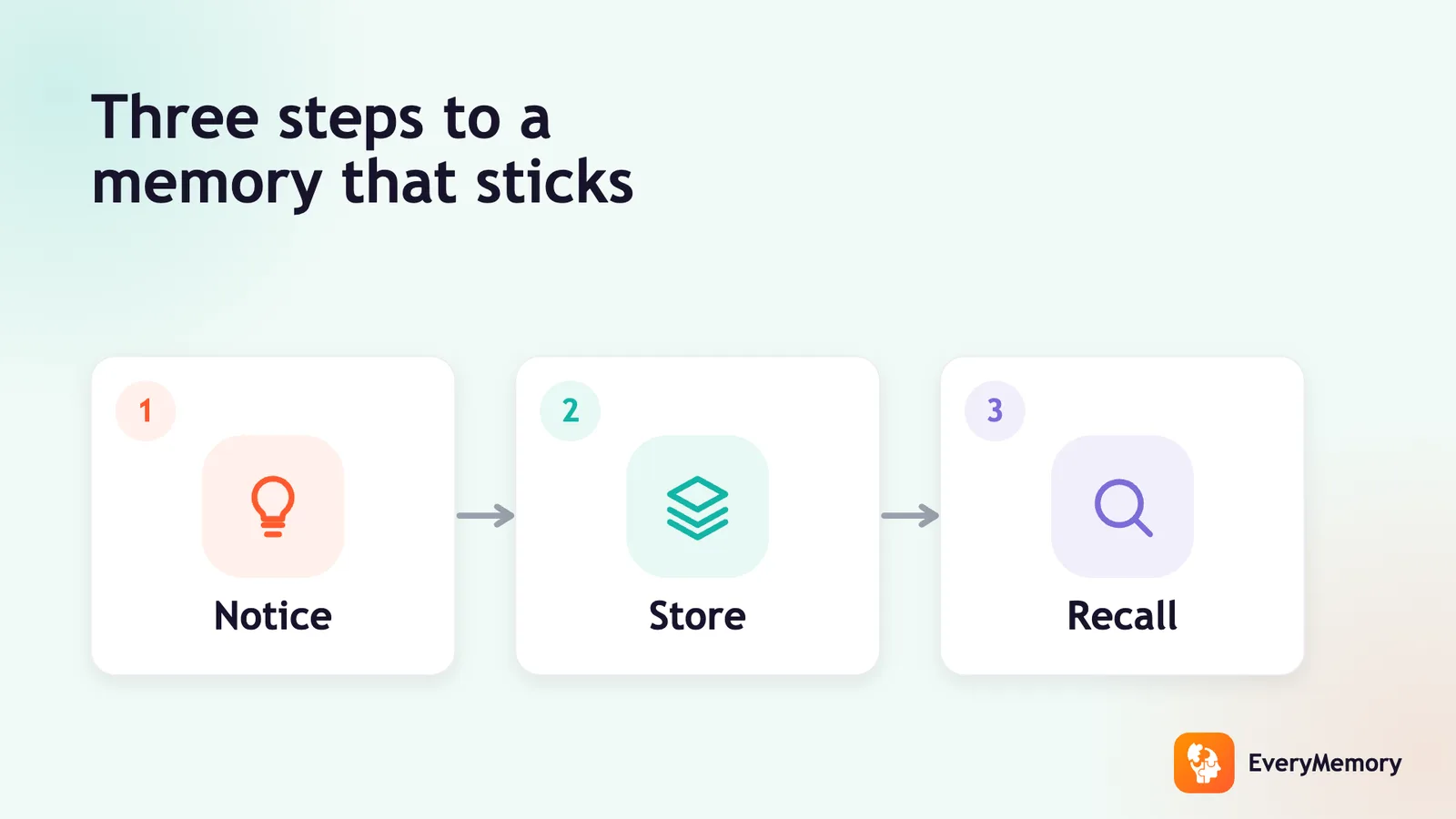
Attention is the process your brain uses to select what to notice and what to ignore. Memory depends almost entirely on it: if you weren't truly paying attention when something happened, the information simply wasn't recorded in the first place. Improving how you direct your attention is one of the most direct ways to support recall.
Key takeaways
- Attention filters information before any recording happens - you cannot remember what you never truly noticed, which is why most everyday forgetting is an attention problem, not a memory problem.
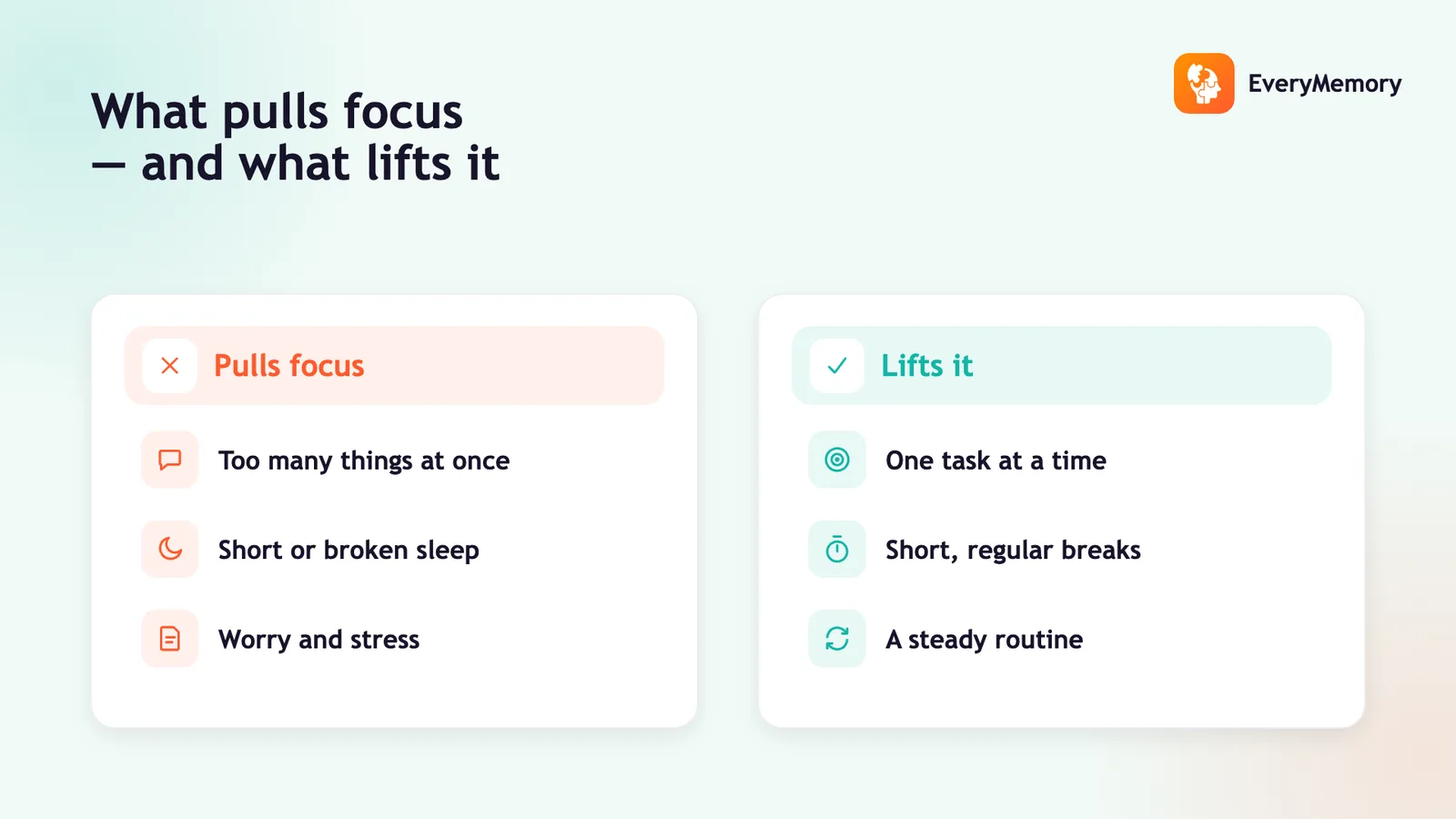
- Divided attention (multitasking) gives each task shallower processing, producing weaker memory encoding - single-tasking is itself a memory technique.
- Stress and fatigue pull the attention spotlight away from the present moment, making encoding of new information harder even when nothing else seems wrong.
- A brief deliberate pause before anything you want to remember - a one-second 'full stop' to lock in the spotlight - is one of the simplest and most effective habits described in the article.
You walk into a room, look straight at the keys on the counter, and later swear you never saw them. You listen to someone's name at a party and it vanishes the moment the conversation moves on. Sound familiar? These aren't signs that your memory is failing. They're signs that your attention never quite engaged in the first place.
Attention is the brain's gatekeeper. Nothing gets into memory without passing through it first. Understanding how attention works - in plain terms - is one of the most practical things you can do to support your recall.
Attention as a spotlight, not a camera
A common misconception is that the brain takes in everything around us and then selects what to remember. In reality, attention filters before any recording happens. Think of it less like a camera capturing a scene and more like a spotlight: whatever falls inside the beam gets processed clearly; everything else is barely registered at all.
At any given moment your senses are receiving an enormous amount of information - sounds, sights, physical sensations, your own thoughts. The brain cannot process all of it consciously. Attention is the mechanism that decides what gets through. That selection happens continuously, mostly outside your awareness.
This is why forgetting where you put your phone isn't really a memory problem. You put the phone down while your attention was elsewhere - on a conversation, on a worry, on what to make for dinner. There was no spotlight on the action, so no clear memory was formed. Our article on why you forget why you entered a room explores a classic example of exactly this.
Three types of attention worth knowing
Researchers typically describe attention in terms of several distinct modes, and each one plays a different role in your daily memory.
- Focused attention is the ability to concentrate on a single task or stimulus. Reading this article requires focused attention. It's what most people mean when they say they want better "concentration."
- Sustained attention is the ability to hold that focus over time - staying with a book, a conversation, or a task without drifting. It's what gets harder when you're tired or mentally fatigued.
- Divided attention is the attempt to attend to more than one thing at once. Despite the name, the brain doesn't truly do two things at once - it rapidly switches between them, and each switch has a small cost in accuracy and memory.
For memory purposes, focused and sustained attention are the ones that matter most. Divided attention - multitasking - is the one most likely to leave gaps in what you remember. You can read more about how these patterns connect to everyday recall in our overview of how memory works.
Why divided attention leaves memory gaps
Every time you split your attention - checking a phone while someone's talking, having the radio on while reading an important letter - the brain's processing of each task becomes shallower. Shallow processing means weaker memory encoding. That's why conversations held while driving are harder to recall than conversations at a table, even if the words were heard perfectly.
This isn't a character flaw or a sign of aging. It's how human attention works at any age. The difference as we get older is that recovering from distraction can take a little longer - refocusing after an interruption isn't quite as instantaneous. More on that in our piece on why focus fades with age.
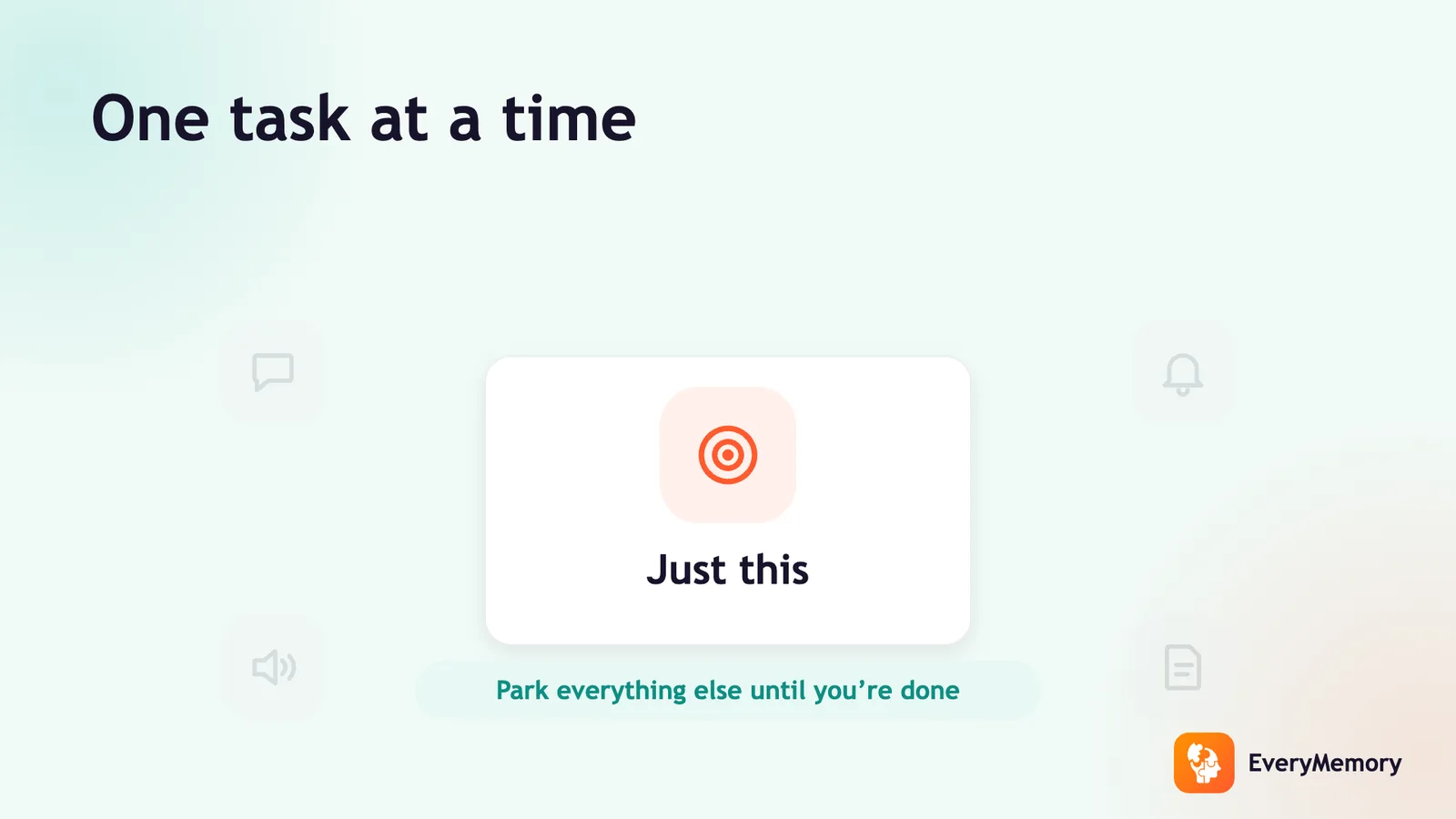
The practical implication is simple and powerful: single-tasking is a memory technique. When something matters - a name, an instruction, a PIN - stop other activity, make eye contact or read carefully, and give it a full beat of real attention.
Stress, fatigue, and the attention system
Attention doesn't operate in isolation. It's tightly linked to your mental and physical state. Stress is one of the most powerful attention disruptors - it floods the brain with signals about threat, pulling the spotlight toward worry and away from whatever is in front of you. Our article on whether stress makes you more forgetful covers this connection in detail.
Fatigue has a similar effect: sustained attention in particular degrades when you're tired, making it harder to stay with a task long enough for a solid memory to form. This is why reading something important before bed, when mental energy is depleted, often feels like it disappears by morning.
Neither of these means you are powerless. Building habits around when and how you do mentally demanding tasks - reading when alert, having important conversations when rested - is a straightforward way to give attention the conditions it needs.
What genuinely supports focused attention
There's a lot of noise about "supercharging" focus, but the most reliable supports are unglamorous: consistent sleep, regular physical movement, and reduced distraction in the environment. These aren't things that need to happen perfectly - they just need to happen enough of the time to give your attention system what it runs on.
Beyond the basics, deliberate practice of focused tasks - reading without interruption, working a puzzle without background noise, having a conversation with your phone in another room - trains the sustained attention muscle in the same way physical exercise builds strength. Small, repeated efforts accumulate over time.
- Put single-tasking into practice for at least one important activity per day.
- Create a low-distraction environment for mentally demanding tasks.
- Take a real break - a short walk, not just a phone scroll - when concentration starts to slip.
- Review important information actively (repeat a name aloud, write down an address) rather than passively.
A practical attention habit: the 'full stop' technique
One of the simplest ways to strengthen the link between attention and memory is to build in brief deliberate pauses before anything you want to remember. Before you put down your keys, pause and notice where they are - say it quietly to yourself. Before you take a pill, pause and register the action. Before you're introduced to someone, take a breath and actually look at them as you hear their name.
This sounds almost too simple, but it works precisely because of what we know about attention: the spotlight needs a moment to lock in. That one-second pause is the difference between information that sticks and information that slips through.
If you want to build this kind of attention practice into a regular routine, our focus and attention brain workout offers a structured way to do it a few minutes a day.
When attention seems harder than usual
It's normal for concentration to fluctuate - with sleep, mood, stress levels, and time of day. If you notice that your ability to focus has become reliably harder over a period of weeks, it's worth looking at the basics first: sleep quality, stress load, and any new medications, since several common ones can affect alertness.
If attention difficulty feels significant, sudden, or is affecting daily life in a noticeable way, it's always worth a conversation with a qualified healthcare professional. Most of the time there's a practical explanation, and addressing it directly makes a real difference.
✅ Try this today - The single-task practice
Pick one daily activity where you typically multitask. For one week, do it with full attention only.
- Choose something you do every day - a meal, a phone call, reading the news, taking medication.
- For that activity, remove or put away any competing distraction: phone face-down, TV off, one thing at a time.
- After the activity, take five seconds to register one thing about it - a detail, a feeling, a piece of information. Notice what you actually retained versus your usual experience.