 EveryMemory
How Good Is Your Memory? A Non-Medical Self-Check
There's no single "good memory" score - memory has several parts, and each is normal in a range. Here's a non-medical way to check where yours sits.
Part of the guide: Understanding Memory Loss and Forgetfulness: A Calm, Reassuring Guide →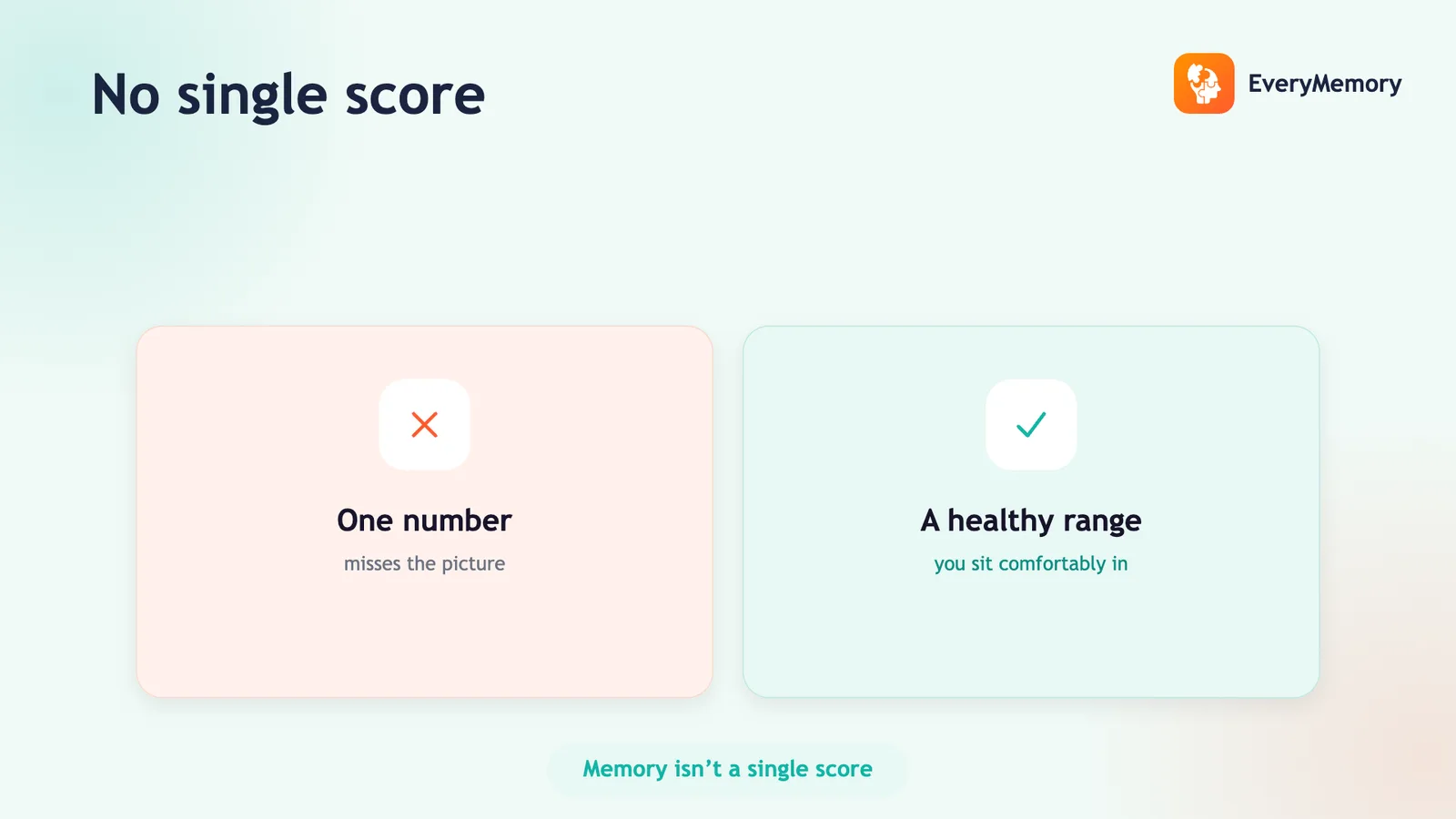
⚡ Quick answer
There's no single number for how good your memory is - memory has several parts (short-term, working, visual, long-term, prospective), and each is normal across a wide range. A non-medical self-check tests each part with a quick task. The useful answer isn't a grade; it's knowing your own baseline and watching it stay steady or improve with practice.
Key takeaways
- There's no single memory score; memory is several systems, each normal across a wide range.
- Check the parts separately with a digit span, tray game, word list, and name recall.
- Normal ranges are wide and shift with sleep, stress, age, and interest.
- Repeat the same self-check to track your own baseline, not a grade.
"How good is your memory?" sounds like it should have a clean answer - a number out of ten. It doesn't. Memory isn't one thing, so there's no single score that captures it.
What you can do is check the main parts separately and see where each one sits for you. Here's a non-medical self-check and what counts as normal.
Why there's no single memory score
Memory is a set of related systems, not one dial. You might hold seven digits easily but struggle to recall where you put your keys; you might remember faces but forget names. A test of one part says little about another. For the map of parts, see types of memory explained.
A quick non-medical self-check
Run each of these once, rested and undistracted, and note how it felt:
- Digit span - have someone read random digits one at a time and repeat them back. Most adults manage about seven, plus or minus two.
- Tray game (Kim's game) - look at 10–15 small objects for 30 seconds, cover them, and list what you can. Six to ten is typical.
- Word list - read 15 unrelated words once, do something else for two minutes, then recall as many as you can. Five to nine after a delay is common.
- Names - meet two or three new people (or photos with names) and recall them later. This one trips up most people.
What "normal" looks like
Notice the ranges above are wide, and they shift with sleep, stress, age, and how interested you were in the material. A below-average round on a tired day means very little. What matters more is consistency: a part that's reliably hard for you across good days is worth practicing - see how to remember names easily for the most common one.
Turn the check into a baseline
A one-off impression is noisy. Repeat the same self-check under the same conditions every couple of weeks and you get a trend you can trust - your memory compared to your own past, not to anyone else (reading your progress). That's the honest version of "how good is your memory."
✅ Try this today - a one-minute self-check
Right now, rested and quiet:
- Glance at any 10 objects on a table for 30 seconds, then look away.
- Write down everything you can recall - aim past six.
- Note the number and the date, then repeat the exact same check in two weeks and compare to yourself.
⚠ When to talk to a professional
This is a non-medical, for-interest self-check, not a diagnosis. Everyday forgetting is normal. If memory changes start to affect daily life or worry you, speak with a qualified healthcare professional.