EveryMemory
Morning Brain Routine for Seniors
A calm, practical morning brain routine for older adults - designed to warm up focus, support recall, and set a clear mental tone for the rest of the day.
Part of the guide: How to Improve Your Memory: The Complete Beginner's Guide →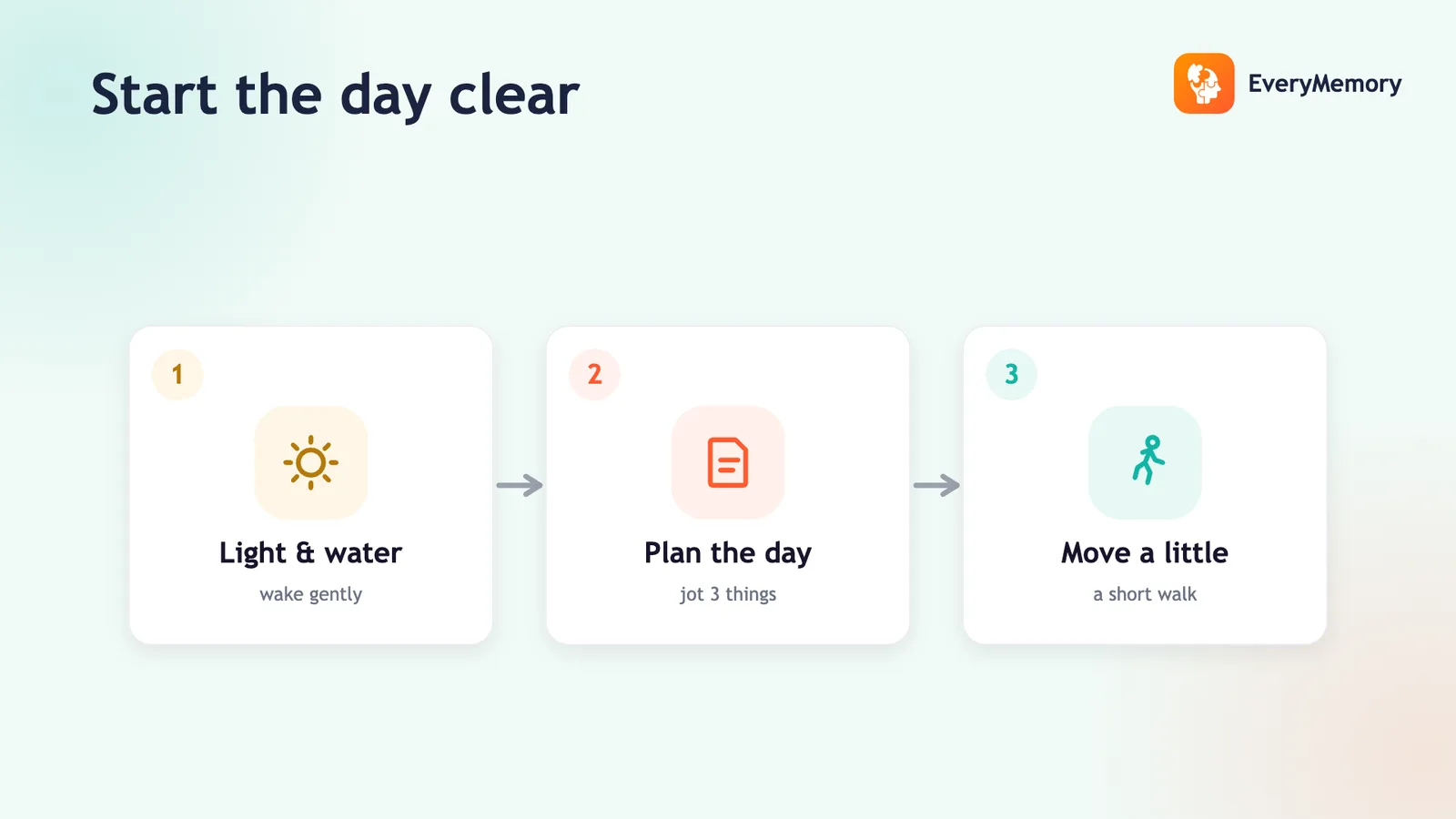
⚡ Quick answer
A morning brain routine for seniors works best when it is calm, structured, and done consistently. Start with a minute of slow breathing to settle your attention, then a short recall warm-up, then one focused memory or attention task. The whole sequence takes 12 to 15 minutes and sets a clear mental tone for the rest of the day.
Key takeaways
- Morning is a practical time for recall practice because working memory tends to be sharpest early in the day.
- The 15-minute sequence flows in four steps: breathing, yesterday recall, a main exercise, and naming intentions for the day.
- Keeping materials in a fixed spot and attaching the routine to a strong morning anchor makes habit formation much faster.
- On difficult mornings, a 5-minute version - breathing, recall, and intentions - is enough to preserve the habit.
The first thirty minutes of the morning quietly shape the rest of the day. A rushed, reactive start tends to produce a scattered, reactive day. A calm, deliberate start - even a short one - tends to produce a clearer, more focused one. For older adults who want to support their memory and attention, those first thirty minutes are a real opportunity.
This guide lays out a morning brain routine built specifically for adults 55 and older. It takes about 15 minutes from start to finish, requires nothing beyond a pen and paper (or a quiet mind), and is designed to become effortless through repetition. The goal is a calm mental warm-up, not a high-intensity workout.
Watch the guided session
Why mornings are the best time for memory practice
After a night of sleep, the brain has had time to consolidate the previous day's experiences and clear out short-term interference. Working memory - the system that holds information while you use it - is typically at its sharpest early in the day for most older adults. Practising recall while that system is at its best makes the training more effective.
There is also a practical reason. Mornings are the most predictable part of most people's days. Events pile up as the day goes on, but the first hour tends to follow a similar pattern most mornings. That predictability is exactly what habit formation needs.
For more on why structured timing supports focus, see why routine matters for focus.
The full morning sequence
Run through these four steps in order. The whole sequence is designed to flow from calming to activating - settling your attention first, then using it.
- 60 seconds of settled breathing. Sit comfortably, let your eyes close or soften, and take five or six slow breaths. This is not meditation - it is simply a brief pause to stop reactive morning momentum and shift your attention inward. It takes 60 seconds and makes everything that follows easier.
- Yesterday recall (3 minutes). With your eyes still closed or a blank page in front of you, run through yesterday in rough order: morning, afternoon, evening. Aim to recall five to eight specific things - not just "had lunch" but what you ate, who you spoke with, something you noticed. Specificity is the point.
- Main exercise (8 minutes). Choose one task from the list below. Rotate through the options across the week.
- Intention for the day (1 minute). Name three things you want to remember or accomplish today. Say them aloud or write them down. This is an active encoding step - you are deliberating storing information rather than letting it drift.
Morning exercise options to rotate through
Keep a simple rotation so different memory systems get regular attention:
- Word list recall. Read 10 words slowly, cover them, write as many as you remember. Our word recall daily exercise has free lists to use.
- Visual pattern recall. Look at a simple image or pattern for 30 seconds, then draw it from memory. Visual memory training for older adults explains how to make this a daily habit.
- Names and faces. Spend 8 minutes with photos - family, friends, or a set of faces from a magazine - practising the name-anchor technique from names and faces memory exercise.
- Focus and attention task. A short concentration exercise such as counting backward by threes, or the tasks in focus and attention brain workout, sharpens the attention side of memory.
- Short-term memory drill. Read a short paragraph once, cover it, and write down everything you recall. Check how close you came. The short-term memory exercise for beginners has guided versions.
Making the routine stick in the first two weeks
The first two weeks are the critical window for any new habit. During this period, it helps to make the routine as frictionless as possible. A few things that make the difference:
- Keep your exercise materials (notepad, pen, word list) in the exact spot where you do the routine - no searching required.
- Attach the routine to a strong existing anchor: right after you make your morning drink, before you check your phone, immediately after waking.
- Tell someone in your household what you are doing - not to be accountable to them, but because naming the intention out loud makes it feel more concrete.
- Start with the 12-minute version. Do not add complexity in the first week.
By day fourteen, most people find the sequence feels natural. By day twenty-one, most find they notice its absence on the days they skip.
Adapting the routine on difficult mornings
There will be mornings that do not go to plan - an early appointment, a poor night's sleep, a house full of family. On those mornings, a reduced version is always better than a skipped version.
A five-minute version: one minute of breathing, three minutes of yesterday recall, one minute of intention-setting. No main exercise. That is enough to maintain the habit and give the day a calmer start than a purely reactive morning would.
If you want a guided schedule for the first week, the simple daily memory routine article has a day-by-day structure you can follow alongside this morning sequence.
What to notice over time
After three to four weeks of consistent morning practice, most people notice one or more of the following: fewer moments of mid-conversation word-searching, faster name recall with people they know well, and a general sense of being more mentally present during conversations and tasks.
These shifts are gradual and not always easy to see without a record. Keeping a simple one-line note after each session - "felt sharp today" or "struggled with the word list" - gives you something concrete to look back on. For a structured format, the weekly memory check-in template takes less than five minutes to fill in each Sunday.
✅ Try this today - Tomorrow morning's five-minute starter
Before committing to the full routine, try this condensed version tomorrow morning:
- Sit quietly for 60 seconds and take five slow breaths before touching your phone.
- Spend three minutes recalling yesterday in rough order - aim for at least five specific details.
- Name three things you want to remember today, out loud or in writing.