EveryMemory
Memory Tips for Medical Students
Memory tips for medical students: use active recall and spaced repetition for sheer volume, mnemonics for arbitrary lists, and memory palaces for anatomy and pathways.
Part of the guide: How to Improve Your Memory: The Complete Beginner's Guide →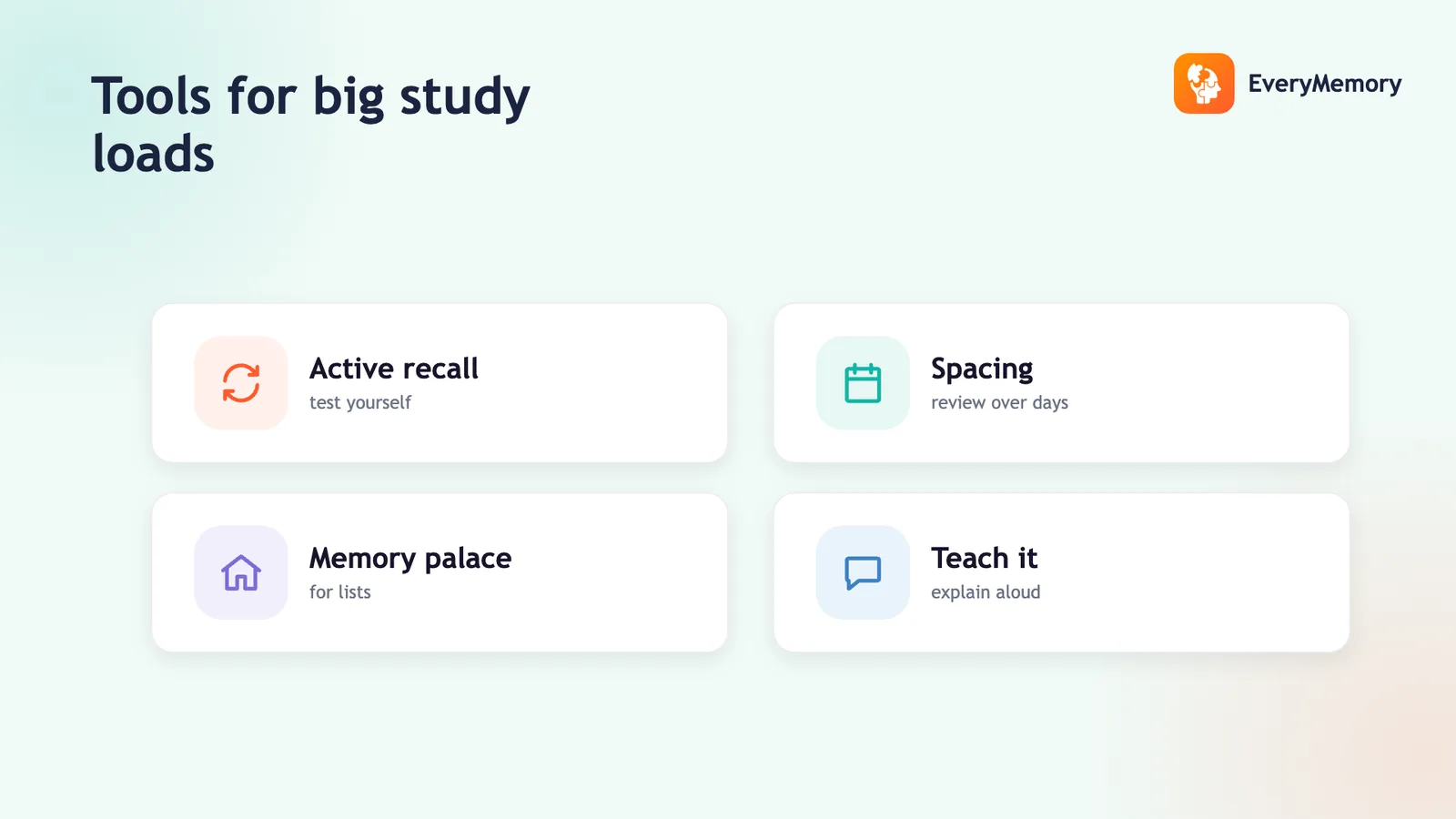
⚡ Quick answer
The most effective memory tips for medical students are study techniques: use active recall (testing yourself, not rereading) as your default, spaced repetition to manage the volume across day 1, 3, 7, 14, mnemonics for arbitrary lists like cranial nerves, and a memory palace for spatial material like anatomy. Match the technique to the material, and review consistently rather than cramming.
Key takeaways
- Make active recall - testing yourself, not rereading - your default study method.
- Use spaced repetition (day 1, 3, 7, 14) to manage the sheer volume of material.
- Use mnemonics for arbitrary lists and a memory palace for anatomy and pathways.
- Match the technique to the material and protect sleep, which consolidates learning.
Medical school is, more than almost any other course, a memory problem. The volume is enormous and much of it is arbitrary - drug names, enzyme pathways, the branches of a nerve - that no amount of understanding alone will make stick.
Rereading textbooks and highlighting feel productive and barely work for this kind of load. The students who cope use a small set of evidence-backed study techniques matched to the type of material. (This is about how to study - not clinical content.) Here they are.
Make active recall your default
Rereading and highlighting feel like studying but barely move material into durable memory. Active recall - closing the book and forcing the answer out - does the real work. Turn everything into questions: cover a diagram and redraw it, explain a pathway aloud from memory, use flashcards that make you produce the answer. Retrieval, even when you get it wrong, strengthens the memory far more than reviewing the page. It's the single highest-yield change most students can make.
Use spaced repetition for the volume
There's too much to learn once and keep. Spaced repetition reviews material just before you'd forget it, with growing gaps, so a huge body of facts stays accessible for the cost of short daily reviews.
| Review | When | What you do |
|---|---|---|
| 1st | Day 1 | Learn the material; self-test once. |
| 2nd | Day 3 | Recall from memory; mark what you missed. |
| 3rd | Day 7 | Recall again; easy items get longer gaps. |
| 4th | Day 14+ | Recall once more; weak items come back sooner. |
This is why so many medical students live in flashcard apps like Anki - they automate exactly this schedule across thousands of cards.
Use mnemonics for arbitrary lists
Some material has no logic to lean on - the order of cranial nerves, the carpal bones, a classification's categories. For these, build a mnemonic: an acronym or a vivid sentence whose first letters cue the list. Med school runs on these for a reason - they convert an arbitrary sequence into one memorable phrase. Make your own where you can; a mnemonic you built sticks better than one you borrowed.
Use a memory palace for anatomy and pathways
Spatial and sequential material - anatomy, biochemical pathways, steps of a process - fits a memory palace beautifully. Walk a familiar route and place each structure or step at a location, as a vivid image. The route enforces the order and the images make each item recallable. For dense topics, chunk the material into smaller groups before placing it.
Match technique to material - and protect sleep
No single method fits everything: active recall and spacing for sheer volume, mnemonics for arbitrary lists, palaces for spatial and sequential content. The skill is choosing the right tool for each topic.
And don't trade sleep for study hours. Sleep consolidates what you learned that day - an all-nighter often costs more in lost retention than it gains in cramming. Consistent daily review beats heroic sessions.
✅ Try this today - Turn one lecture into recall practice
Take today's lecture and convert it instead of rereading:
- Write 10 questions that cover the lecture's key facts - make them produce answers, not recognise them.
- Close your notes and answer all 10 from memory; mark the ones you missed.
- Schedule recall checks for day 3 and day 7, and build a mnemonic for any arbitrary list in the material.