 EveryMemory
How to Stop Forgetting Things
You can't stop forgetting entirely - but most everyday forgetting is avoidable, because it's an attention problem, not a memory one. The fixes that actually work.
Part of the guide: Understanding Memory Loss and Forgetfulness: A Calm, Reassuring Guide →
⚡ Quick answer
You can't stop forgetting entirely - and you wouldn't want to - but you can stop the avoidable kind. Most everyday forgetting is a failure of attention, not memory: the information never got stored because you were distracted. Give what matters a few seconds of full attention, link it to meaning, write down what doesn't need to be in your head, and build fixed habits for the things you lose most often.
Key takeaways
- Most everyday forgetting is information that never got stored because attention was divided - not memory failing.
- Give what matters a few seconds of single-tasked attention, and say it aloud to force encoding.
- Offload appointments and to-dos to a calendar, and give frequently-lost items one fixed home.
- Protect sleep and lighten the load - both raise the capacity to focus and store.
Forgetting feels like something going wrong, but a memory that forgot nothing would be unbearable - you'd be buried under every number plate and overheard sentence you ever met. The goal isn't to stop forgetting; it's to stop the avoidable kind.
And almost all avoidable forgetting comes from the same place: information that never got stored because attention was elsewhere. Fix that, and the slips fall away.
Most 'forgetting' is really not-storing
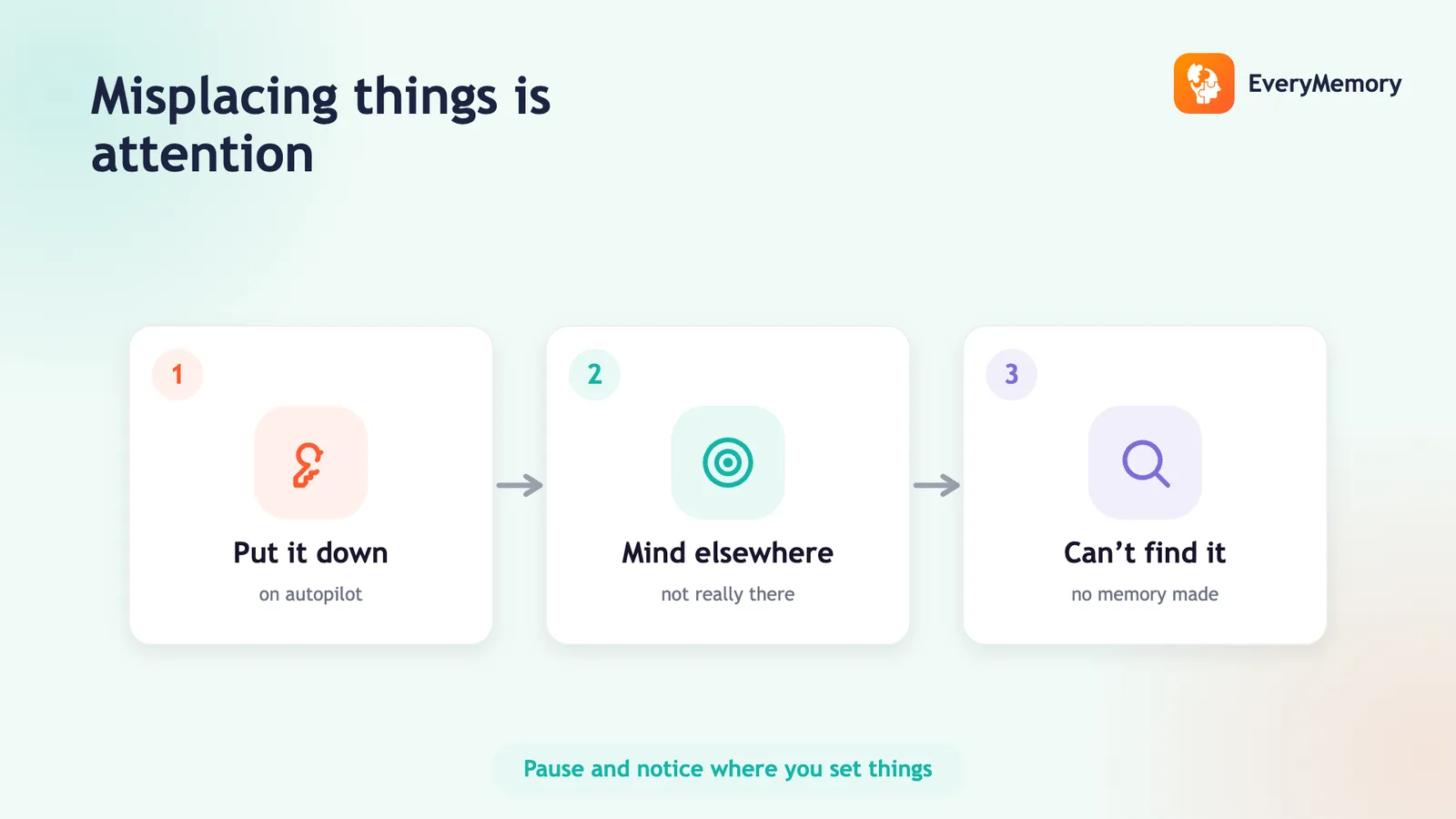
When a name vanishes seconds after you hear it, or you can't find the keys you set down two minutes ago, the memory didn't fade - it was never formed. You were half-listening, or on autopilot. There's nothing to recall because nothing was stored. That's good news: the fix is at the moment of taking it in, which you control. The mechanics are in why you forget things so quickly.
Give it a few seconds of real attention
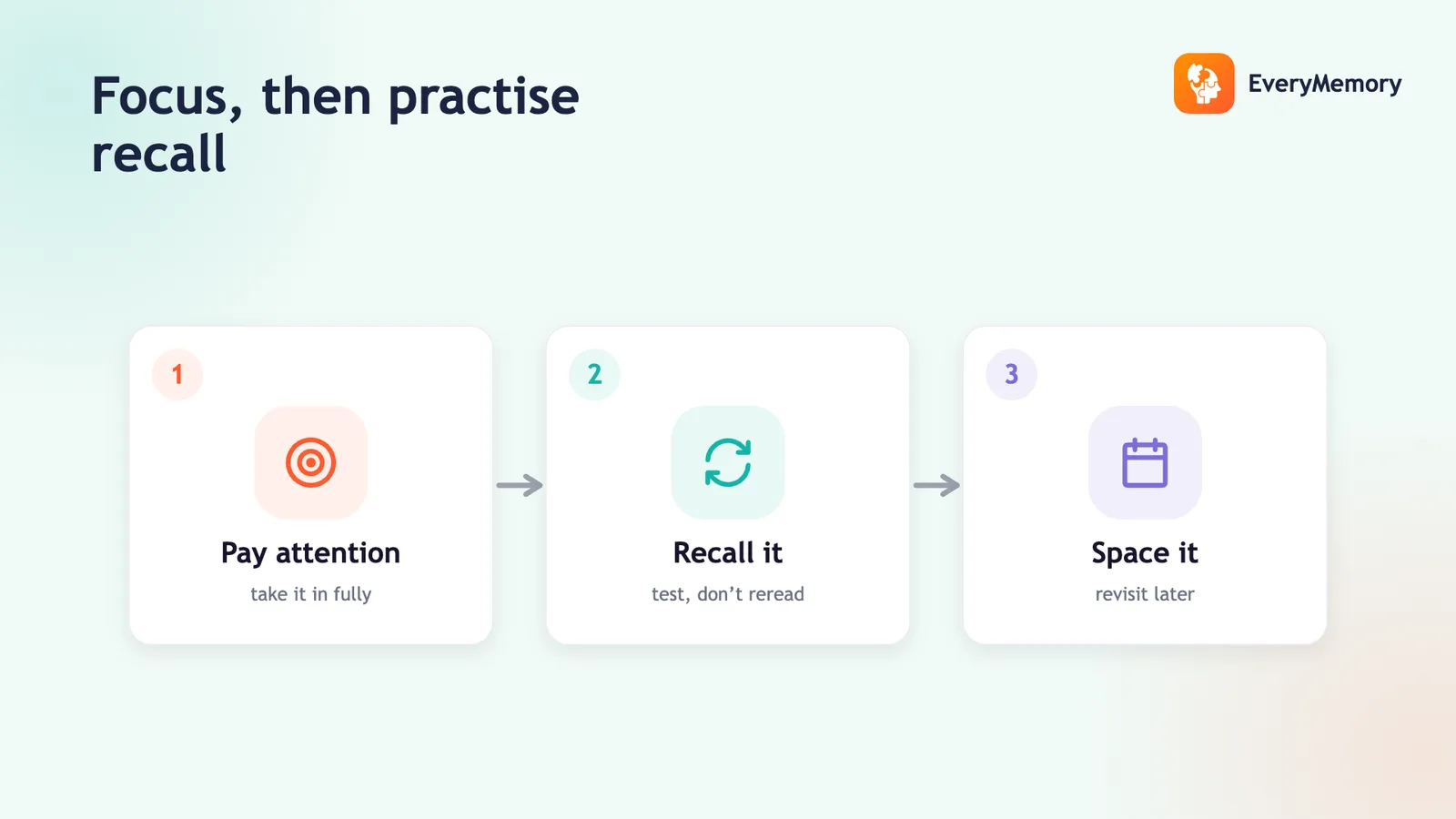
The single biggest fix is to stop dividing your attention. When something matters - a name, an instruction, where you put something - give it a clear three seconds of single-tasked focus before moving on. Most slips simply never get that, and no memory forms without it.
Use these in-the-moment habits
- Say it aloud. Repeating a name or 'keys on the hook' out loud forces the attention that stores it.
- Link it to meaning. Connect the new thing to something you already know - that's what memory holds onto.
- Pause at transitions. Before walking off or switching tasks, take one second to register what you're carrying.
- Do one thing at a time. Multitasking guarantees that some things never encode.
Stop relying on memory for what it's bad at
Working memory is for thinking, not storage. Write down appointments and to-dos, and give frequently-lost items one fixed home you always return them to - keys on a hook, glasses in a dish. This removes whole categories of forgetting by removing the need to remember. The same fix solves misplacing things, and remembering things better covers the wider toolkit.
Reduce the load behind the slips
Forgetting spikes when you're tired, stressed, or doing too much - all of which shrink the capacity to focus and store. Protecting your sleep and not piling on tasks does as much for everyday memory as any technique.
When forgetting is worth a closer look
Occasional forgetting, worse on busy or tired days, is normal. It's reasonable to speak with a qualified professional if it gets noticeably and steadily worse over weeks, starts to disrupt daily life, or comes with confusion about familiar people or places - especially if others notice before you do.
✅ Try this today - the three-second rule
For one day, give one category of slips full attention:
- Pick your most common slip - names, or where you put things.
- Each time it comes up, stop and give it three seconds of single-tasked attention, saying it aloud.
- Notice how many fewer slips you have by evening.
⚠ When to talk to a professional
Everyday forgetting that's worse when you're tired or busy is normal. If forgetfulness is clearly and steadily worsening, disrupting daily life, or noticed by others alongside confusion, talk to a qualified professional.