 EveryMemory
How to Support a Parent's Memory
Supporting a parent's memory is less about drills and more about gentle habits - routines, cues, good conversation, and shared activities that keep them engaged and confident.
Part of the guide: Helping a Parent With Memory Changes: The Complete Family Guide →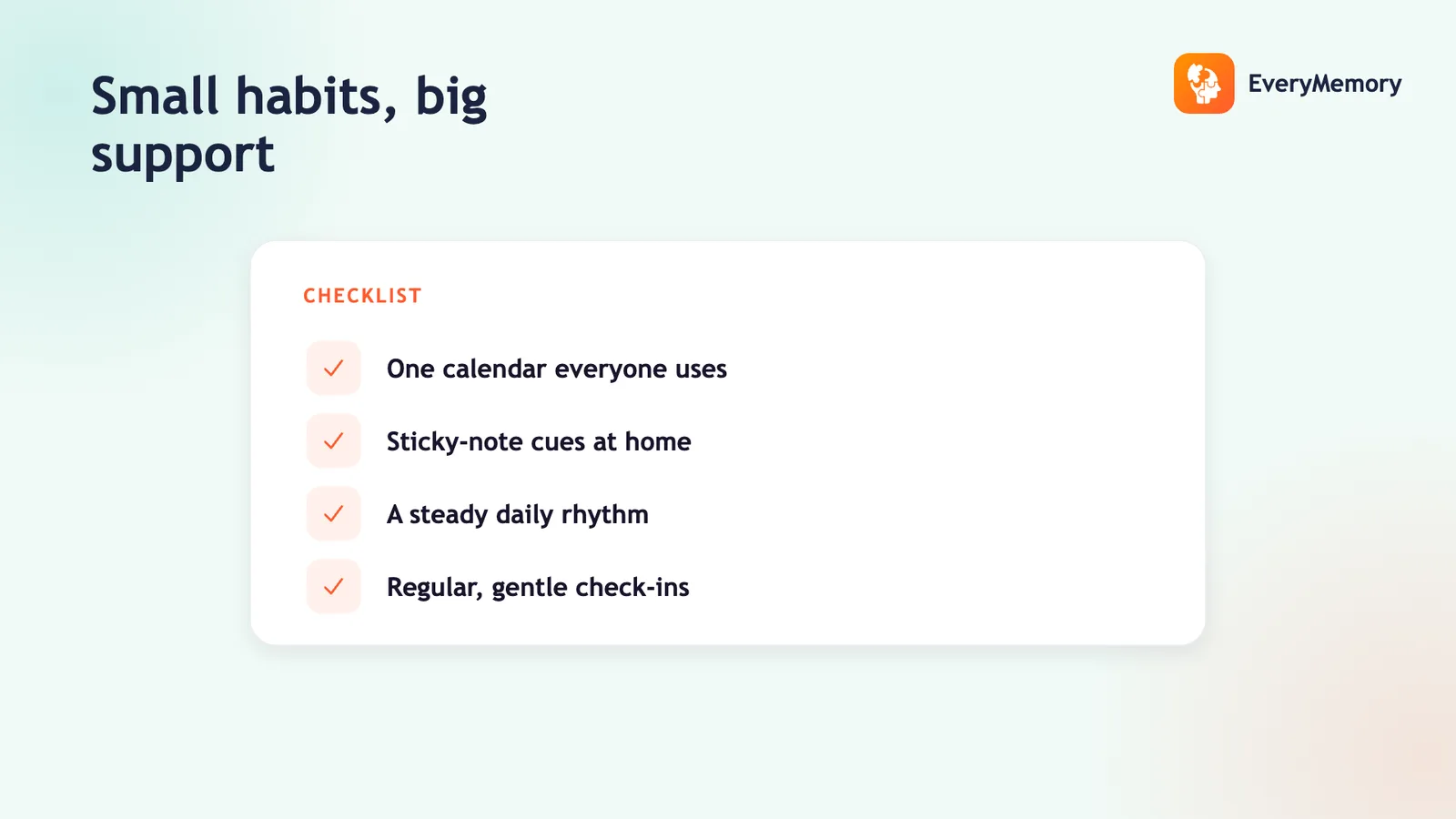
⚡ Quick answer
Support a parent's memory with gentle, practical habits rather than drills: keep a predictable daily routine, place clear cues like a calendar and labelled lists where they're needed, talk in ways that invite stories instead of testing recall, and share enjoyable activities that keep the mind engaged. Protect their dignity by helping discreetly and leaving them in control. For genuine concerns, involve their doctor.
Key takeaways
- A predictable routine reduces how much must be remembered.
- Use cues like calendars and pill organisers instead of corrections.
- Talk to build confidence, not to quiz or catch them out.
- Involve a doctor if memory is noticeably worsening.
When you notice an older parent leaning more on notes or repeating themselves, the instinct is to step in and fix it. The most helpful support, though, is quieter than that. It's about making daily life easier to navigate, keeping their mind comfortably engaged, and protecting their confidence - not running memory drills.
Most of what helps is structure and kindness. A steady routine, a few well-placed reminders, and regular, warm activities do more for everyday memory than any single exercise. And throughout, the aim is to support, not to manage - your parent stays in charge of their own day.
Routine does the heavy lifting
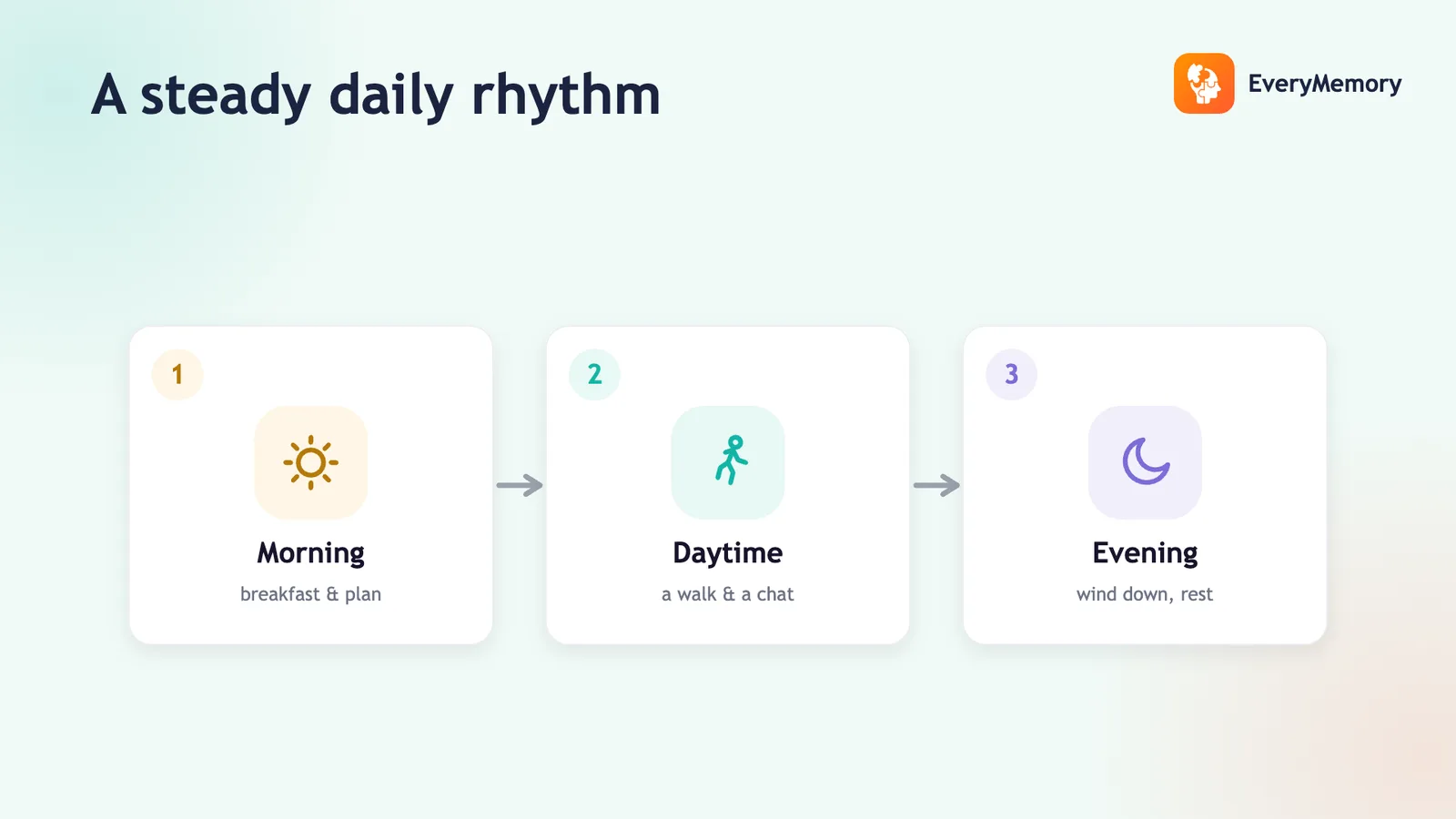
A predictable day reduces how much has to be remembered from scratch. When meals, medication, and activities happen at roughly the same times, the rhythm itself carries a lot of the load, and your parent feels more in control. You're building scaffolding, not restrictions.
Anchor the routine to fixed points - morning coffee, the lunchtime news, an afternoon walk - and let the day hang off them. For a full template, see a daily routine that supports a senior's memory and the gentler morning brain routine for seniors.
Helpful cues, not corrections
External cues take pressure off recall without anyone losing face. A large wall calendar, a whiteboard for the week, labelled cupboards, and a pill organiser all quietly answer questions before they're asked. The skill is making them obvious and consistent.
| Everyday challenge | Gentle cue |
|---|---|
| Losing track of the day | Large date-and-day calendar in the kitchen |
| Forgetting appointments | A single shared family calendar with reminders |
| Repeating medication | Weekly pill organiser with morning/evening slots |
| Misplacing keys and glasses | A labelled bowl or hook by the door |
| Forgetting names of visitors | A small photo board of family and friends |
Talk in ways that build confidence
How you talk matters as much as what you do. Avoid quizzing - "Don't you remember?" rarely helps and often stings. Offer the missing detail kindly and move on: "We're seeing Dr Lee on Thursday - I'll drive." When you want their stories, ask open questions about the past, which are easier and more enjoyable to reach.
Repeating an answer without irritation, and without pointing out that you've said it before, preserves dignity. For prompts that invite stories rather than test recall, see conversation starters for seniors.
Keep the mind comfortably engaged
Engagement beats isolation. Regular activities your parent enjoys - cards, gardening, cooking, a weekly call with a friend - keep their mind active in a natural, pleasant way. The word to keep in mind is "enjoyable." Nothing here is a workout; it's a life kept full.
- Protect social contact - visits, calls, a club, a place of worship.
- Keep hands and mind busy with hobbies they already love.
- Do activities with them rather than handing over tasks.
- Offer choices so they stay in charge of their day.
- Add a small, optional shared game if you both enjoy it.
Knowing when to involve a professional
Supportive habits are for everyday life, not for diagnosing or treating anything. If you notice memory changes that are getting noticeably worse, affecting safety, or distressing your parent, that's a conversation for their doctor - gently raised and ideally attended together.
There's no shame in it, and it's often a relief. For a calm, practical guide to that step, see how to help an aging parent with memory concerns.
✅ Try this today - A confidence-first week
Set up the quiet supports that take pressure off everyday memory.
- Put up a large day-and-date calendar somewhere your parent passes often.
- Set up a weekly pill organiser together and agree where it lives.
- Anchor three fixed points in the day - a meal, a walk, a call.
- Replace one quizzing habit with a kind cue ("I'll remind you - it's Thursday").
- Add one enjoyable shared activity to the week and keep it regular.
⚠ When to talk to a professional
This is general, non-medical guidance for supporting everyday memory and wellbeing, not a diagnosis or treatment. If a parent's memory is noticeably worsening or affecting daily life or safety, speak with their doctor or a qualified professional.