 EveryMemory
The Link and Story Method for Remembering Lists
Turn a list into a chain of vivid images, or one absurd story, and recalling the first item pulls up the rest. The simplest technique for everyday lists.
Part of the guide: How to Improve Your Memory: The Complete Beginner's Guide →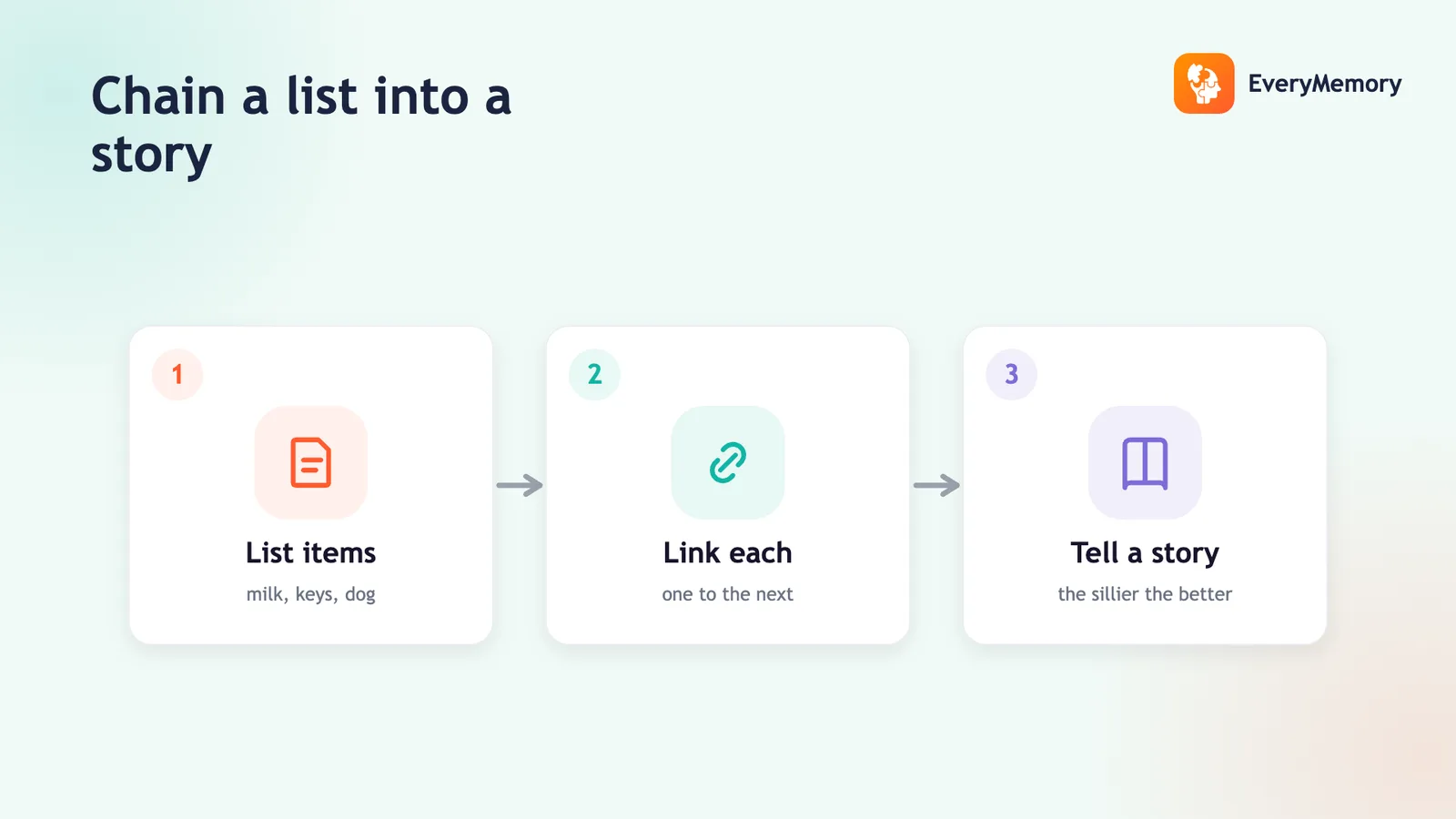
⚡ Quick answer
The link method turns a list into a chain of vivid images, each connected to the next; the story method strings them into one short, absurd story. Both work because a narrative gives order and meaning to items that otherwise have neither, so recalling one item pulls up the next. It's the simplest technique for everyday lists and needs no setup.
Key takeaways
- The link method joins list items into a chain of vivid images; the story method weaves them into one short narrative.
- Both give an otherwise meaningless list order and meaning, so recalling one item pulls up the next.
- Make every connection vivid, exaggerated and active - sensible links break, absurd ones hold.
- It's best for short ordered lists you need briefly; use the memory palace or peg system for longer or reusable ones.
Of all the memory techniques, this is the easiest to start with - no familiar route to set up, no system to learn. You just connect the things you want to remember into a chain or a story.
It's ideal for everyday lists: errands, a few points to make, the steps of a task.
Link vs story - the difference
Both connect your list items so each leads to the next. The link method joins them in pairs: item 1 interacts with item 2, item 2 with item 3, like a chain. The story method weaves all of them into a single short narrative. Use the link method for speed; use the story method when the items resist pairing and a story flows more naturally.
How to use it, step by step
- Turn each list item into a clear, vivid image.
- Connect the first to the second with an action - make them interact, dramatically.
- Connect the second to the third the same way, and so on down the list.
- To recall, start at the first image and let each one pull up the next.
Example - milk, stamps, umbrella: a cow (milk) licking a giant stamp, which you fold into an umbrella that rains milk. Silly is the point.
What makes the chain hold
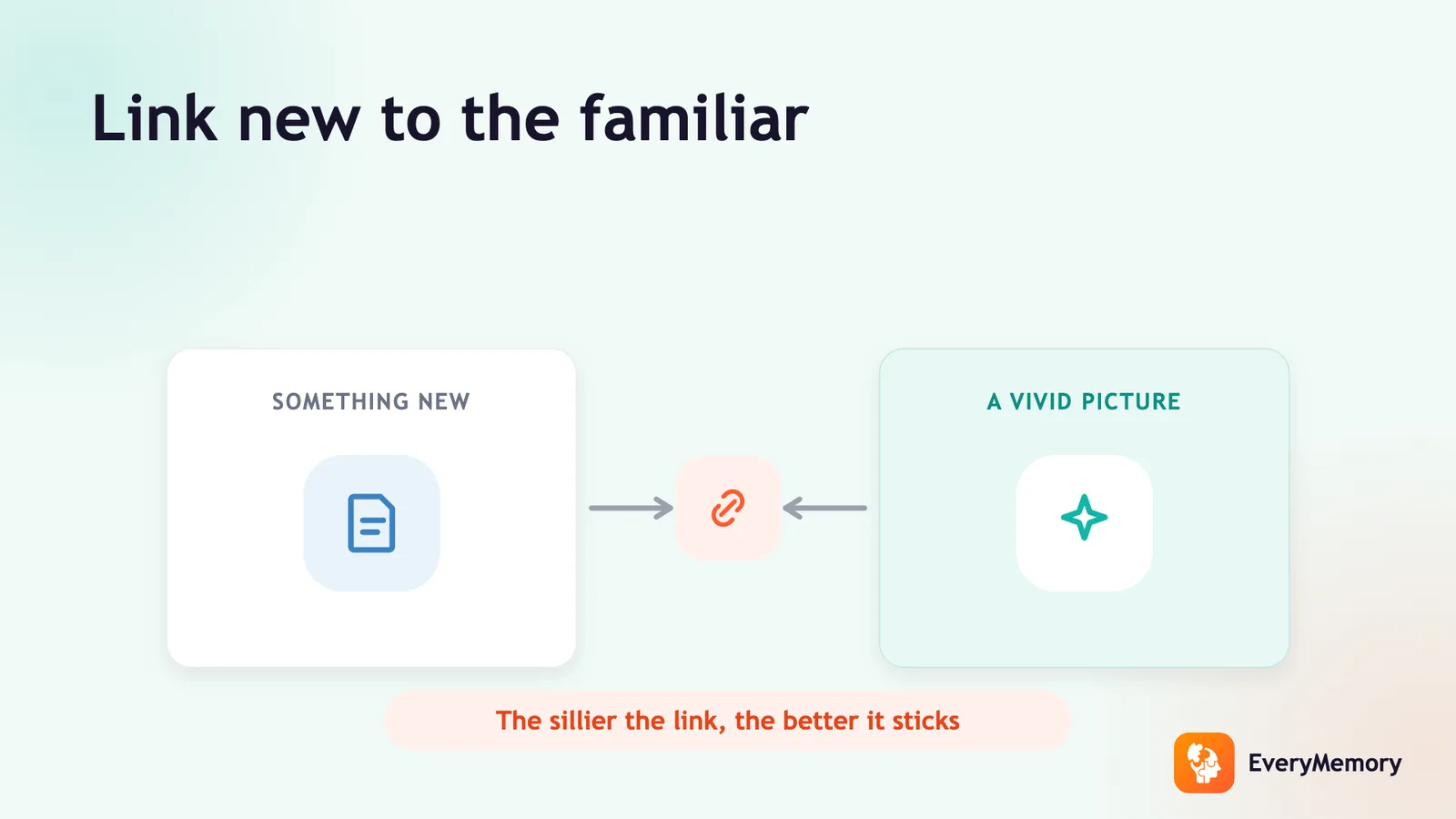
The same rules as all imagery techniques: make each connection vivid, exaggerated, and active. A weak, sensible link breaks; an absurd one holds. If a join feels forgettable, push it further. This is association applied in sequence.
Best for - and its limits
The link and story method shines for short, ordered lists you need briefly: a shopping list, the points of a toast, steps in a recipe. Its weakness is that one broken link can stall the chain, and it's not built for jumping to 'item seven' directly. For longer or reusable ordered lists, the memory palace or peg system are sturdier.
✅ Try this today - chain a five-item list
Try it on your next errand list:
- Picture each of five items vividly.
- Link item 1 to 2 with an exaggerated action, then 2 to 3, and so on.
- Recall the chain now, and again in an hour - start at item one and follow it.