 EveryMemory
The Peg System: Remembering Ordered Lists
The peg system gives each number a fixed image to hang information on, so you can recall a list in order - or jump straight to item seven. Reusable forever.
Part of the guide: How to Improve Your Memory: The Complete Beginner's Guide →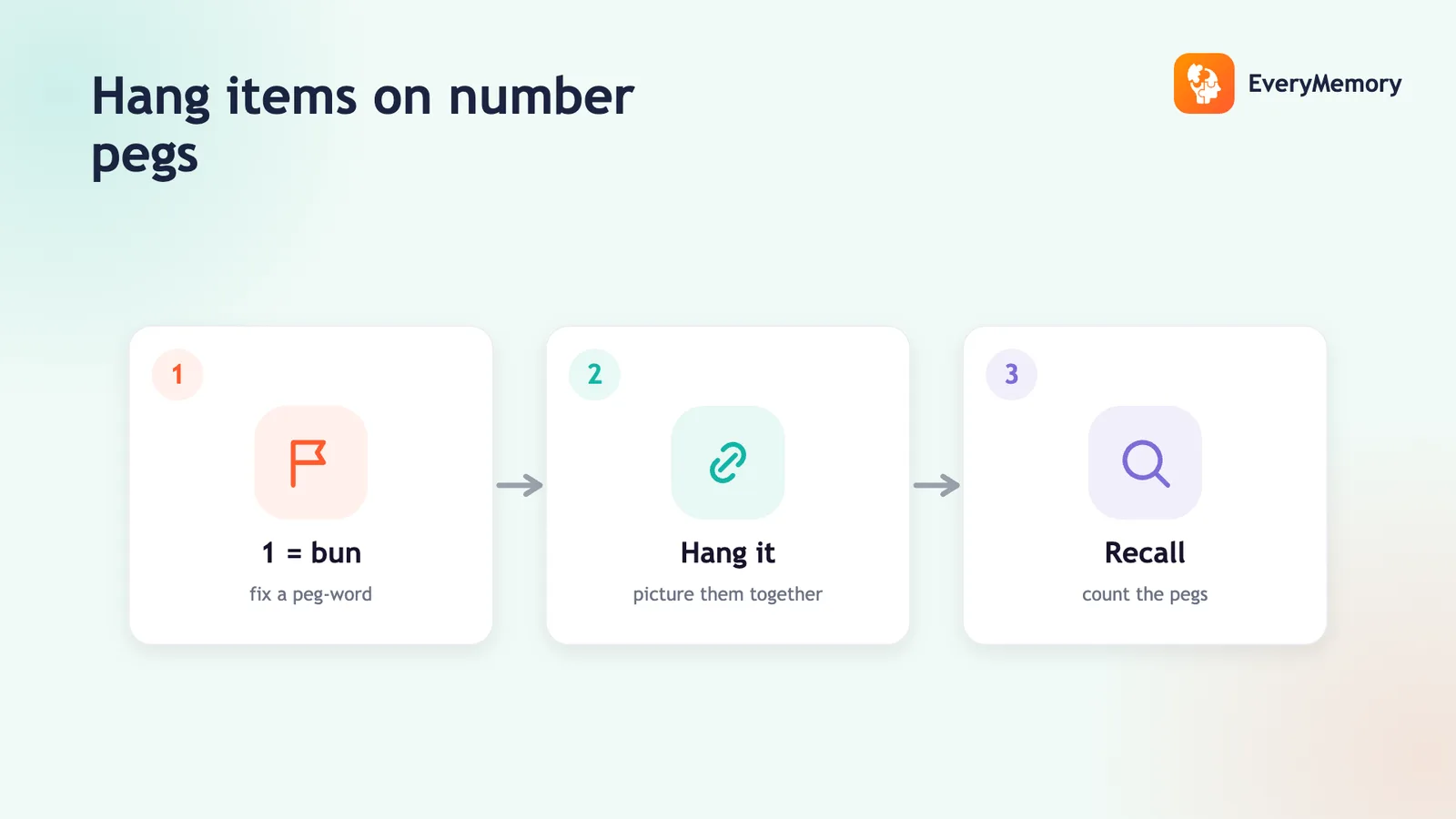
⚡ Quick answer
The peg system links numbers to fixed 'peg' images (1 = bun, 2 = shoe, 3 = tree…), so you can hang any list on numbered hooks and recall items in order - or jump straight to item seven. It's ideal for ordered or numbered lists, and once your pegs are memorised they're reusable for every list you make.
Key takeaways
- The peg system attaches a fixed image to each number (1-bun, 2-shoe…), so you hang list items on numbered hooks.
- Because each item has a number, you can recall the list in order or jump straight to any position.
- Rhyming pegs are easiest and are memorised once, then reused for every future list.
- Pegs suit short reusable lists and recall-by-position; the memory palace suits longer material and natural routes.
The peg system solves a problem the link method can't: recalling a list by position. Want item number seven without walking through one to six? Pegs give you that.
You build a set of numbered 'hooks' once, then reuse them for any list, forever.
What the peg system is
A 'peg' is a fixed image permanently attached to a number. Once 1 always means a bun and 2 always means a shoe, you can hang the first item of any list on the bun and the second on the shoe. The numbers give you instant random access - item five is whatever's on peg five.
Build your pegs (the rhyming set)
The easiest pegs rhyme with their number, so they're effortless to recall:
- 1 = bun, 2 = shoe, 3 = tree, 4 = door, 5 = hive,
- 6 = sticks, 7 = heaven, 8 = gate, 9 = wine, 10 = hen.
Memorise these ten once. They never change, so this is a one-time cost that pays off on every future list.
How to use it
- Take your list in order.
- For item 1, picture it interacting vividly with your '1' peg (a bun).
- For item 2, picture it with the shoe; continue down the list.
- To recall, run the numbers: 'one - bun - and…?' The image hands you the item. To get item seven directly, just call up peg seven.
Peg system vs memory palace
Both store ordered lists. The memory palace uses places along a route; the peg system uses numbers. Pegs win when you want list positions (item nine, fast) and for short reusable lists; palaces win for longer material and when a natural route fits. Many people learn both and pick per task. Both build on plain association.
✅ Try this today - peg a 5-item list
Use the rhyming pegs above:
- Memorise pegs 1–5: bun, shoe, tree, door, hive.
- Hang five list items on them with vivid, interacting images.
- Recall the list in order - then test yourself by jumping to item four directly.