 EveryMemory
Memory Palace Mistakes - and How to Fix Them
The memory palace is one of the most powerful recall tools ever devised - but five common mistakes quietly undermine it. Here is how to spot and fix each one.
Part of the guide: How to Improve Your Memory: The Complete Beginner's Guide →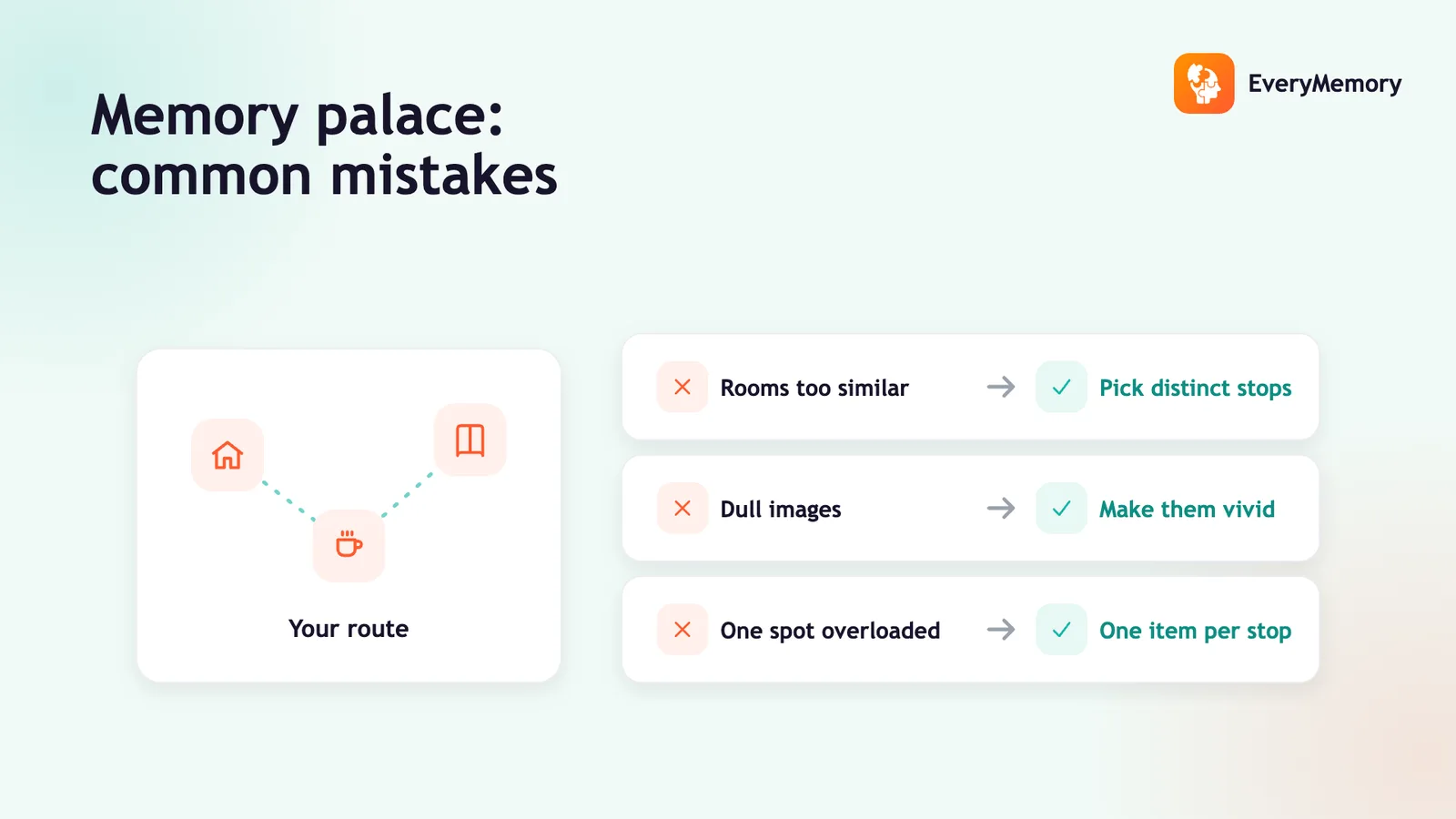
⚡ Quick answer
The most common memory palace mistakes are choosing locations that look too similar to each other, using dull or passive images, cramming too many items into one spot, walking the route inconsistently, and never reviewing what you stored. Each of these quietly undermines recall, but all are easy to fix with small adjustments to how you build and revisit your palace.
Key takeaways
- Similar-looking loci cause interference - make each stop as distinct as possible before placing any images.
- Passive, static images are forgettable; active, sensory, and exaggerated ones stick far better.
- One item per locus is the rule - cramming two images into one spot reliably scrambles both on retrieval.
- Consistent routing and regular review walks are what convert short-term encoding into lasting memory.
You built your memory palace, placed your images carefully, then walked the route - and promptly forgot half of what you stored. Sound familiar? The problem is almost never the technique itself. The method of loci has been in use for more than two thousand years; when it fails, the cause is usually one of a handful of very fixable errors.
This guide is a practical companion to our memory palace for beginners introduction. It goes straight to the five mistakes that trip up most new users and gives you a clear fix for each.
Mistake 1: Choosing Locations That Look Too Similar
When two loci (location-stops) in your palace resemble each other - two chairs in the same room, two similar shelves, two windows facing the same wall - the brain blends them. Memory researchers call this interference: one image bleeds into the adjacent one, and on retrieval you cannot be sure which item belonged where. The result is scrambled recall even though you encoded everything carefully.
The fix is to make each locus as distinct as possible before you place a single image there. Walk your route mentally and ask: could I mistake this spot for the one before it? If yes, swap it for something that stands out - a corner rather than a flat wall, a door rather than a window, a specific object you would recognise blindfolded (the squeaky floorboard, the cold light switch). Aim for ten clearly different stops rather than twenty similar ones. Fewer, distinctive loci outperform more, generic ones every time.
- Use corners, doorways, and unique objects - not two chairs or two similar shelves.
- If your home feels too same-looking, use a familiar walking route or a different building.
- Sketch the route once - drawing forces you to notice which stops are genuinely distinct.
Mistake 2: Using Dull or Passive Images
Placing an image at a locus and calling it done is the single most common reason people feel the technique is not working for them. A plain, static mental picture - a glass of water sitting quietly on a table - creates almost no emotional or sensory signal. The brain does not bother flagging it as worth retaining.
Effective memory palace images are active, exaggerated, and sensory. The glass does not sit on the table; it explodes upward, soaking the ceiling and raining back down in slow motion. You hear the smash, feel the cold spray. The more your imagined scene involves movement, sound, smell, or even absurd humour, the stronger the trace it leaves. This is the same principle behind association techniques - the brain prioritises the unusual and the vivid.
For abstract information - a date, a name, a concept - convert it into something you can see first. The number 1066 might become a Viking at your front door; the name Margaret might become a daisy-filled shopping cart. Encoding takes a few extra seconds but pays back in much better recall.
Mistake 3: Cramming Too Many Items Into One Spot
Beginners often try to economise by stacking two or three images onto a single locus. The first item associates with the spot and partially blocks retrieval of the second; the second and third blur together. Memory researchers describe this as proactive interference - earlier items suppress later ones at the same location.
The rule is simple: one item, one locus. It sounds extravagant, but familiar spaces contain far more usable stops than most people realise. A single room in your home - door, light switch, coat hook, mat, left wall, right wall, window sill, bookshelf, sofa arm, coffee table - already gives you ten distinct stops. If your list is longer than your palace has spots, build a second palace rather than doubling up. It is faster and more reliable than cleaning up a crowded one later.
For anything that genuinely needs long-term storage, pairing the palace with spaced repetition reviews is the most reliable approach - but the first step is always finding enough distinct loci so you never need to double up.
Mistake 4: Walking the Route Inconsistently
Your memory palace is a spatial journey, and its power depends on always travelling the same path in the same order. Some people start at the front door one day and the kitchen the next, or loop back through rooms in a different sequence - that inconsistency breaks the orderly chain of cues the technique relies on.
Before placing a single image, commit to a fixed route: starting point, direction, every stop in sequence. Then always walk the same path. Consistency turns the route itself into an automatic prompt - you reach the coat hook and your brain expects an image there, making retrieval almost involuntary. For more on how habits support recall, see how to improve your memory.
Mistake 5: Building the Palace and Never Reviewing It
A memory palace encodes information beautifully in the short term - but without review the images fade within a day or two, just like any other memory. Encoding is the first step; consolidation requires retrieval practice.
Palace review is quick: close your eyes and walk the route, naming each item as you pass its locus. A first walk twenty to thirty minutes after encoding catches the initial forgetting curve; a second the following day, and a third a week later, is usually enough for robust long-term storage. One pass of ten loci takes under two minutes - tie it to making morning tea and it becomes effortless.
Putting It All Together
These five mistakes rarely appear in isolation - similar loci lead to cramming, which leads to inconsistent routing, which makes review feel pointless. Fixing loci distinctness first often resolves the rest. Once you have ironed out these habits, the technique becomes reliably powerful. For a step-by-step refresher, revisit the memory palace for beginners guide.
✅ Try this today - A Five-Minute Palace Audit
Use this checklist to review your current palace - or to build your next one on solid ground.
- Walk your route mentally and pause at each locus. Ask: is this spot clearly different from the one before it? If two stops feel similar, replace one with a more distinctive anchor - a corner, a unique object, a change in height or material.
- At each locus, ask: is my image active and sensory, or is it just sitting there? If it is passive, add movement, sound, or absurdity - make the item do something dramatic at that spot, and replay the scene for three seconds.
- Check for crowding. Does any locus have more than one item? If so, move the second item to a fresh locus - even a new room or a second building if needed. Then schedule two review walks: one today and one tomorrow.
⚠ When to talk to a professional
Occasional memory slips while learning a new technique are completely normal. If you notice a sudden, rapid, or persistent change in your everyday memory that is different from your usual baseline, it is worth discussing with a qualified healthcare professional.