 EveryMemory
Spaced Repetition for Everyday Memory
Spaced repetition is the most evidence-backed way to make information stick long-term. Here's how to use it for names, appointments, medication, and anything else worth remembering.
Part of the guide: How to Improve Your Memory: The Complete Beginner's Guide →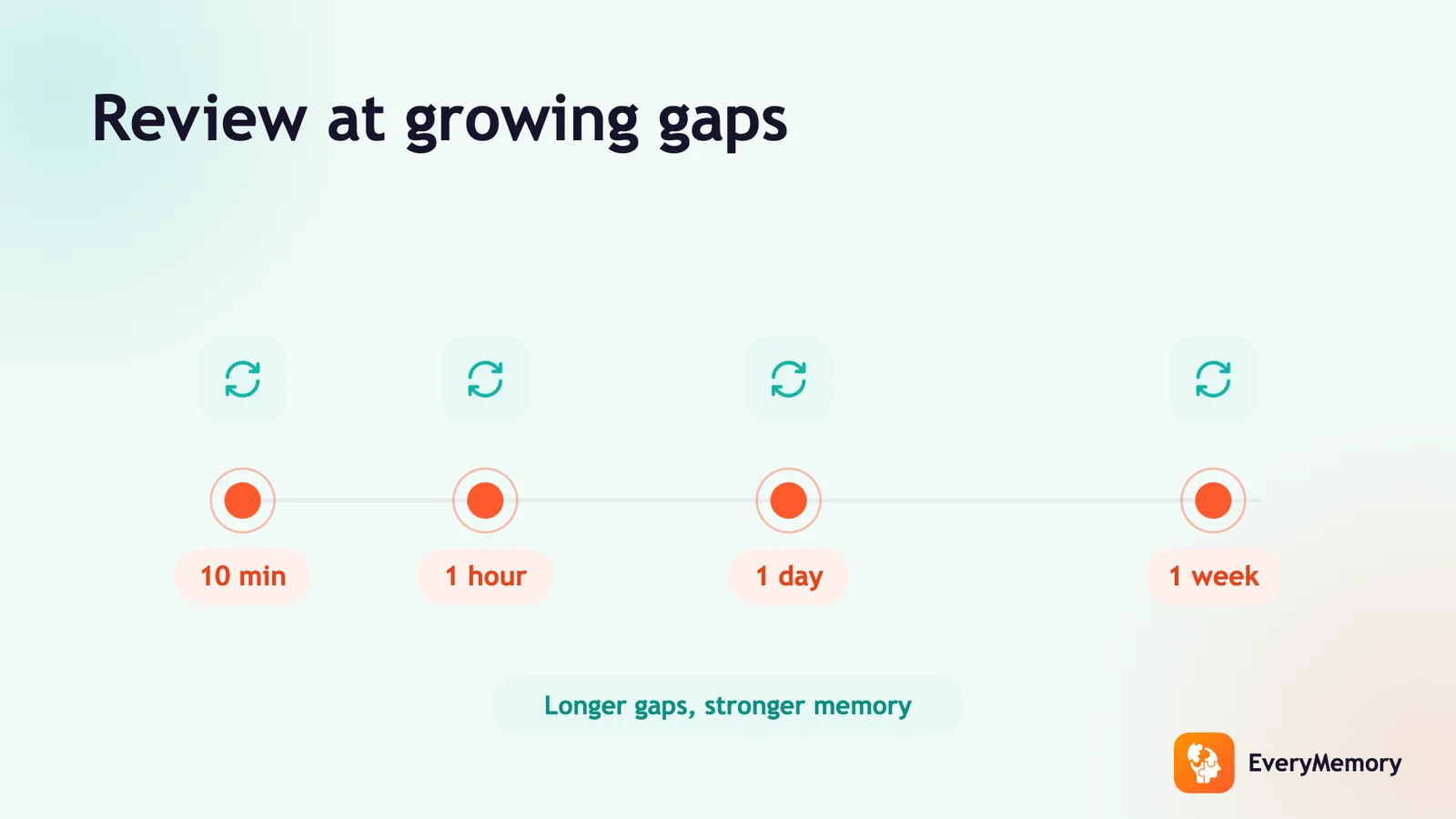
⚡ Quick answer
Spaced repetition means reviewing something right before you'd normally forget it, then waiting a bit longer before reviewing it again. Each review strengthens the memory and extends how long it lasts. In practice: review new information after 1 hour, then after 1 day, then after 3 days, then after a week. After that, occasional use is usually enough to keep it.
Key takeaways
- Review new information after 1 hour, then the next morning, then at 3 days, then at 1 week - four reviews is usually enough to make it last.
- Active recall - trying to retrieve the information before looking - does far more to strengthen memory than re-reading does.
- A paper index-card system with three decks (daily, every 3 days, weekly) is all you need - no app required.
- If you forget something before a review date, shorten the interval and restart - the relearning still builds lasting retention.
You meet someone on Monday, use their name twice, and feel sure you've got it. By Wednesday it's gone. You study a list of medication names, feel confident, and then draw a blank at the pharmacy. You've probably had the experience of reading something important, nodding along, and then finding almost none of it accessible a week later.
None of this is a sign of a failing memory. It's a completely predictable consequence of the way memory is built - and there's an equally predictable fix. Spaced repetition is the practice of reviewing information at carefully timed intervals that match the natural curve of forgetting. It's the most rigorously studied memory technique in existence, and it works just as well without a flashcard app as it does with one.
Why most learning doesn't stick
The central problem is massed practice - studying everything in one block and expecting a single session to last. Memory follows a forgetting curve: we lose a significant fraction of new information within the first hour, and most of the rest within a day or two. A single round of study plants a seed; without watering at the right moments, the seed doesn't grow.
Spaced repetition is the system of watering at the right moments. Each review is short - sometimes just a few seconds of active recall - but it lands exactly when memory is starting to fade, which is when it does the most good.
The basic schedule
You don't need software or a complicated system. The basic spacing that works for most everyday information is:
- Learn the information (a name, a fact, a phone number).
- Review it 1 hour later - just try to recall it without looking.
- Review it again the next morning.
- Review it 3 days after the original learning.
- Review it 1 week later.
- After that, occasional natural use is usually enough to maintain it.
The reviews don't need to be long. For a name, you're just asking yourself: what was the name of the person I met on Monday? For a phone number, you're reciting it without looking at your notes. For a medication name, you're saying it aloud from memory before checking the label. The act of retrieval - not re-reading - is what strengthens the memory.
This is closely related to the techniques described in how to remember phone numbers and PINs, where spaced review is the final step that takes a newly learned number from short-term to long-term storage.
How retrieval practice makes memories stronger
Re-reading feels productive but does very little to strengthen memory - you're simply recognising information you already processed. Active retrieval, even when you struggle, builds a much stronger memory trace.
Think of it like a path through a field. The first time you walk it, you barely bend the grass. Walk it the next day and a faint trail appears. Walk it again after three days and it's clearly visible. Each retrieval reinforces the pathway that leads to that memory.
The effort involved is a feature, not a problem. Effortful-but-successful recall is where most of the benefit comes from. If it comes too easily, the interval is too short; if it's impossible, the gap is too long. This is the principle behind the 10-minute memory workout for beginners.
Using spaced repetition for names and faces
Names are one of the most practical applications. After meeting someone new, the standard single repetition at the introduction gives the name a foothold. Spaced practice cements it:
- At the introduction: repeat the name back, link it to a facial feature.
- One hour later (or at the end of the same event): think through the people you met. Can you name each face?
- That evening: go through the names again. For any that didn't come, look at a photo if you have one, or reconstruct the association.
- The following morning: run through the names once more. Any name that comes easily is likely in long-term memory.
- Three days later: a final quick review. If it comes, you own it.
This five-step sequence takes maybe 5 minutes spread across three days. That's a tiny investment for a name you can reliably retrieve months later. More detail on the underlying technique is in how to remember names and faces.
Applying spaced repetition to daily life (no app needed)
For most everyday applications, a physical index card system or a simple notebook is all you need. Here's a paper-based system that takes 2 minutes a day to manage:
- New card: whenever you want to retain something, write it on an index card - the thing you want to remember on one side, a prompt or clue on the other.
- Deck 1 (review daily): new cards live here. Each day, go through Deck 1 and try to recall the answer before flipping.
- Deck 2 (review every 3 days): cards you got right two days in a row move here.
- Deck 3 (review weekly): cards you got right in Deck 2 move here.
- Long-term file: cards you know reliably go here. Revisit monthly.
You can adapt this as loosely as you like - some people use a single notebook with dates written next to each item instead of physical decks. The format matters less than the habit of scheduled retrieval.
Pairing this with a consistent daily routine - as described in a simple daily memory routine - makes the reviews easier to sustain because they become part of an established rhythm rather than an extra task.
Common mistakes and how to avoid them
Even people who understand spaced repetition make a few consistent errors that undercut their results:
- Re-reading instead of recalling: always try to retrieve the information before you look at the answer. Even getting it wrong and then checking is more useful than skipping straight to the answer.
- Reviewing everything at the same interval: the spacing should increase with each successful recall. Daily review of items you already know well is wasted effort - and boring.
- Making cards too complex: each card should test one specific thing. 'What is Maria's surname?' is useful. 'Everything I know about Maria' is too broad to retrieve reliably.
- Giving up after one failed retrieval: failing to recall something doesn't mean the information is gone. It means the spacing was too long this time. Shorten the interval and try again.
- Only using apps: apps are helpful but not essential. The key is the spacing and the active retrieval - both are possible with pencil and paper.
Starting your own spaced practice today
Pick one category you struggle to retain - family phone numbers, new names, medication names - and apply the 1-hour / 1-day / 3-day / 1-week schedule for two weeks. After that period, most people find the practised information noticeably more accessible than comparable facts they simply read once.
For a structured approach, the 7-day memory training plan for beginners builds spaced recall into a daily routine, and building a memory training habit explains how to make any practice stick long-term.
✅ Try this today - Three-day name retention challenge
The next time you meet someone new, use this spaced schedule to keep their name:
- At the introduction: repeat the name back, and link it to one feature of their face.
- One hour later: without looking at any notes, recall the name. If you can't, reconstruct the association and try once more.
- The following morning: run through the name again from scratch. Did it come immediately or did you have to work for it?
- Three days later: recall the name one final time. If it comes reliably, it's in long-term memory.