EveryMemory
Memory Palace for Beginners
The memory palace is one of the oldest recall techniques in existence. Here's how it works and how to build your first one in under 20 minutes.
Part of the guide: How to Improve Your Memory: The Complete Beginner's Guide →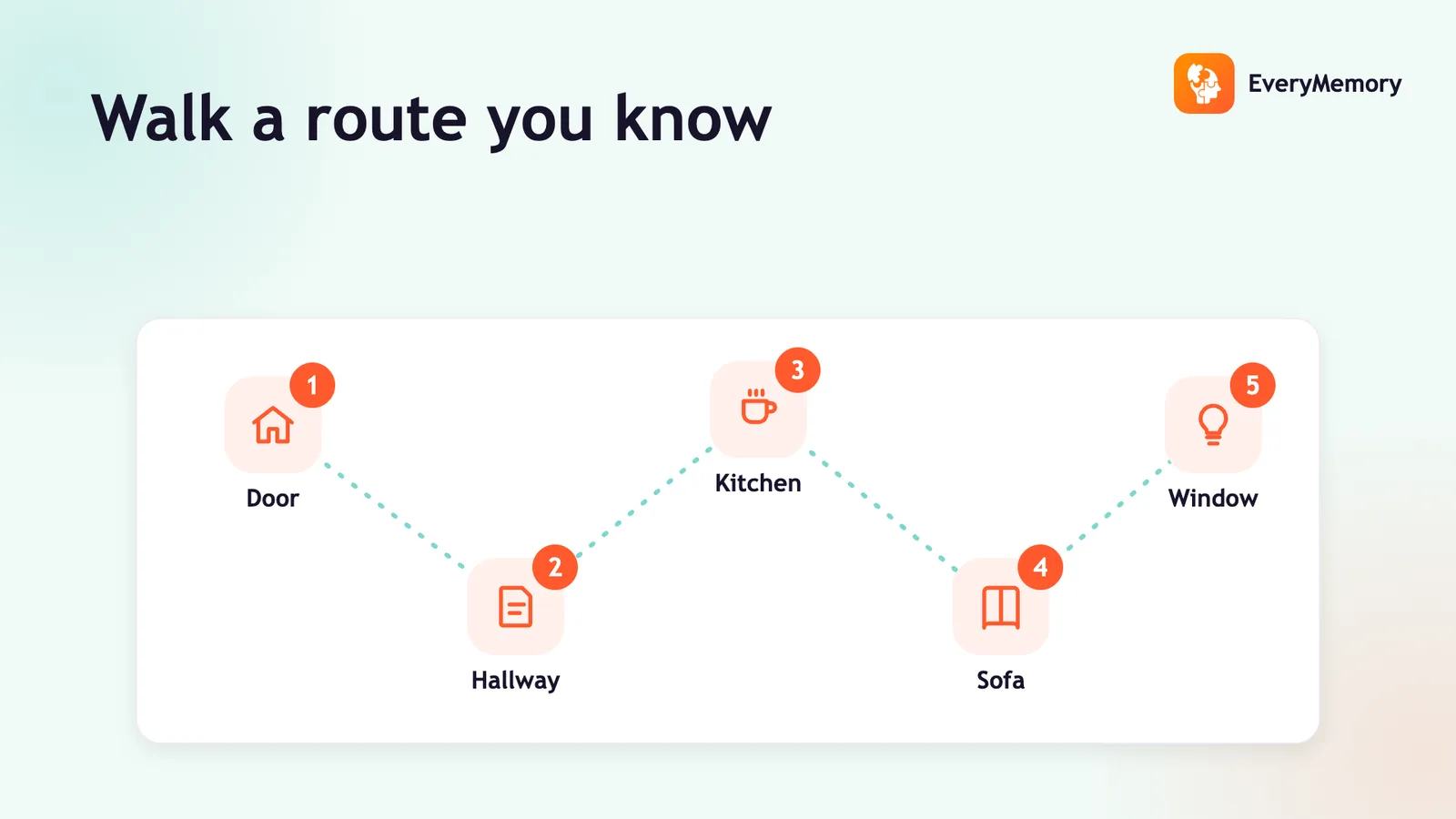
⚡ Quick answer
A memory palace is a familiar place - your home, a walk you take often - that you mentally 'walk through' to retrieve information stored as vivid images at specific locations along the route. To use it: choose a route, place a striking mental image at each stop representing what you want to remember, then mentally walk the route to recall the items in order.
Key takeaways
- Choose a place you know well enough to walk through with your eyes closed, then map a sequence of five to ten distinct stops.
- At each stop, place one vivid, exaggerated image representing what you want to remember - one item per location only.
- Walk the route mentally before loading it, and review it at least twice on the first day to lock images in place.
- Clear old images before reusing a palace each week by mentally removing or replacing each one in turn.
The memory palace sounds like something out of a thriller novel, but it is a genuine and very old technique that competitive memory champions, actors, and everyday people have used for thousands of years to remember things they could not afford to forget. It works by borrowing the most reliable kind of memory most people have - memory for places - and using it to carry any other kind of information you want to keep.
If you have ever walked into your own kitchen and immediately known where everything is without thinking, you already have a working memory palace. This article shows you how to turn that natural skill into a deliberate tool for remembering lists, appointments, names, or anything else that tends to slip.
What is a memory palace and why does it work
The technical name is the Method of Loci - loci is Latin for places. Orators in ancient Greece and Rome used it to deliver hour-long speeches from memory. It still works today because spatial memory is one of the most automatic, deeply wired systems in the human brain.
Think about your childhood home. Even if you haven't visited in thirty years, you can probably walk through it mentally - the light switch, the creaking stair, the smell of the kitchen. That kind of place-memory is robust across a lifetime in a way that lists and names are not.
The technique takes advantage of this: you attach new, fragile information - a shopping list, a sequence of appointments - to a spatial structure you already know perfectly. The new information is stored as a scene in a familiar place, and your brain is very good at scenes in familiar places. This is the same principle behind memory association: the more concretely you link new information to something you already know, the easier it is to retrieve.
Choosing your memory palace
For your first memory palace, start with a place you know so well you could describe it in detail with your eyes closed. Good choices for most people:
- Your current home, room by room
- A route you walk regularly - to the shops, through a park, along your street
- Your childhood home
- A workplace you spent years in
The key requirement is that the place has a natural sequence of distinct locations: front door, hallway, living room, kitchen, and so on. Each of these stops becomes a "slot" where you deposit a piece of information.
For a first attempt, choose a route with five to ten stops. That's enough to hold a shopping list, a week's worth of appointments, or any other manageable chunk of items.
How to place memories along the route
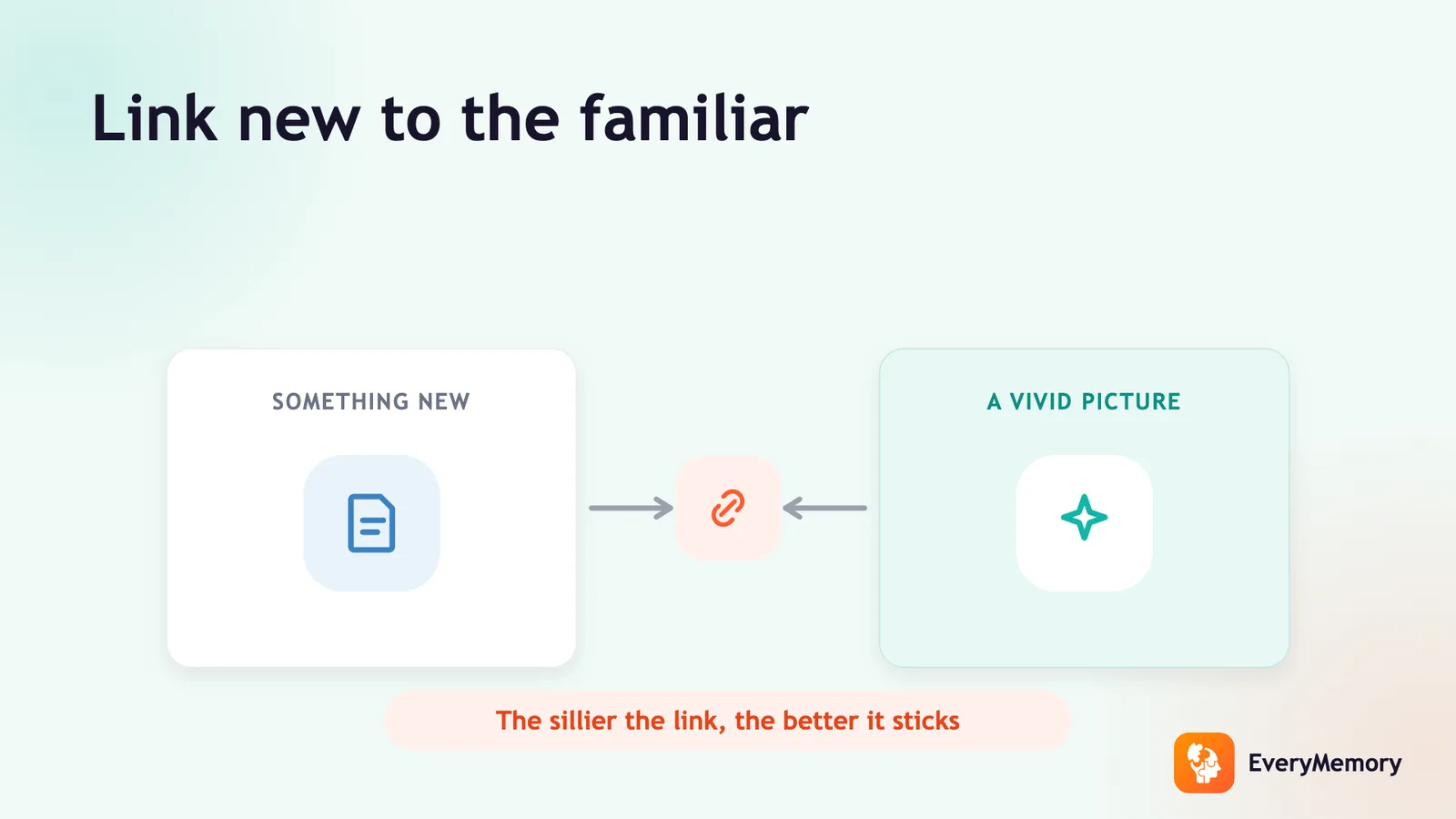
The technique works like this. Take what you want to remember and transform it into a concrete, vivid image. Then mentally place that image at a specific stop in your palace, interacting with the environment there in some exaggerated or unusual way.
The more vivid, strange, or emotionally resonant the image, the stickier it will be. Your brain is wired to notice things that are surprising, funny, large, or in motion - use all of that.
- Take the first item. Say you need to remember to call your doctor. Transform it into an image: a giant telephone sitting in your front hallway, ringing loudly, with a stethoscope wrapped around it.
- Place it vividly at stop one. Don't just picture it floating there. Make it interact with the space: the phone is so enormous it's blocking the door; you have to push past it to get in.
- Move to stop two with the next item. Say you need to pick up bread. In your living room, picture a ten-foot loaf of bread sitting in your armchair, crumbling all over the cushions.
- Continue along the route. One item per stop. Take a mental snapshot at each location before moving on.
When it's time to recall, simply take a mental walk along the same route. The images will be waiting at their spots, and the images lead you back to the real information. This pairs naturally with the broader strategy of remembering appointments and daily tasks.
Your first practice walk
The best way to understand the technique is to do it once today. Write down five things you need to remember this week. Pick five stops in your home in order. For each item, spend fifteen seconds building a vivid image and placing it at a stop. Walk away for five minutes. Come back and mentally walk through your home, retrieving each item without looking at the list.
Most people are surprised. Items that would normally vanish after thirty seconds come back easily when attached to a real place. For a programme that builds the skill day by day, the 7-day memory training plan includes memory palace exercises.
Common beginner mistakes
A few pitfalls trip up almost everyone on the first attempt:
- Images that are too vague. "Remember the dentist" placed at the kitchen doesn't work. "A giant drilling machine filling the entire kitchen, spraying tooth-paste everywhere" does. Force yourself to make it specific and unusual.
- Too many items per stop. One item per location. Piling two or three things at the same spot creates confusion when you try to retrieve.
- Not walking the route before placing items. Spend thirty seconds mentally walking your full route first, confirming all the stops are clear and distinct in your mind.
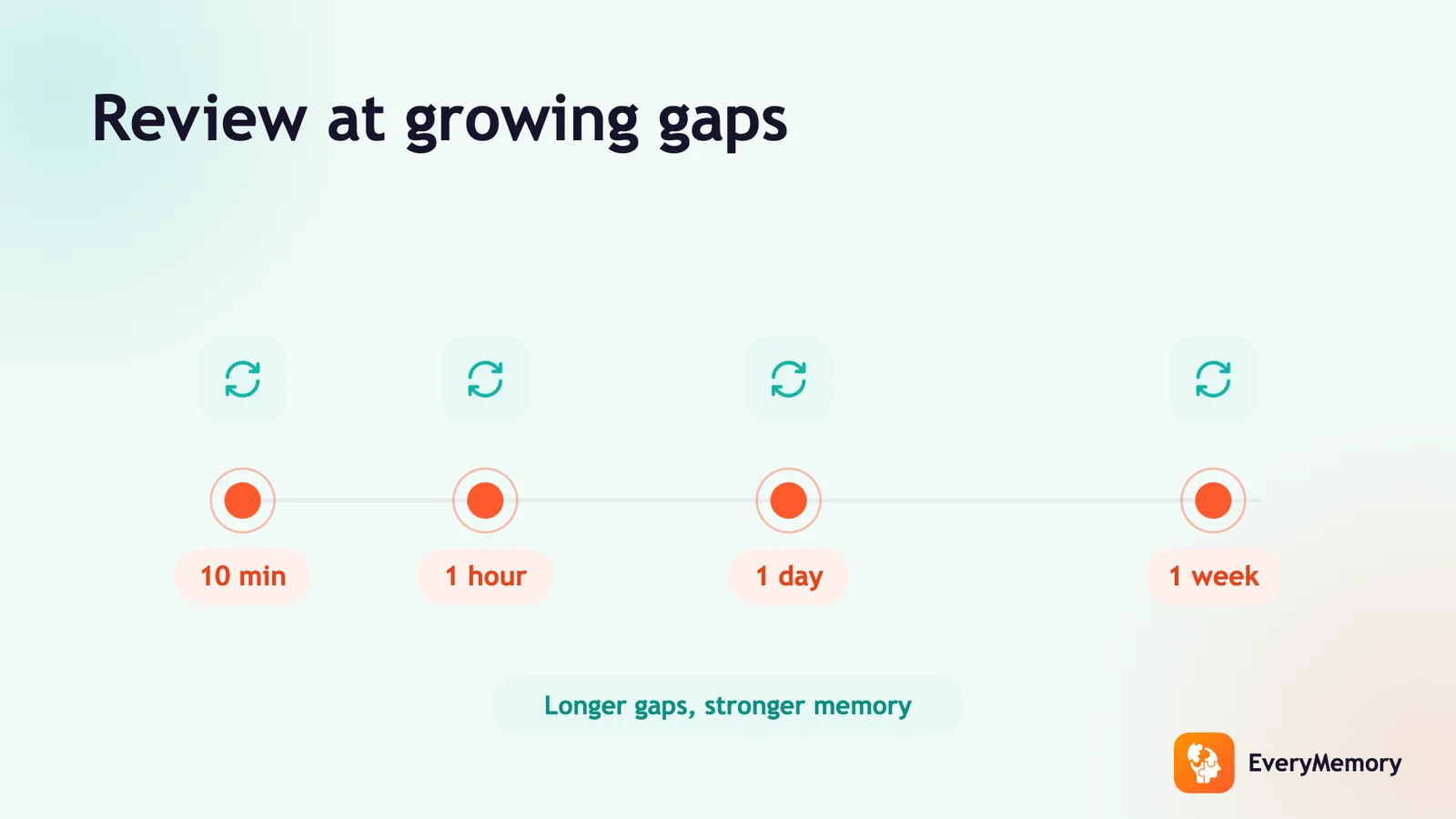
- Never reviewing the palace. The first day, walk the route mentally at least twice. The second day, once. After three reviews, most items are solid. Combine this with spaced repetition for long-term retention.
What to use a memory palace for in everyday life
You don't need to memorise epic speeches. Practical everyday uses: shopping lists (no phone-checking in the supermarket), weekly appointments, names of people you met at an event, steps in a recipe, key points for a conversation.
Start with one category and use the same palace every week, refreshing the images each Monday. As you get comfortable, build a second palace for a different type of information. Our daily brain training routine puts the memory palace alongside other techniques in a manageable daily structure.
✅ Try this today - Build your first five-stop palace
Set aside ten minutes and follow these steps:
- Choose your home as the palace and pick five stops in order: front door, hallway, living room, kitchen, bathroom.
- Write down five things you need to remember this week - appointments, tasks, anything.
- For each item, build a vivid, exaggerated image and mentally place it at one stop. Spend at least fifteen seconds making the image feel real and strange.
- Walk away and do something else for ten minutes.
- Come back and take a slow mental walk through your home, stopping at each location to retrieve the image and the real-world item it represents.