 EveryMemory
Memory Quiz Questions Explained
Most memory quizzes reuse a handful of question types - digit span, grid recall, word lists, spot-the-change. Here's what each one is really measuring.
Part of the guide: Understanding Memory Loss and Forgetfulness: A Calm, Reassuring Guide →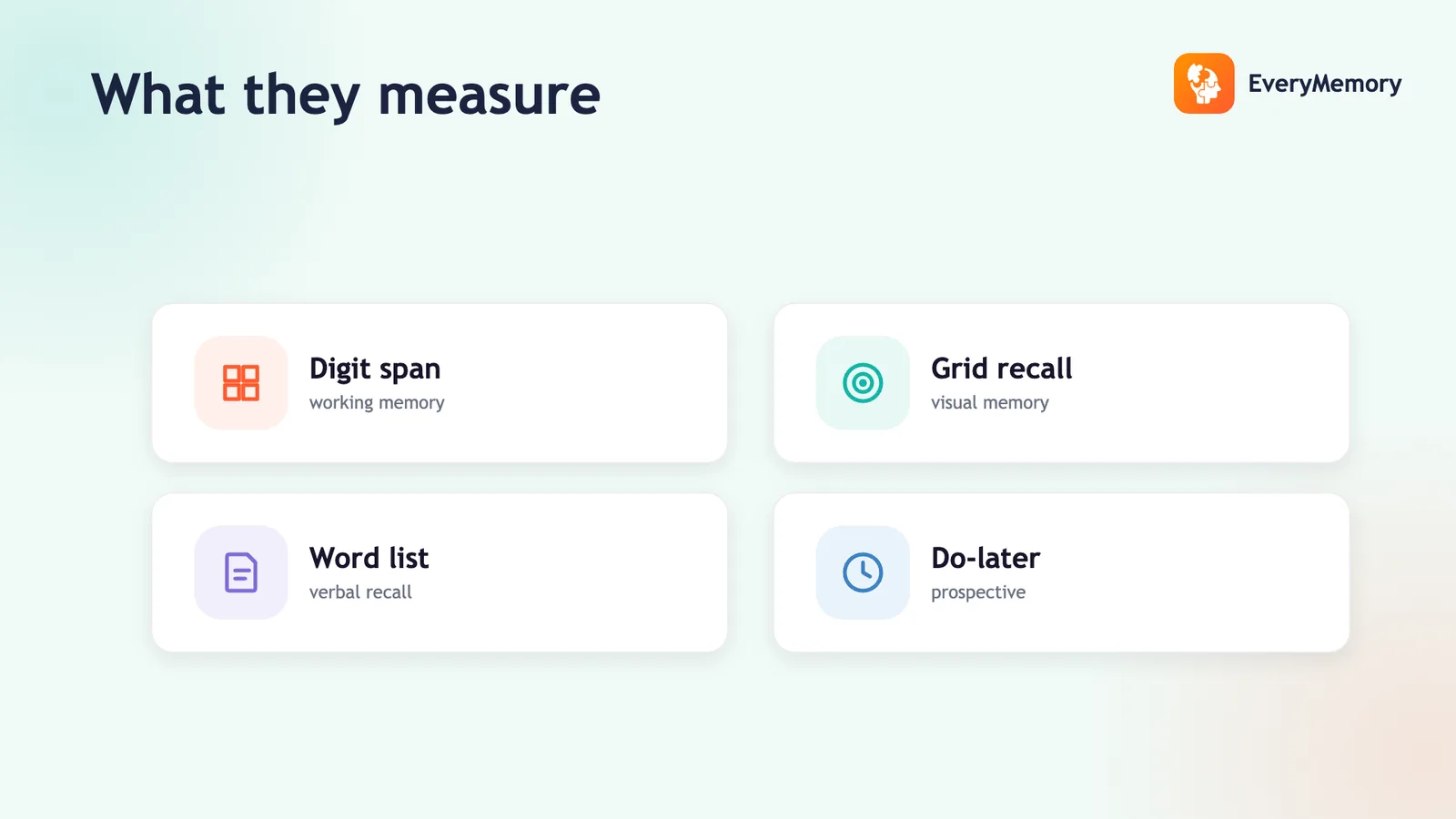
⚡ Quick answer
Most memory quiz questions come from a small set: digit span (short-term memory), backward span and n-back (working memory), grid and pattern recall (visual-spatial memory), word lists (verbal memory), and spot-the-change (attention to detail). Each targets a different system, which is why a good quiz mixes several rather than repeating one type.
Key takeaways
- Most quizzes reuse a small set of question types across different skins.
- Forward span tests short-term memory; backward span and n-back test working memory.
- Visual tasks and word lists tap different systems, so one score can mislead.
- Trivia and illusions aren't real memory questions; encoding-and-recall tasks are.
Memory quizzes look varied, but most reuse the same handful of question types under different skins. Once you know what each is measuring, the whole quiz makes more sense - and you can tell a serious task from a gimmick.
Here's a tour of the common memory quiz questions and exactly which memory each one tests.
The main question types at a glance
| Question type | What you do | What it measures |
|---|---|---|
| Digit span (forward) | Repeat a number sequence in order | Short-term memory |
| Digit span (backward) | Repeat a sequence in reverse | Working memory |
| N-back | Flag when an item matches one N steps earlier | Working memory, attention |
| Grid / pattern recall | Reproduce a lit-up tile pattern | Visual-spatial memory |
| Word list recall | Recall a list of words after a delay | Verbal / episodic memory |
| Spot the change | Find what altered between two scenes | Attention to detail |
| Match the pairs | Find matching cards from memory | Visual recognition, location |
Span tasks: forward vs backward
Forward digit span asks you only to hold a sequence and repeat it - pure short-term memory. Backward span asks you to hold and reverse it, which adds manipulation and pushes into working memory. That small change is why your backward span is usually shorter than your forward one. The gap between the two is itself informative (the difference explained).
Visual and verbal questions test different systems
Grid recall, match-the-pairs, and spot-the-change lean on visual-spatial memory; word lists and name recall lean on verbal memory. These can come apart - you might ace the grid and stumble on the word list. That's why a single "memory score" can mislead, and why picture quizzes and word quizzes aren't interchangeable. See types of memory explained for the full map.
Spotting a gimmick question
Some quiz "questions" measure little: trivia you either know or don't, optical illusions, or anything that hands you a confident percentile from one tap. Real memory questions ask you to encode something fresh and reproduce it after a delay. If a question doesn't do that, it isn't testing your memory - it's filler.