 EveryMemory
Mood and Memory
How you feel quietly shapes what you notice and recall - low mood narrows attention while a lighter mood widens it, and that has real effects on everyday memory.
Part of the guide: How to Keep Your Brain Healthy: A Complete Lifestyle Guide →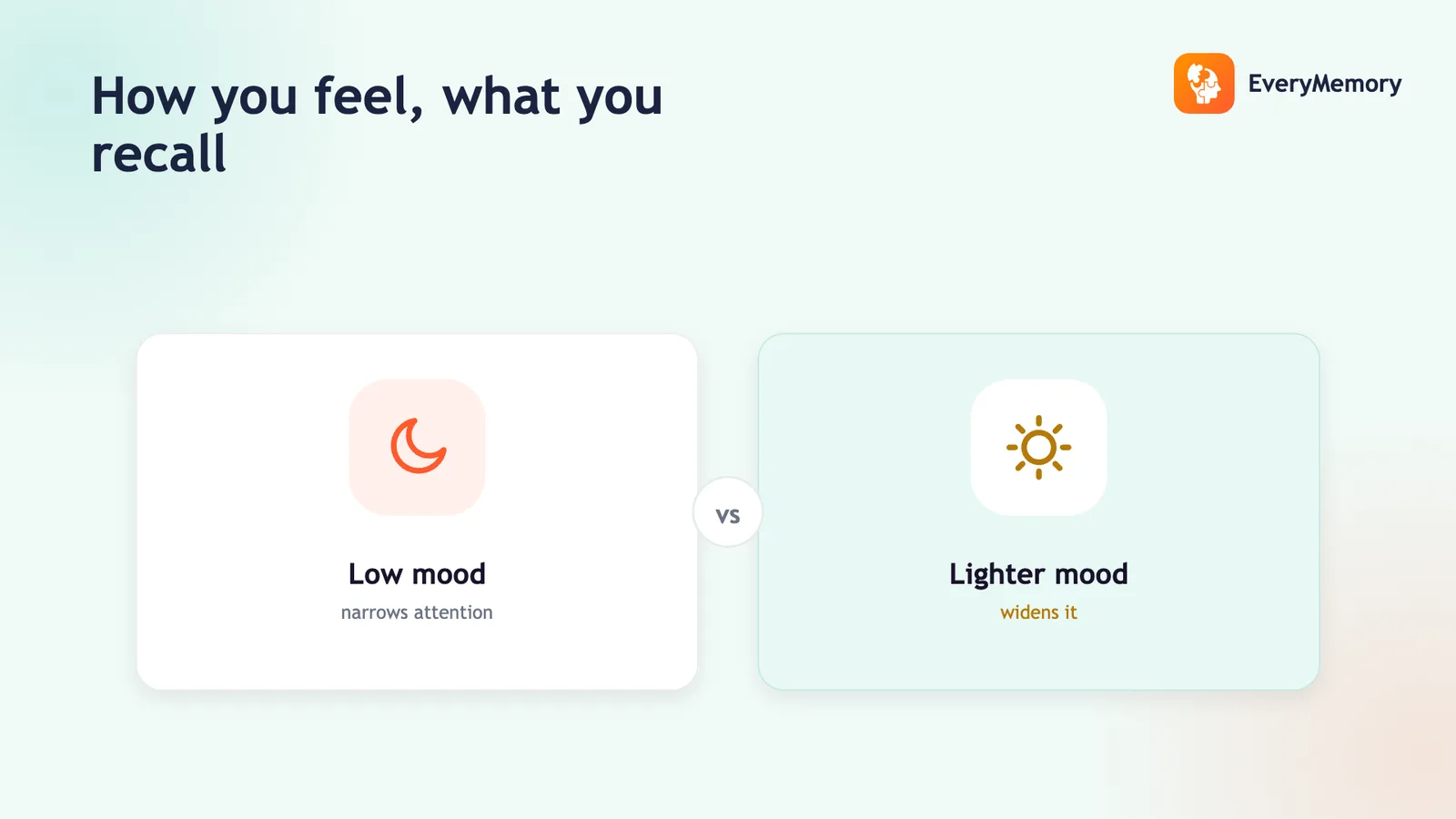
⚡ Quick answer
Mood shapes memory mainly through attention. Low mood narrows and turns focus inward, so you notice fewer details and recall feels slow and effortful - and you may dwell on negative memories. A lighter mood widens attention and makes remembering easier. Most mood-related forgetfulness eases as mood improves; persistent low mood is worth discussing with a professional.
Key takeaways
- Low mood narrows and turns attention inward, so fewer details get encoded.
- Mood-congruent recall surfaces gloomy memories on flat days, exaggerating how things feel.
- Daylight, movement, sleep, and connection support both mood and attention.
- Persistent, severe, or distressing low mood should be discussed with a professional.
Memory doesn't run on a fixed, neutral setting - it bends with how you feel. When mood dips, attention tends to narrow and turn inward, and recall can feel slow and effortful. When mood lifts, attention opens back up and remembering feels easier. The brain hasn't changed; the conditions it's working under have.
Seeing this link clearly takes some of the worry out of a foggy patch. Much of what looks like a failing memory during a low stretch is really a mood-shaped change in attention - and that tends to lift as the mood does.
How mood steers attention
Low mood tends to pull attention inward, toward your own thoughts, and to narrow the spotlight. With less attention reaching the outside world, fewer details get encoded - so the meeting, the name, or the instruction was never fully taken in. It reads as forgetting, but it started as not-noticing.
A lighter, more relaxed mood does the opposite: attention broadens, you take in more, and recall flows more easily. This is why the same task can feel sharp on a good day and sludgy on a flat one - without any real change in your memory.
Mood-congruent memory
Mood also colours which memories surface. When you feel low, the brain finds low-toned memories more readily; when you feel good, brighter ones come to mind. This mood-congruent effect can make a flat day feel like proof that everything's going wrong, when really your recall is just matching your mood.
Knowing this is oddly freeing. A rush of gloomy memories on a bad day isn't a verdict on your life - it's a temporary tilt that rights itself as mood lifts. For the related role of worry, see worry and forgetfulness.
Mood states and what you notice
Matching the state to its everyday effect makes the pattern easier to spot in yourself - and easier not to over-read.
| Mood state | Likely effect on memory & focus |
|---|---|
| Low or flat | Narrowed, inward attention; slow, effortful recall |
| Anxious or worried | Attention split by the worry loop; details slip past |
| Calm and content | Broad attention; easier encoding and recall |
| Energised and curious | Sharp focus; new information sticks more readily |
Supporting mood in everyday ways
The everyday levers that lift mood are the same ones that support attention: daylight, movement, sleep, connection, and small enjoyable wins. None of this is a treatment - it's just looking after the conditions your memory works best in. Be patient with a flat patch rather than reading it as decline.
And the honest line that matters most here: low mood that's persistent, severe, or distressing isn't something to push through alone. Please talk to a doctor or qualified professional. For keeping engaged in lighter ways, see keep your brain active.
✅ Try this today - A small mood-and-attention lift
A short routine for a flat day, aimed at gently widening attention.
- Step outside for ten minutes of daylight and a little movement.
- Notice three small, neutral things around you - colours, sounds, textures.
- Do one easy, finishable task to bank a quick win.
- Message one person, even briefly, to break the inward pull.
- Go easy on yourself: a flat day is a passing condition, not a verdict.
⚠ When to talk to a professional
This is general wellbeing information about everyday mood, not medical advice and not a treatment for depression or any condition. If low mood is persistent, severe, or distressing, please talk to a doctor or qualified professional.