 EveryMemory
Pattern Memory Exercise
Recognising and rebuilding visual, number, and sequence patterns sharpens the part of memory that keeps everyday life organised and predictable.
Part of the guide: Brain Exercises for Seniors: The Complete Guide →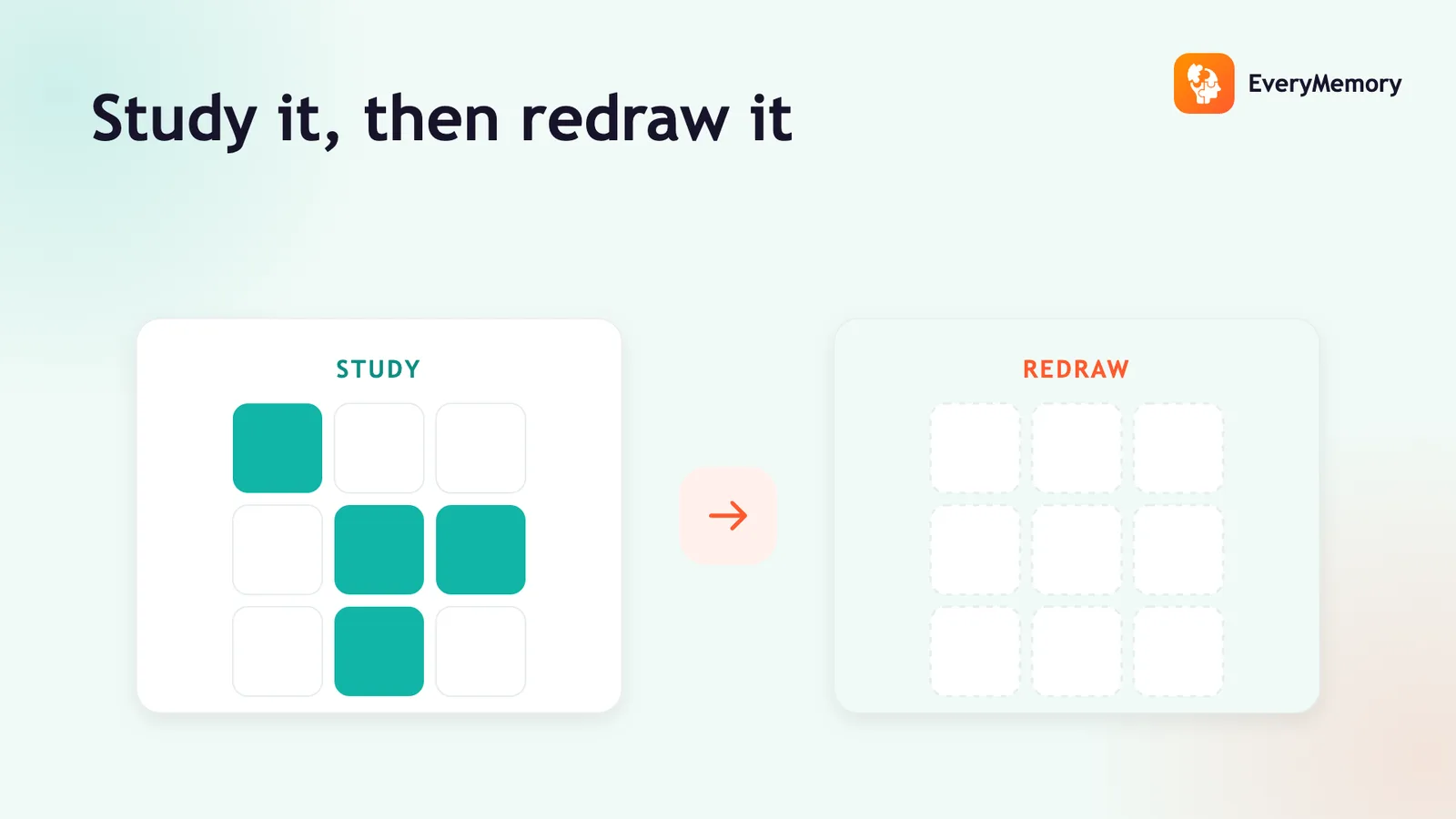
⚡ Quick answer
A pattern memory exercise asks you to study a visual, number, or sequence pattern, look away, and then recreate or continue it from memory. Repeating short drills like these several times a week trains the part of working memory responsible for holding and manipulating ordered information, which supports recall for things like directions, routines, and multi-step tasks.
Key takeaways
- Pattern drills train the visual-spatial working memory by asking you to study a grid, number sequence, or shape chain and then recreate it from memory.
- Practising patterns also builds chunking - grouping items into single units - which is why phone numbers and PINs feel easier to hold.
- Three to four short sessions a week (two to five minutes each) is enough to see measurable progress within two to three weeks.
- Rotating across grid, number, and shape drills gives a more rounded workout than repeating just one pattern type.
Have you ever memorised a PIN by noticing the shape your fingers trace on the keypad, or found a familiar route easier to remember because of a repeated landmark pattern? That is pattern memory at work - the brain's ability to detect, hold, and rebuild a sequence of visual or numerical information.
Pattern memory exercises target exactly this skill. They are short, screen-free drills that ask you to observe a pattern closely, hold it in mind, and then reproduce or continue it. With regular practice they can help strengthen the kind of working memory that keeps everyday routines feeling smooth and predictable. This guide gives you a full set of drills, explains why they work, and shows you how to make them easier or harder as you improve.
What pattern memory actually is
Working memory has a visual-spatial component - a mental sketchpad that holds images and spatial relationships just long enough to use them. Pattern memory drills load that sketchpad deliberately. Instead of waiting for life to supply a pattern to remember, you practise the mechanics of observing, encoding, and retrieving in a controlled, repeatable way.
This kind of practice complements other recall work. If you already do a 10-minute memory workout for beginners, adding a short pattern drill gives your brain a different kind of encoding challenge - spatial and sequential rather than purely verbal.
The three main pattern types each stress memory slightly differently: visual grid patterns (where things are), number sequences (what comes next), and shape or colour sequences (order and identity combined).
Why pattern drills support everyday memory
Everyday tasks that feel "automatic" often run on implicit pattern memory: the sequence of steps to make your morning coffee, the layout of a familiar supermarket aisle, the way a signature feels. When working memory is well-practised, these sequences load quickly and stay stable under distraction.
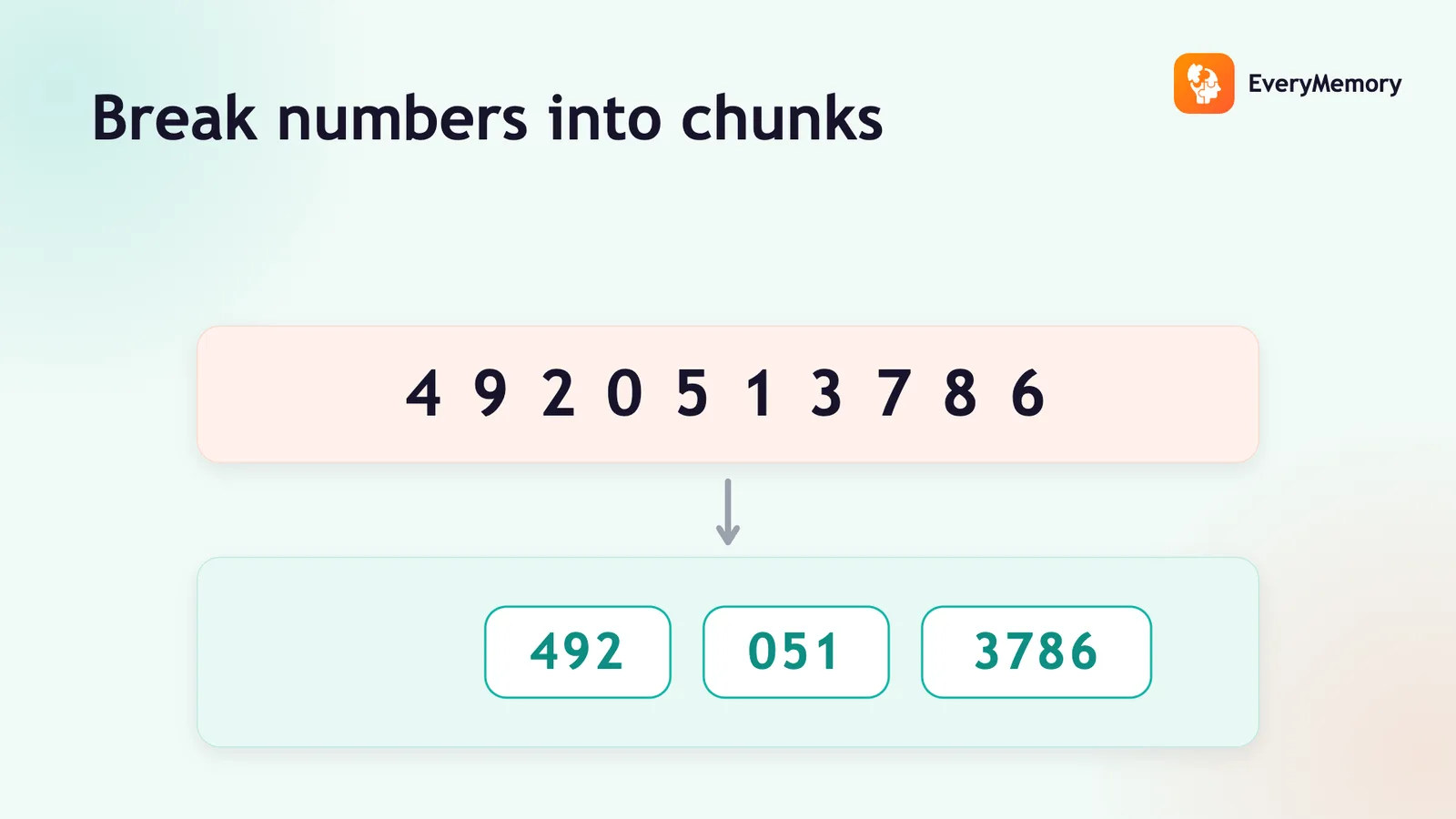
Pattern drills also build what researchers call chunking - grouping pieces of information into a single unit so that four items feel like one. A phone number is easier to remember as three chunks than as ten digits. Practising patterns trains this grouping habit. You will find a full explanation of chunking in our chunking technique guide.
There is also an attention benefit. Noticing a pattern requires sustained focus on detail, which is the same skill that keeps you from losing track mid-conversation or missing a step in a recipe.
Three core pattern memory drills
Each drill below takes two to five minutes. You need only a pen and paper - or a printed grid if you prefer.
- Grid copy-and-recall. Draw a 4x4 grid and shade 6 random squares. Study it for 20 seconds, then turn the paper over. On a blank grid, try to shade the same squares. Check your work. Start with 6 squares and work up to 10.
- Number sequence extension. Write a short sequence: for example, 3 – 6 – 9 – 12 – ___. Cover it and recall both the rule and the next number. Use arithmetic patterns at first (add 3, double, subtract 2), then try alternating rules (add 2, add 5, add 2, add 5).
- Shape chain recall. On a strip of paper, draw 5 shapes in a row (circle, square, triangle, circle, star). Study for 15 seconds, cover, and redraw the chain from memory. Advance to 7 shapes, then add colour as a second attribute.
These three drills cover visual-spatial, numerical, and combined encoding. Rotating through all three across a week gives a more rounded workout than repeating just one.
Easier and harder variations
Every drill can be scaled to your current level. Starting too hard leads to frustration; staying too easy means no meaningful challenge. Both extremes stall progress.
- Easier: reduce the grid to 3x3; use sequences of 3 items; give yourself 30 seconds of study time instead of 15.
- Easier: allow yourself one quick peek if you get stuck, then try again from scratch.
- Harder: reduce study time to 10 seconds; add a 30-second distraction task (count backwards from 50) before recalling.
- Harder: use two grids and recall both after one combined study period; extend sequences to 8+ items.
- Harder: add a second attribute to grids - shaded squares must also be labelled with a letter, and you recall both position and letter.
A useful rule: if you are getting more than 80 percent of items correct across three sessions in a row, add one step of difficulty. If you are below 50 percent, step back. The goal is to work just at the edge of comfortable.
How to track progress and stay consistent
Tracking does two things: it shows you genuine improvement over time, and it prevents the common habit of quietly making drills easier when they feel hard. Both are important.
Keep a simple log - date, drill type, number of items attempted, number correct. After two weeks you will almost certainly see a line moving upward, which is motivating in a way that vague effort rarely is. Our printable memory tracker for older adults has a ready-made grid for exactly this.
For consistency, attach pattern drills to something you already do every day - morning coffee, an after-lunch rest, or the few minutes before an evening programme. Habit pairing is more reliable than willpower. More on building that rhythm is in our guide on how to build a memory training habit.
Aim for three to four short sessions a week rather than one long one. Distributed practice is more effective for memory than massed practice - your brain consolidates during the gaps.
✅ Try this today - The 4x4 grid drill
Try this right now - no preparation needed:
- Draw a 4x4 grid on any scrap of paper. Shade 6 squares in any pattern.
- Study your grid for exactly 20 seconds, then flip the paper face down.
- On a second blank 4x4 grid, shade the squares you remember. Flip the original back and check. Note your score and repeat tomorrow.