 EveryMemory
Visual Memory Training for Older Adults
Visual memory exercises help older adults sharpen spatial recall, remember faces and places, and notice fine details. Here are the best drills and how to do them daily.
Part of the guide: Brain Exercises for Seniors: The Complete Guide →
⚡ Quick answer
Visual memory training means practising the deliberate encoding and recall of images, patterns, or spatial arrangements. You study a scene or a set of objects, look away, and then try to reconstruct what you saw. Done daily in short sessions, this strengthens the brain's visual storage and retrieval pathways, which supports everyday tasks like remembering faces, finding misplaced items, and navigating familiar routes.
Key takeaways
- Visual memory training means studying a scene or set of objects, then looking away and describing it in detail from memory.
- Active reconstruction - rebuilding a mental image without looking - strengthens visual memory more reliably than simply looking again.
- Five minutes of daily practice typically produces a noticeable lift in recalled details within one to two weeks.
- The habit of deliberate observation built by these drills carries over into everyday life, supporting tasks like remembering where things were placed.
Visual memory is the ability to hold and recall what you have seen - the layout of a room you visited once, where you left your keys, the face of someone you met briefly, the route you drove last week. It is a quiet, everyday skill that does enormous practical work. When it starts to feel unreliable, it shows up as misplaced objects, wrong turns in familiar places, and faces that refuse to connect to names.
The good news is that visual memory is highly trainable. The brain responds to regular visual recall practice the same way it responds to word-based drills: with stronger, faster retrieval pathways. You do not need any special equipment. A few focused minutes a day, done consistently, are enough to see real change within a few weeks.
Watch the guided session
What visual memory training is
Visual memory works differently from verbal memory. Instead of encoding words and sounds, your brain captures spatial arrangements, colours, shapes, and the relationship between objects. When you walk into a room looking for your glasses, you are running a visual search powered by a stored mental image of the last place you remember seeing them.
Training this system means giving it regular, deliberate practice: look at something, look away, try to recall it with precision. The challenge is not recognition ("yes, I've seen that before") - it is free recall ("I can describe exactly what I saw without any prompts"). That distinction matters because free recall is what you need in real life.
Visual training pairs naturally with other memory work. If you are already doing a simple daily memory routine, adding a two-minute visual drill keeps the session varied and covers a different part of memory than word lists alone.
Why visual memory exercises work
When you actively try to reconstruct a scene from memory - rather than simply looking at it again - you force the brain to search its own stored representation. That search process strengthens the underlying memory trace each time. Brain training researchers call this active reconstruction, and it is one of the most reliable ways to improve recall.
Visual drills also train sustained attention. To encode a scene well enough to recall it later, you need to pay deliberate, careful attention while you are looking - not just glance. That focused observation habit carries directly into everyday life: you become more likely to actually notice where you put things, rather than placing them on autopilot.
Regular visual practice also supports remembering names and faces, since faces are fundamentally visual memories. The same encoding skills - slowing down, picking out distinctive features, linking details - apply to both.
The core visual recall drill: step by step
This drill takes about five minutes and requires nothing more than a magazine, a room in your house, or a photograph.
- Choose your scene. Open a magazine or newspaper to any photograph. Or stand in a room in your home, or pick up any object from your desk.
- Study it for sixty seconds. Look deliberately. Name things to yourself: "Blue vase on the left. Two books stacked on top of each other. Red candle on the right." Do not rush.
- Look away or close your eyes. Take a slow breath. Give yourself thirty seconds to let the image settle.
- Describe it from memory. Speak or write a description as detailed as you can manage. Include colours, positions, sizes, and any relationships between objects.
- Compare and score. Look back at the scene. Count how many distinct details you got right. Write the date and number in a small notebook.
- Repeat with a fresh scene the next day. Using a different image or a different room each time prevents you from memorising a single scene rather than training the skill itself.
How to make the drill easier or harder
The drill should feel like a mild stretch - achievable with effort, but not perfect on the first try.
- Easier: Use a very simple scene - one object on a plain background, or just two or three items. Give yourself a longer study time (ninety seconds). Immediately after looking away, whisper the details aloud before writing anything down.
- Harder: Use a busy photograph with many elements. Shorten the study time to thirty seconds. Wait five minutes before recalling, and do a different small task during the gap. Try to recall the positions of objects relative to each other, not just their names.
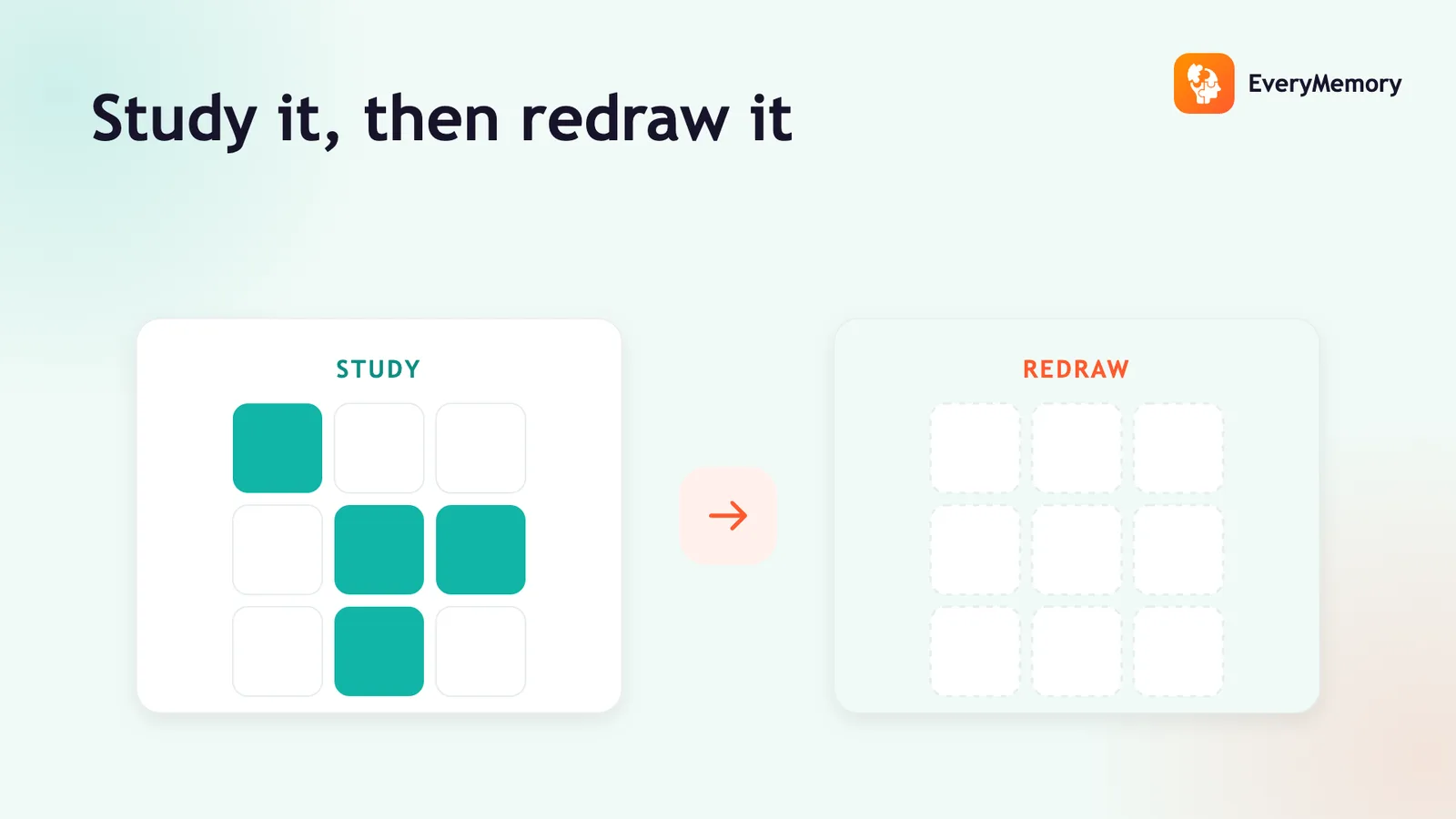
- Progression: Once you are consistently recalling eight or more details from a moderately complex scene, move to a pattern memory exercise - remembering the positions of shapes on a grid rather than objects in a photograph. This adds another layer of spatial challenge.
If you are helping an older parent stay mentally active, this drill works well together. One person describes the scene from memory; then you swap. Our guide on memory activities to do with an older parent has more ideas.
Building a daily visual memory habit
Five minutes a day is all this takes. The simplest approach is to attach the drill to a fixed daily moment: right after breakfast, before turning on the television in the evening, or alongside your morning coffee. Consistency over weeks is what builds lasting improvement - brief daily practice outperforms occasional longer sessions.
Track your scores in a notebook or use the weekly memory check-in template to spot upward trends. Most people notice more detail captured within ten to fourteen days. After a month, you will likely find you are more naturally observant - noticing where you put things and retaining the layout of new places. The 7-day memory training plan for beginners includes visual drills alongside verbal and attention exercises and requires no prior experience.
✅ Try this today - The kitchen counter recall drill
Try this version right now using whatever room you are in:
- Look around the surface nearest to you - a table, counter, or desk. Study it carefully for sixty seconds. Silently name every object you can see, noticing colours and positions.
- Walk into the next room or turn to face away. From memory, write down or speak aloud every object you noticed, including its colour and rough location.
- Return and compare. Count the details you got right and the details you missed. Write today's date and your score. Tomorrow, use a different surface or a photograph from a magazine and see if your score improves.