 EveryMemory
How to Build a Memory Training Habit
Starting a memory training habit is easy. Keeping it going past week three is the real challenge. Here is a practical framework that works for adults 55+.
Part of the guide: How to Improve Your Memory: The Complete Beginner's Guide →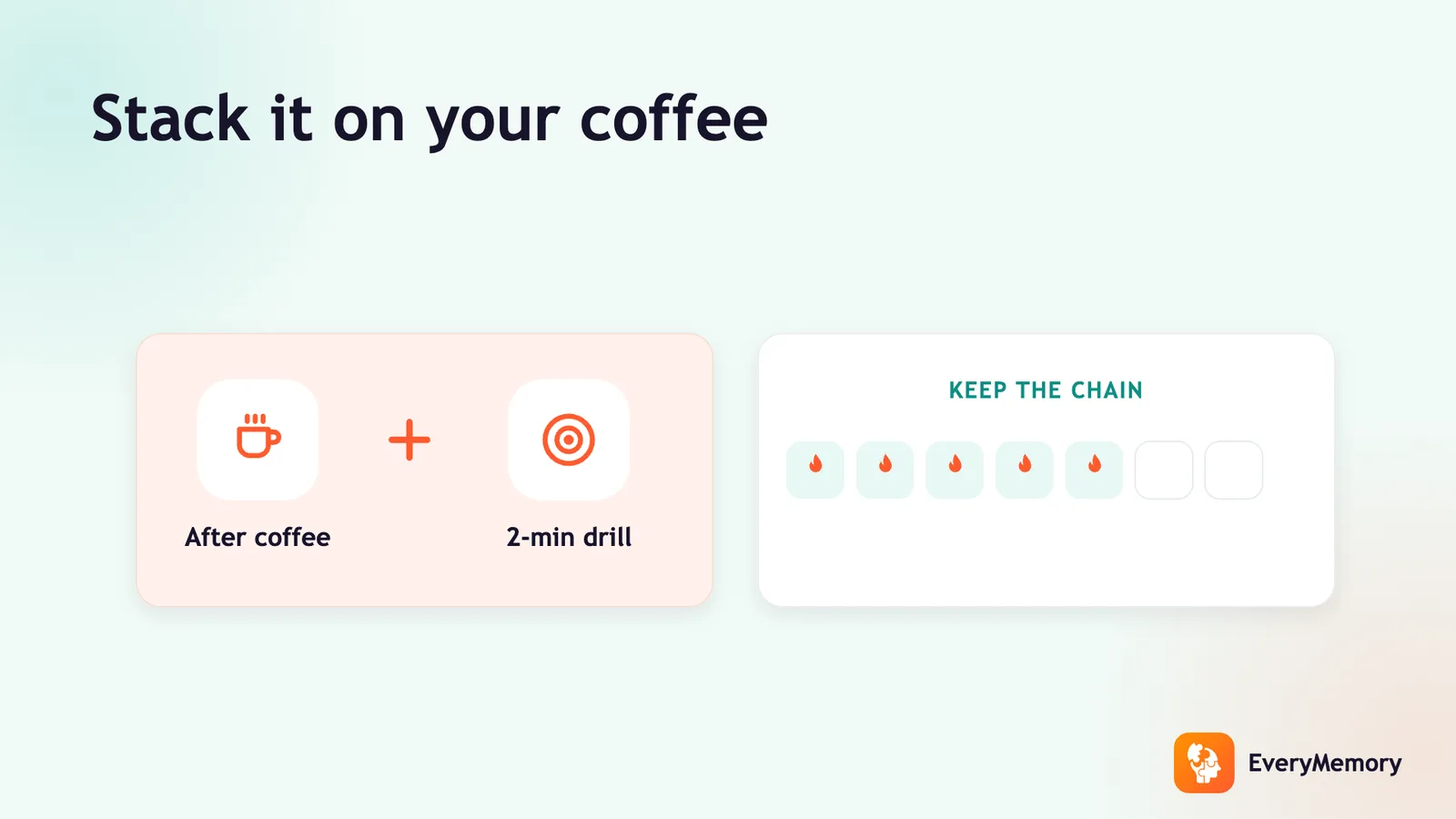
⚡ Quick answer
To build a memory training habit, start with five minutes a day rather than twenty, attach it to something you already do reliably, make success the default by keeping materials ready, and track completion rather than performance. Most habits become automatic around day eighteen to twenty-one. The goal is to reach that window without a long break.
Key takeaways
- Start by defining the smallest possible version of your habit - just 5 minutes - so you can succeed even on hard days.
- Attaching practice to a reliable anchor, such as making morning coffee, removes the need to rely on willpower.
- Tracking completion with a simple X on a calendar is more effective than tracking performance in the first month.
- Planning a break protocol in advance - resume tomorrow after one missed day - stops guilt from derailing the habit entirely.
There is a pattern that almost everyone who tries to improve their memory follows. Week one feels great - motivated, consistent, noticeably engaged. Week two gets a little ragged. By week three, the routine has quietly dissolved into the background noise of a busy life, and the intention has become another item on the long list of things to return to someday.
The problem is almost never motivation or willpower. It is design. Most people try to start a memory training habit the way they would start a project - with enthusiasm and a vague plan - rather than the way a habit actually forms: through structure, repetition, and a system that survives difficult days. This guide gives you that system.
Why most memory routines fail after week two
Habit researchers generally agree that new routines fail at a predictable point: when the initial motivation fades and the habit has not yet become automatic. The first week runs on novelty and resolve. Week two runs on fading novelty. If the routine is not yet automatic by week three, there is nothing left to carry it through a difficult Thursday.
Three specific design problems make memory habits especially fragile. First, people start too ambitious - a 30-minute daily session is exciting on day one and exhausting by day ten. Second, the routine requires decision-making (when? what exercise? for how long?) instead of just execution. Third, there is no visible record of progress, so the habit feels arbitrary when motivation drops.
All three problems are fixable. The solutions are not motivational - they are structural.
Step one: define the smallest possible version
Before you choose any specific exercises, define the minimum version of your habit - the version you can do on the worst possible day. This is not your ideal session; it is your floor.
For most people, the floor is: one recall exercise, five minutes, sitting wherever you normally sit in the morning. That is it. If you can do more, great. But the habit is defined as the floor, not the ceiling. On a hard day, hitting the floor is a win.
This matters because an unbroken streak is more valuable than occasional long sessions. A streak of 14 days at five minutes produces better habit formation than six days at 30 minutes followed by a week off. See the exercises outlined in 10-minute memory workout for beginners for easy floor-level options.
Step two: stack the habit on an anchor
A habit anchor is an existing behaviour you do reliably every day without thinking. Morning coffee, brushing teeth, sitting down for breakfast - these happen automatically. The goal is to attach your memory practice to one of these anchors so tightly that the anchor becomes a trigger.
The formula is simple: "After [anchor], I will [memory habit]." For example: "After I make my morning coffee, I will sit and do five minutes of memory practice." The anchor does not carry the habit - it just cues it at a reliable time every day.
Pick an anchor that already happens at roughly the same time and place each day. The more stable and predictable the anchor, the more reliably it fires the new habit. Our guide on morning brain routine for seniors is built around exactly this approach.
Step three: remove all friction
Friction is any small obstacle that stands between you and starting. Having to find your notepad, download an exercise, or decide what to do today - each of these adds two or three seconds of resistance, and at low-motivation moments that resistance wins.
Eliminate friction before you need to overcome it:
- Leave a notepad and pen in your anchor spot. Do not put them away after each session.
- Write this week's exercise schedule on a sticky note on the notepad cover - no decisions required in the morning.
- If you use an app, put it on your phone's front screen so there is no hunting.
- Prepare word lists or exercise sheets the night before, not the morning of.
These steps feel almost absurdly small, but they work. The five seconds you save on friction removal is often the five seconds that decides whether you start or drift to something else.
Step four: track completion, not performance
The most common tracking mistake is measuring how well you did - how many words you recalled, how fast you completed an exercise - rather than simply whether you showed up. Performance tracking is useful eventually, but in the first month it adds pressure that works against the habit.
Instead, keep a simple completion log. A small calendar on the fridge with an X on each day you completed your floor-level routine tells you everything you need to know: is the streak intact? Seeing a growing row of X marks is a quiet, satisfying reinforcement that costs almost nothing.
After four to six weeks of consistent practice, you can start tracking performance as well - how many words recalled, how you rate your focus. The weekly memory check-in template is a good format for this stage.
Step five: plan for breaks before they happen
A habit broken by an unexpected disruption - travel, illness, a family event - often never resumes. The solution is to plan the break protocol in advance rather than improvising.
Decide now: if you miss one day, you resume tomorrow without any catch-up. If you miss three days in a row, you restart from day one of a simplified version for one week before building back up. Having the rule in advance removes the guilt that leads to "I've already broken it, there's no point resuming."
Missing a day is not failure. Letting the habit disappear for two weeks because of the guilt of missing one day is the only real failure. The 30-day memory challenge is designed with exactly this kind of resilience built in - check it out if you want a structured guided version.
What the habit looks like at week six
By week six of consistent daily practice, the routine should feel unremarkable - not exciting, not burdensome, just a thing you do in the morning like brushing your teeth. That unremarkableness is the goal. Habits that feel dramatic are fragile; habits that feel ordinary are durable.
At this stage you can start adding variety and gentle challenge - longer exercise sessions, new exercise types, a structured week on tracking memory changes month by month. But none of that is necessary to start. Start with the floor.
✅ Try this today - The two-week habit starter
Use this protocol for the first fourteen days to build the foundation:
- Choose your anchor (morning coffee is ideal). Write it down: "After [anchor], I will spend five minutes on memory practice."
- Set out your materials tonight - notepad, pen, a simple word list - in the spot where you will sit tomorrow morning.
- After each day you complete the routine, put an X on a calendar. Your only goal for the first two weeks is an unbroken row of X marks.