 EveryMemory
The Pomodoro Technique for Focus
Short, timed focus bursts with real breaks between them can do more for concentration and recall than longer, unstructured sessions. Here's how to use the Pomodoro Technique - and adapt it for your pace.
Part of the guide: How to Improve Your Memory: The Complete Beginner's Guide →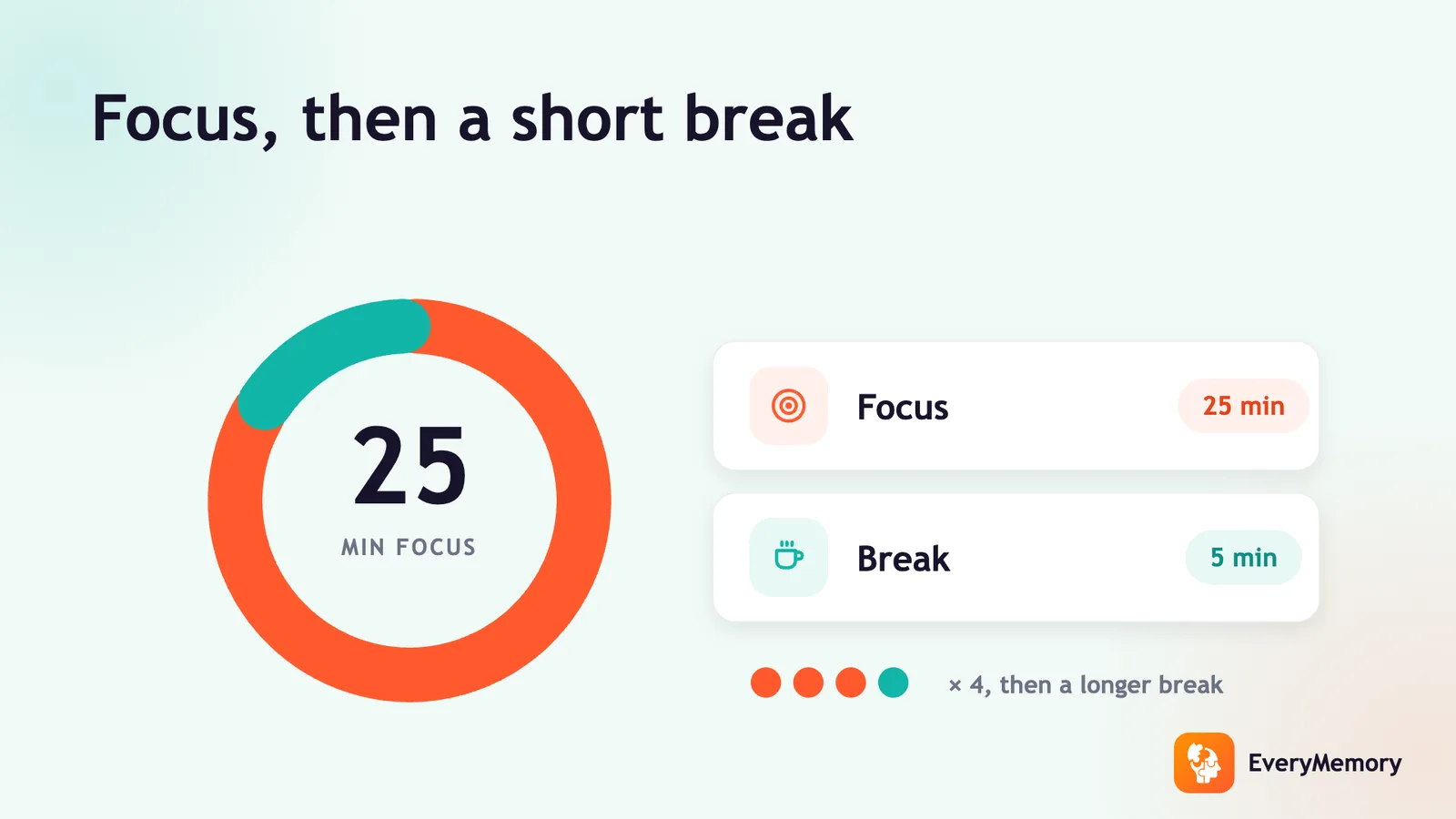
⚡ Quick answer
The Pomodoro Technique involves working with full attention for a short, fixed period - typically 25 minutes - then taking a 5-minute break. After four cycles, you take a longer break of 15 to 30 minutes. The structure helps sustain concentration, reduces mental fatigue, and improves what you actually retain from focused sessions.
Key takeaways
- Work on one task for a fixed period - 15 to 25 minutes - then take a genuine 5-minute break away from your desk before the next cycle.
- Shorter intervals of 15 or 20 minutes work just as well as the standard 25 minutes and are a better starting point if focus is harder to sustain.
- Breaks must be screen-free and physically active - standing, stretching, or a short walk - to give the attention system a real rest.
- Two fully focused Pomodoro cycles produce better recall and output than an equal or longer stretch of drifting, divided attention.
There's a common assumption that longer, uninterrupted work sessions are the most productive. In practice, the brain doesn't work that way. Sustained attention fades over time, and pushing through mental fatigue typically produces worse results - not better ones.
The Pomodoro Technique is a simple time-management method built around that reality. It uses short, timed periods of focused work separated by genuine rest breaks. For anyone working on memory exercises, learning, reading, or any task that requires concentration, it offers a surprisingly effective structure - and it adapts well to older adults who may prefer shorter intervals than the original format suggests.
How the technique works
The method was developed in the late 1980s as a practical way to manage attention and prevent the mental fatigue that comes from long, unfocused work periods. The name comes from the tomato-shaped kitchen timer the creator used as a student. The mechanics are deliberately simple.
- Decide on one specific task to work on.
- Set a timer for 25 minutes and work on only that task until the timer sounds.
- When the timer goes off, stop - even if you're mid-sentence or mid-thought.
- Take a 5-minute break. Stand up, move around, have a drink of water. Don't stay at the desk.
- After four cycles, take a longer break of 20 to 30 minutes before starting again.
The critical element is the timer. Having a defined endpoint does two things: it makes starting easier (25 minutes feels manageable even when motivation is low), and it creates a predictable rest, which means the brain can sustain fuller effort during the work period because it knows a break is coming.
Why timed focus bursts support attention and recall
The attention system has a natural arc within a focused session. In the first few minutes, the brain is settling in - engagement is building. In the middle of the session, focus is typically at its peak. Toward the end of a long session, attentional resources deplete and focus begins to drift. Information processed in that latter phase tends to be encoded less well.
Short focused bursts with real breaks interrupt that arc at the right point - before significant depletion occurs. The break allows mental resources to recover, so the next work period starts fresh rather than continuing on a diminishing return.
This has a direct effect on memory. Information engaged with during a genuinely focused period - without divided attention, without fatigue-driven drift - is encoded more deeply than information absorbed in a fatigued or distracted state. Using the Pomodoro Technique for memory practice, reading, or learning isn't just a productivity trick: it's a way to get more out of the same amount of time. Our focus and attention brain workout can be structured in Pomodoro intervals for exactly this reason.
Adapting the technique for older adults
The original 25/5 format works well for many people, but it's not a rigid prescription. There's nothing magic about 25 minutes specifically - the principle is what matters: concentrated effort followed by genuine rest, before fatigue builds significantly.
For older adults, or anyone finding the standard format difficult to sustain, shorter intervals often work just as well or better:
- 15/5 intervals: 15 minutes of focused work, 5-minute break. Effective for mentally demanding tasks like learning new material or working complex puzzles.
- 20/5 intervals: A middle ground that many people find easier to sustain than 25 minutes.
- 10/5 intervals: A good starting point if you're building back a concentration habit from scratch or working on tasks that require high intensity.
The key is to be honest about where your current sustained focus actually sits - then use the timer to extend it gradually over time, not to prove something by setting it too long. Starting comfortably and lengthening gradually is more effective than starting with an ambitious target and struggling through.
Making the break actually work
The quality of the break matters as much as its timing. A break spent scrolling a phone is not a mental rest - it's continued stimulation of the same attention system that's trying to recover. A useful break involves something physically different and mentally low-demand.
- Stand up and move - a brief walk to another room, a stretch, a look out the window.
- Have a glass of water. Mild dehydration has a measurable effect on concentration and is easily fixed.
- Do something physical and mindless: water a plant, rinse a dish, tidy something small.
- Avoid reading, screens, or anything that continues to demand focused attention.
After a genuine break, most people notice that returning to the task feels easier - the sense of mental freshness is real. Pairing quality breaks with a consistent memory training habit tends to make sessions more sustainable and the habit easier to maintain.
Applying Pomodoro to memory practice specifically
The technique is particularly useful for structured memory exercises, reading, and any learning task where you want to maximise retention. The concentrated, single-task nature of a Pomodoro session creates exactly the encoding conditions that support stronger recall: full attention, no competing input, active engagement rather than passive reception.
A practical approach for a daily memory practice session might look like this: one 15 or 20-minute interval on a memory exercise or reading, followed by a 5-minute break, followed by a second interval on something different. Total active practice time: 30 to 40 minutes, structured around two genuinely focused windows. That tends to produce better results than an hour of drifting in and out of focus.
If you want a ready-made framework, our simple daily memory routine is built around exactly this kind of structured, manageable session structure.
Common mistakes that undermine the technique
A few patterns consistently reduce how well this approach works:
- Not actually stopping at the timer. The impulse to keep going when you're in a flow is understandable, but the break is doing something - skipping it means the next interval starts at a lower baseline.
- Setting the interval too long. If you're consistently struggling through the last few minutes, the interval is too long for your current capacity. Reduce it without judgment.
- Treating the break as optional. The break is half the technique. An unbroken 90-minute session is not the same as three Pomodoro intervals.
- Multitasking during the focus period. One task, one timer. Splitting attention during the work period defeats the encoding benefit entirely.
Building it into a broader focus routine
The Pomodoro Technique works best as part of a broader approach to focus - one that also addresses when you do focused work, how much sleep you're getting, and whether background distraction in your environment has been reduced. The technique structures time; the other factors determine what your attention system has to work with.
If you want to track how your focus changes over time as you build these habits, our focus and attention brain workout provides a simple way to check in on your concentration regularly. Noticing improvement is motivating, and tracking it keeps the habit visible.
✅ Try this today - Your first Pomodoro session
Try one Pomodoro cycle today with a task you've been putting off.
- Choose one task to focus on - reading, a memory exercise, writing, learning something new. Set a timer for 15 or 20 minutes (or 25 if you're comfortable).
- Work on only that task until the timer sounds. If a different thought or task comes to mind, write it on a notepad and return to it after the break.
- When the timer goes off, set a 5-minute break timer, get up and move away from where you were working, and return only when the break timer sounds. Notice how your focus feels at the start of the second cycle compared to the first.