 EveryMemory
Supporting a Parent Through a Memory Assessment
When a parent faces a memory assessment, your role as a caring adult child is to be a steady, respectful presence - before, during, and after - without taking over.
Part of the guide: Helping a Parent With Memory Changes: The Complete Family Guide →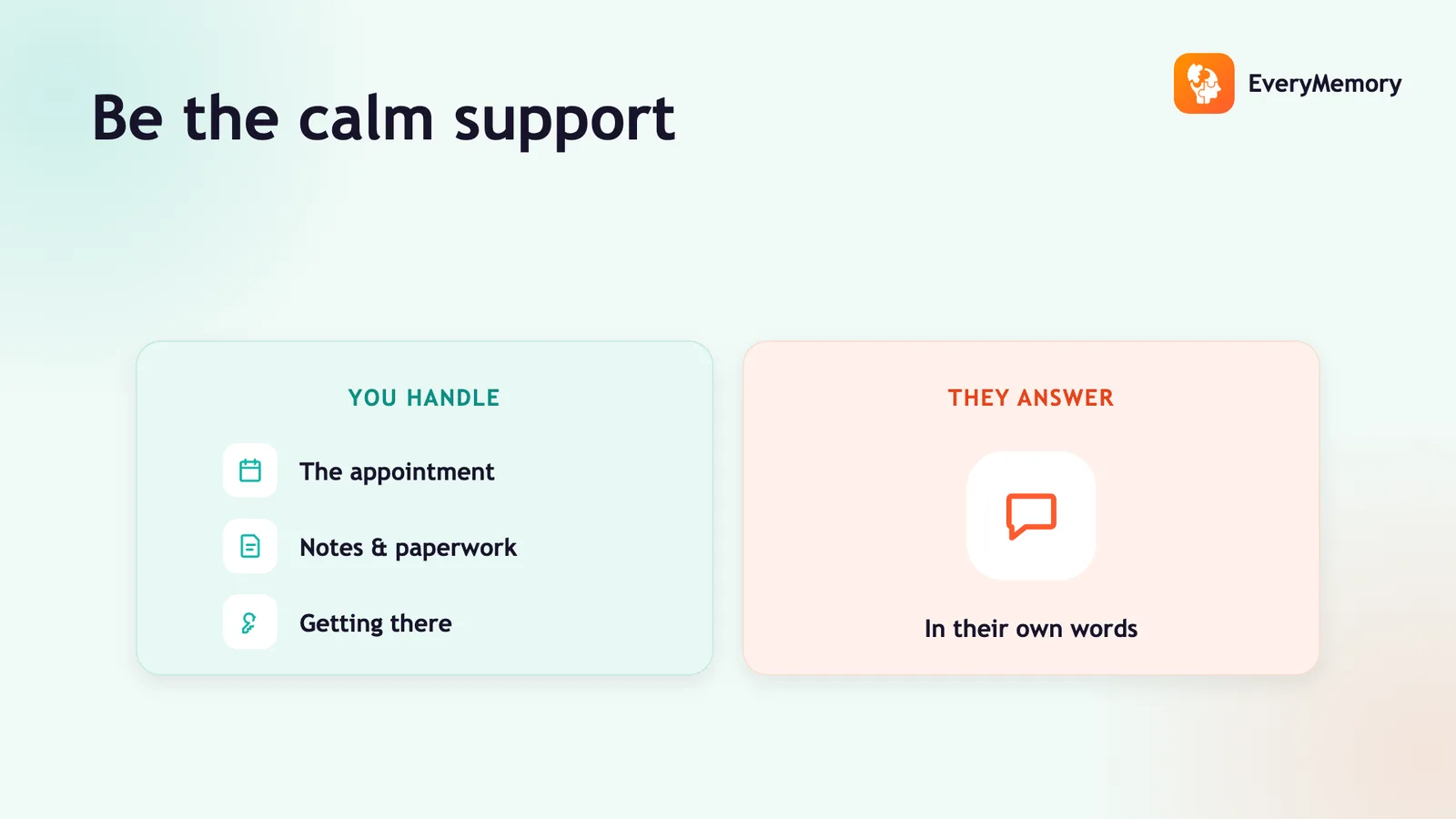
⚡ Quick answer
The most helpful thing you can do is handle the logistics quietly, show up as a supportive presence rather than a spokesperson, and let the professional lead the assessment. Before the appointment, prepare notes and a medication list. During it, offer information when invited rather than speaking over your parent. Afterwards, follow up gently whatever the outcome - and make sure your own worry has somewhere to go too.
Key takeaways
- Prepare a medication list and written observations before the appointment - quietly, so prep doesn't add to your parent's stress.
- During the assessment, be a supportive presence rather than a spokesperson - let the professional lead.
- Small acts of agency (where to sit, what to eat) preserve dignity when other parts of the day feel outside your parent's control.
- Your own worry deserves a place to go too - talk to someone, and don't carry the emotional weight of caregiving alone.
When you begin to notice changes in a parent's memory, one of the hardest steps is moving from private worry to actually getting them to a professional assessment. And then comes the next challenge: how to be genuinely helpful without making them feel managed, rushed, or stripped of control.
This guide is for the adult children in the waiting room - and in the car on the way there, and in the days that follow. It covers the practical preparation that makes the appointment more useful, the emotional navigation that keeps your relationship intact, and how to look after yourself through a process that can be quietly exhausting.
Encouraging the visit without pressure
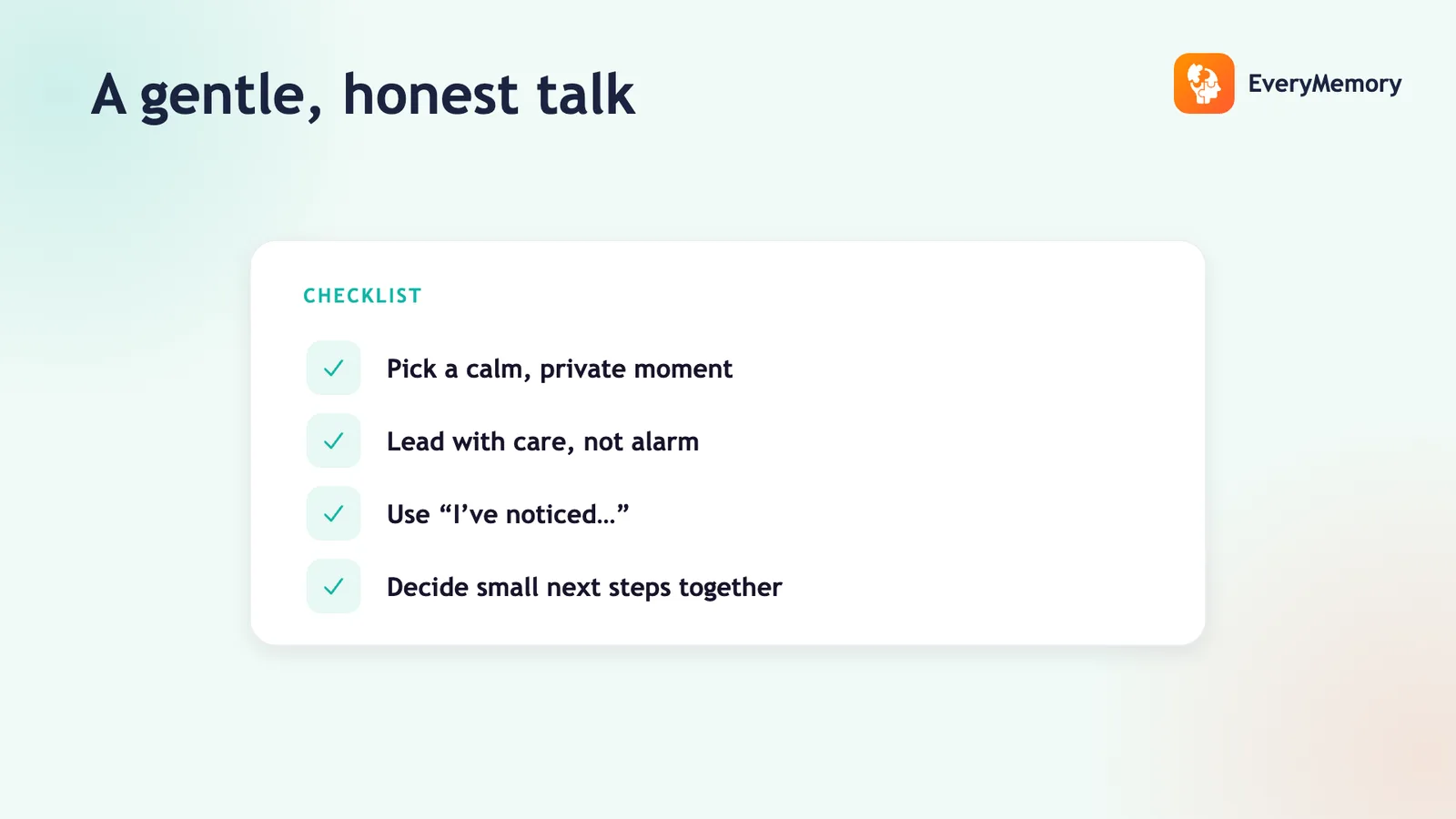
Many people resist the idea of a memory assessment because it feels like an accusation - as if going means admitting something is wrong. These fears deserve to be taken seriously rather than argued away. A gentler approach is to frame the visit around your parent's own priorities: feeling less foggy, sleeping better, having more energy. A professional check can explore many contributing factors - not just memory, but sleep, stress, and medication - and many of those are addressable. Our guide on how to talk about memory without scaring a parent has specific language for these conversations.
Choose a calm moment and keep it short. Plant the idea, leave it to settle, and return another day. Repeated gentle mentions tend to work better than a single urgent push.
Preparing practically before the appointment
The most useful thing you can do before the day is pull together information the clinician will need - and do it quietly, so the preparation itself doesn't become a source of stress for your parent.
- Current medication list: every prescription, over-the-counter medicine, and supplement, with doses. Bring the original bottles if that's easier.
- Brief notes on what you've observed and when - changes in memory, mood, sleep, or daily tasks. Keep them factual rather than alarming.
- Any recent health events: illnesses, falls, changes in sleep, or major life stressors.
- Practical logistics: transport, parking, and any aids your parent uses daily - glasses, hearing aids, mobility support.
If you have specific concerns you want the clinician to know about and your parent might not mention, it is worth writing these down and handing them to the receptionist or a nurse before the appointment - discreetly, so your parent doesn't feel talked about. Our article on what to track before talking to a doctor has a useful framework for organising this kind of information.
Being present at the appointment without taking over
This is the part that requires the most conscious effort. Your job in the appointment room is to be a calm, supportive presence - not a translator, advocate, or narrator. Your parent is the patient. The professional is there to talk with them, not to receive your summary. Clinicians will often turn to family members and ask what they've noticed - when that happens, answer honestly and specifically, and leave it there.
Try not to correct your parent during the assessment. If they say something that isn't quite right, resist the urge to jump in. The clinician is trained to observe how your parent communicates, and that includes how they handle questions under mild pressure. Well-meaning corrections can interfere with that process.
Bring a notepad. There may be information shared at the end that is worth recording - next steps, follow-up dates, or recommendations. Taking notes means neither of you has to rely on memory under the stress of the moment.
Respecting dignity and autonomy throughout
Memory assessments can feel infantilising, and your parent will be keenly aware of anything that suggests they are being handled rather than supported.
Talk to your parent, not about them, when in their presence - in the waiting room, during the appointment, and afterwards. If the clinician speaks to you instead of to your parent, gently redirect: "I think Mum would want to answer that." Give them as much choice as possible within the day: where to sit, when to take a break. These small acts of agency matter when other parts of the experience feel out of their control.
Whatever the outcome, they are still the same person. An assessment is a piece of information, not a verdict. For broader guidance on ongoing support, see how to help an aging parent with memory concerns.
Managing your own worry through the process
It is entirely normal to feel anxious before a parent's memory assessment. You may be carrying fears that have built up quietly over weeks or months. That anxiety is legitimate - but try to keep it separate from your parent's experience on the day. Your worry is yours to manage; their appointment is theirs to have. Make sure your feelings have somewhere to go outside the room, not into it.
Talk to someone you trust before and after. If siblings or other family are involved, share the weight - don't carry it alone. If the worry is persistent and affecting your sleep or daily life, take that seriously: caregiver stress is real, and your own wellbeing is not a luxury but a practical foundation for sustained support.
Following up kindly, whatever the outcome
The days after an assessment can feel suspended. If results are reassuring, your parent may feel relieved - or sometimes oddly deflated if their concerns weren't quite validated. If further evaluation is recommended, there may be a lot to absorb. Give them time to process before pressing for decisions. Ask how they're feeling before launching into next steps - the conversation you have that evening may be more useful than any planning conversation before it.
If follow-up appointments are suggested, offer to help arrange them rather than taking over. If a second opinion feels right to your parent, support it. And if the results were broadly positive, treat that as genuinely good news rather than rushing past it.
Whatever was found, the assessment itself was an act of courage. Acknowledging that - directly, to your parent - is one of the kindest things you can do. Our piece on what to expect at a memory check-up can also help both of you make sense of what the appointment involved and what any next steps might look like.
✅ Try this today - The pre-appointment preparation checklist
In the week before the appointment, work through this short checklist at your own pace.
- Write out a complete medication list - prescriptions, over-the-counter, supplements - with doses and frequency. Put it in an envelope in your bag so you don't have to search for it on the day.
- Write two to three specific, factual observations you want the clinician to have: what you've noticed, how long, and any patterns. Keep it to a page. Hand it discreetly to reception before the appointment.
- Plan something easy for after the appointment: a quiet lunch together, a familiar walk, or simply going home for tea. Give the day somewhere calm to land, for both of you.
⚠ When to talk to a professional
This article contains general, non-medical information and practical support guidance only. If you are concerned about sudden, rapid, or significantly worsening changes in a parent's memory or behaviour, seek prompt guidance from a qualified healthcare professional rather than waiting for a scheduled appointment.