EveryMemory
The Leitner Flashcard System: Low-Tech Spaced Repetition
The Leitner system turns a shoebox and a stack of index cards into a surprisingly powerful memory tool - here is how the box method works and why it still holds up.
Part of the guide: How to Improve Your Memory: The Complete Beginner's Guide →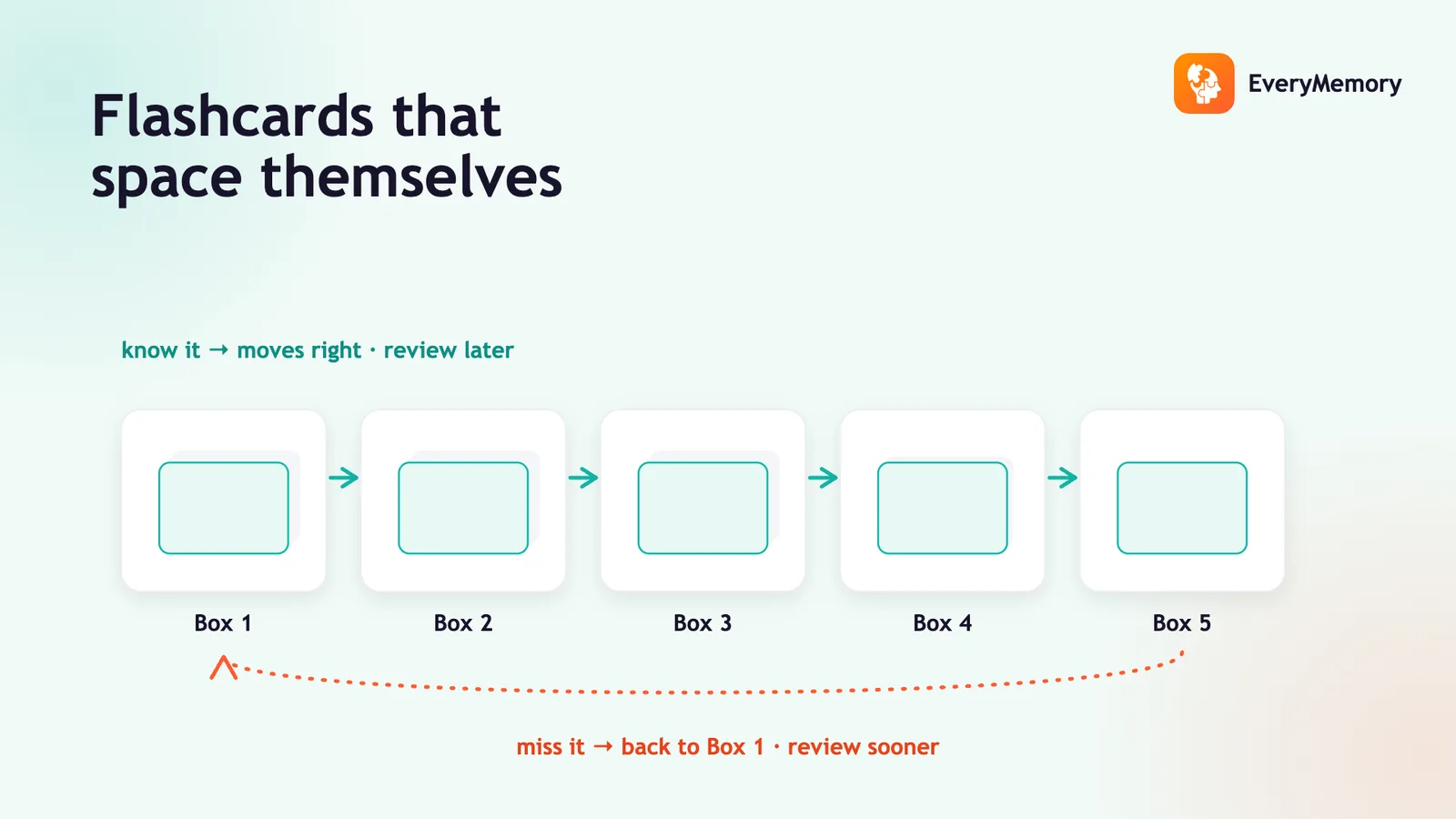
⚡ Quick answer
The Leitner system sorts flashcards into numbered boxes (or envelopes) based on how well you know each card. Cards in Box 1 are reviewed daily; cards in higher boxes are reviewed less often. Answer correctly and the card moves up to a longer interval; answer incorrectly and it drops back to Box 1. This built-in spacing means you spend more time on what you don't yet know and progressively less time on what you've already secured in memory.
Key takeaways
- The Leitner system sorts flashcards into boxes reviewed at increasing intervals - cards you know well are seen less often, cards you don't are seen every day.
- A five-envelope or shoebox setup takes about ten minutes to build and requires no app or special materials.
- It works especially well for vocabulary, names, and discrete facts - one clear prompt and answer per card.
- Writing cards by hand deepens encoding before the first review even begins, adding extra memory benefit to the setup itself.
Before smartphone apps, before algorithmic scheduling, there was a cardboard box. In the early 1970s, German science journalist Sebastian Leitner described a simple method for making flashcard study far more efficient than rereading the same stack every day. His insight: cards you already know well don't need to be reviewed as often as cards you keep getting wrong. Space your reviews to match how firmly each fact is held in memory, and you waste far less effort while retaining far more.
The Leitner system is a paper-based version of spaced repetition for everyday memory - built with nothing more than index cards, a few envelopes, and a consistent daily habit. For adults who find apps tiresome or who simply learn better with physical objects in hand, it remains one of the most practical memory tools ever devised.
What the boxes do and why the intervals matter
The system typically uses three to five boxes. Every new flashcard starts in Box 1, which you review every day. When you answer a card correctly, it moves up one box - to a longer review interval. When you answer incorrectly, regardless of which box the card was in, it returns to Box 1 and begins the cycle again.
A common five-box schedule looks like this:
- Box 1 - review every day
- Box 2 - review every other day
- Box 3 - review every four days
- Box 4 - review twice a week
- Box 5 - review once a week
A three-box version - daily, every two to three days, and weekly - works equally well for beginners and requires less tracking. The exact numbers matter less than the principle: each box represents a longer gap, and a wrong answer always resets the card to the most frequent review slot.
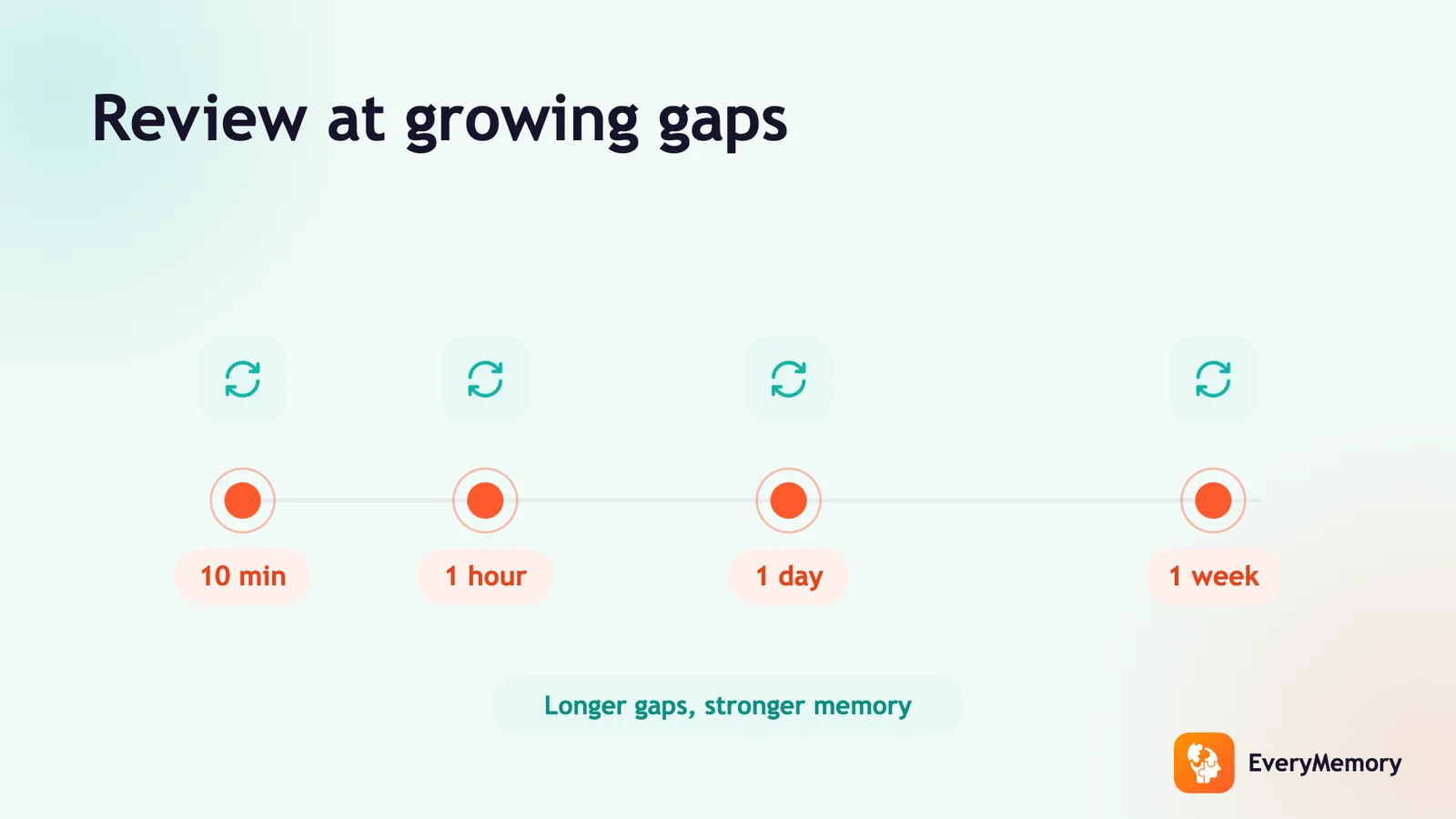
This structure embodies what memory researchers call the spacing effect - the finding that information reviewed at increasing intervals is retained far more durably than information reviewed repeatedly in quick succession. The Leitner system encodes that principle into a physical object, making the scheduling automatic.
Setting it up at home in about ten minutes
You do not need to buy anything. Here is a minimal setup that works well:
- Five envelopes or a divided shoebox. Label them 1 through 5. Envelopes are ideal because they are opaque and stack neatly in a drawer - cards stay sorted without any fuss. A shoebox with cardboard dividers works just as well if you prefer everything in one place.
- Index cards, or paper cut to a uniform size. Write the prompt on the front and the answer on the back. Keep cards short - one fact per card, no paragraphs. The goal is a single, clean retrieval attempt.
- A small calendar or a dated sticky note. Each box needs one marker: the next date you will review it. Updating this takes about thirty seconds per session.
Start with no more than twenty cards. Put them all in Box 1 and begin reviewing the next morning. Daily sessions of ten to fifteen minutes are enough to manage a working deck of fifty to eighty cards across all five boxes.
One practical tip: keep Box 1 small on purpose. If it grows beyond twenty cards, split the review across two short sessions. The active recall - actually trying to retrieve the answer before flipping - is what produces the memory benefit. Rushing defeats that.
What the Leitner system is especially good at
Not every type of learning suits flashcards, but several common memory challenges fit the Leitner format very well.
Vocabulary is the classic use case. Whether you are learning a foreign language, picking up new terminology, or simply building word-retrieval speed, individual word-meaning pairs are exactly what one card per concept handles well. For adults working on a second language, combining the Leitner system with the strategies in our article on how to remember new words and vocabulary makes for a particularly efficient practice.
Names and faces respond well to the same approach. Write a person's name on the back and describe a distinctive feature on the front. Review daily until familiar names migrate to later boxes - and when you meet that person again, retrieval feels noticeably easier.
Factual knowledge - dates, medication names, grandchildren's birthdays, a PIN - is straightforwardly suited to flashcards. Any discrete, two-sided fact can become a card. The system is a precision tool for this kind of material; for deeper conceptual understanding or procedural skills, other approaches work better.
The connection to writing by hand
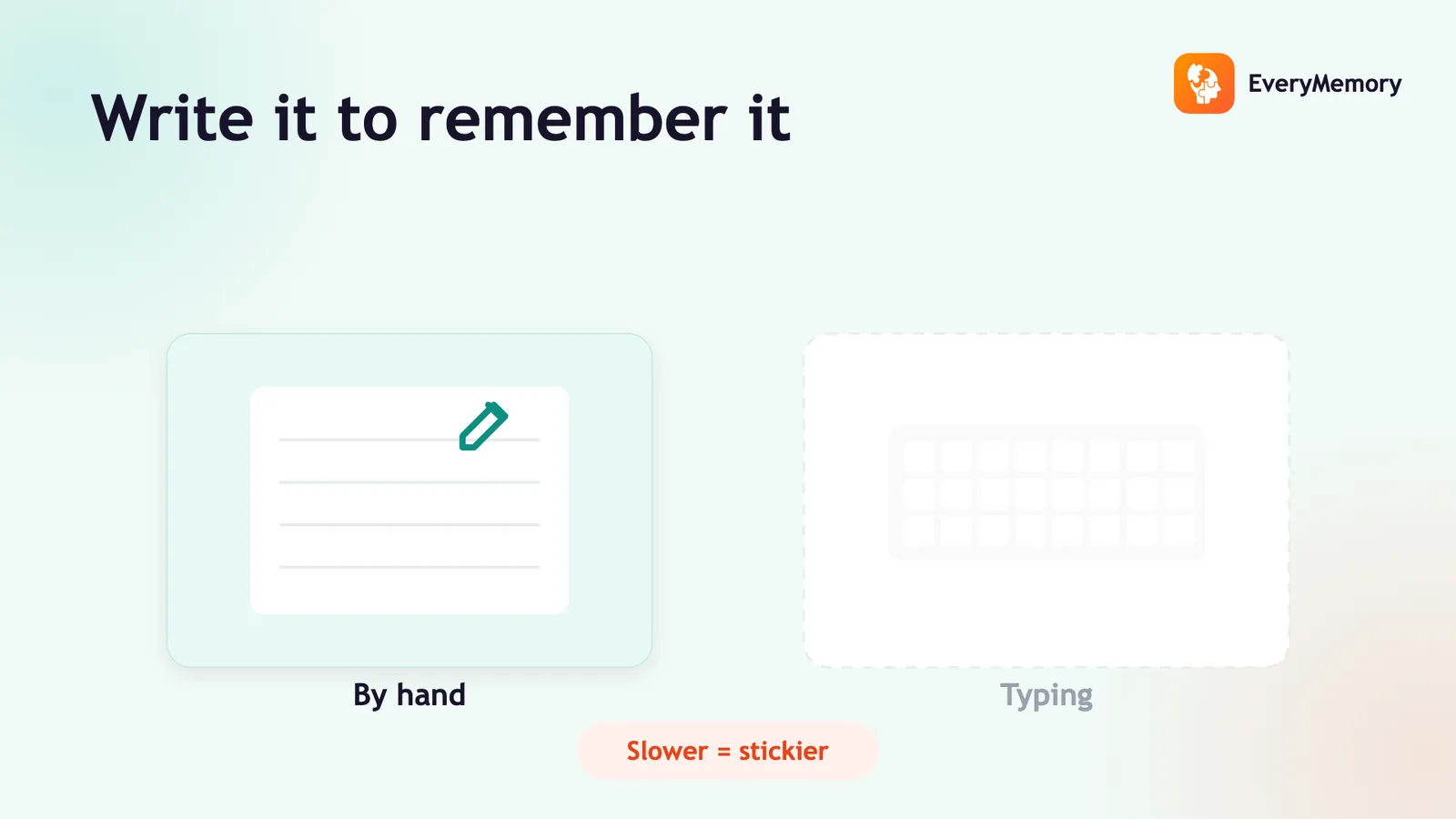
One often-overlooked aspect of the Leitner system is that it naturally involves writing the cards yourself. Research consistently shows that writing by hand and memory are linked: the slower, more deliberate nature of handwriting appears to produce deeper encoding than typing or reading alone. When you write a word or fact onto a card, you are already beginning the memory work - not just preparing a study tool.
Even the setup phase carries real value. Creating a deck of twenty cards takes ten minutes and leaves you with a better grasp of the material before you have reviewed a single card. The small effort of handwriting is worth keeping rather than printing pre-made ones.
How the Leitner system pairs with digital spaced repetition
Apps such as Anki use the same spacing principle in software form. If you enjoy the tactile quality of physical cards or find screens tiring, the Leitner system offers the same cognitive benefit with the added advantage of handwriting. Some people use both: a physical box for vocabulary or names they care about, and an app for larger decks where manual sorting becomes unwieldy.
The underlying mechanism is identical - active recall at spaced intervals. Our article on spaced repetition for everyday memory covers the science in more depth, and our broader guide on how to improve your memory places flashcard practice alongside other evidence-backed approaches worth building into daily life.
✅ Try this today - Build your first Leitner box today
This takes about fifteen minutes and requires only materials you already have at home.
- Gather five envelopes (or a shoebox with five labelled sections). Choose one topic: ten foreign words, the names of ten people you struggle to remember, or ten facts you keep forgetting - a medication dose, a PIN, a grandchild's birthday.
- Write one card per fact: prompt on the front, answer on the back. Use your own handwriting. Place all ten cards in Box 1.
- Tomorrow morning, spend five minutes on Box 1. Cover the back of each card, say the answer aloud, then check. Correct: move it to Box 2. Wrong: it stays in Box 1. Repeat daily. When Box 2 cards are due (every other day), review those too. Keep a dated sticky note on each box so you know when it is next due.
⚠ When to talk to a professional
This article is for general information only. If you notice sudden, rapid, or worsening changes in your ability to recall words, names, or familiar facts - especially changes that feel different from ordinary forgetfulness - please speak with a qualified healthcare professional rather than relying on self-study techniques alone.