 EveryMemory
How to Remember New Words and Vocabulary
Whether you're learning a new language, studying plant names, or picking up professional terms, four proven methods make new vocabulary stick long-term.
Part of the guide: How to Improve Your Memory: The Complete Beginner's Guide →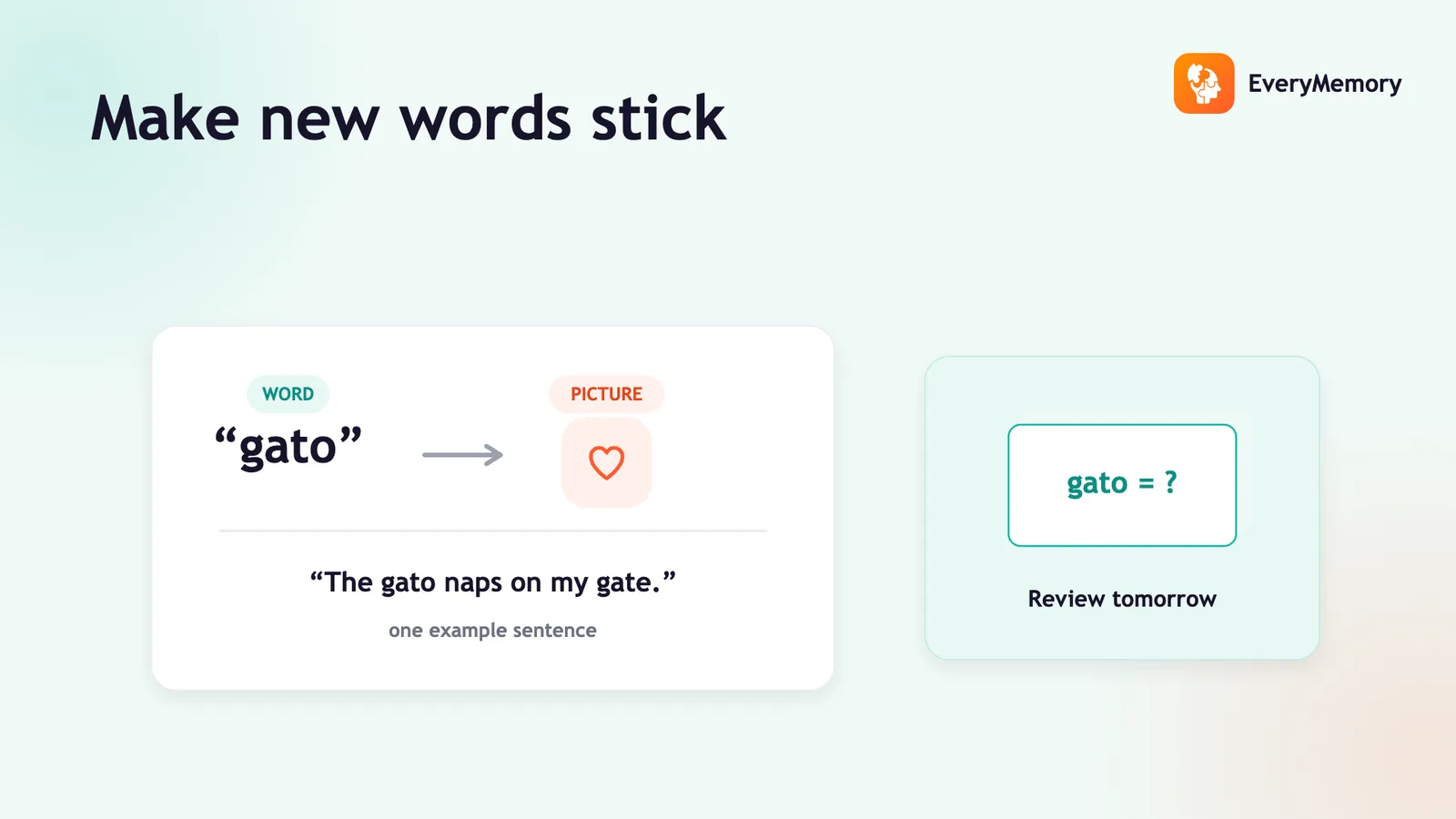
⚡ Quick answer
The most effective way to remember new words is to link them to something you already know - a mental image, a sound, or a personal sentence - and then review them at spaced intervals rather than in a single sitting. The keyword method creates a vivid association with the word's sound; writing a personal sentence embeds its meaning in context; the Leitner system organises flashcards by how well you know each one; and spaced repetition schedules reviews just before you're likely to forget. Used together, these four methods reliably move new vocabulary from short-term to long-term memory.
Key takeaways
- The keyword method links a new word's sound to a vivid mental image, giving memory something concrete to hold onto.
- Writing a personal sentence with each new word adds contextual meaning that significantly improves long-term recall.
- The Leitner system organises flashcards by how well you know them, so review time goes where it is most needed.
- Spaced repetition - reviewing just before forgetting - can improve retention by up to 200% compared to cramming.
Learning new words can be satisfying - and deeply frustrating when those words refuse to stay. You look up the Spanish word for 'butterfly' for the third time this week. You learn a plant name and forget it before reaching the garden centre. You blank on a colleague's job title the morning after you learned it.
These slips are almost always a method problem, not a memory problem. Most people try to learn new words by reading a definition once and hoping it sticks. This article walks through four techniques that actually work: the keyword association method, using a word in your own sentence, the Leitner flashcard system, and spaced repetition.
Why new words are so easy to forget
Memory does not store isolated facts well. When you encounter a new word - say, the Italian farfalla (butterfly) - your brain has almost nothing to attach it to. No existing association, no emotional hook, no sensory connection. Without those links, the memory trace is thin and fades within hours.
All four methods below work on the same principle: give the new word something familiar to attach to. The richer and more personal that connection, the stronger the trace - and the more reliably you will retrieve the word when you need it. They also share a second feature: they exercise retrieval memory (recalling a word from scratch) rather than mere recognition (reading a definition and nodding). Active retrieval is where the real learning happens.
The keyword method: hook the sound to a picture
The keyword method is a two-step technique developed in the 1970s for foreign-language vocabulary. Research - including a Stanford study where users scored 88% versus 28% for free-study - consistently shows it outperforms simple repetition.
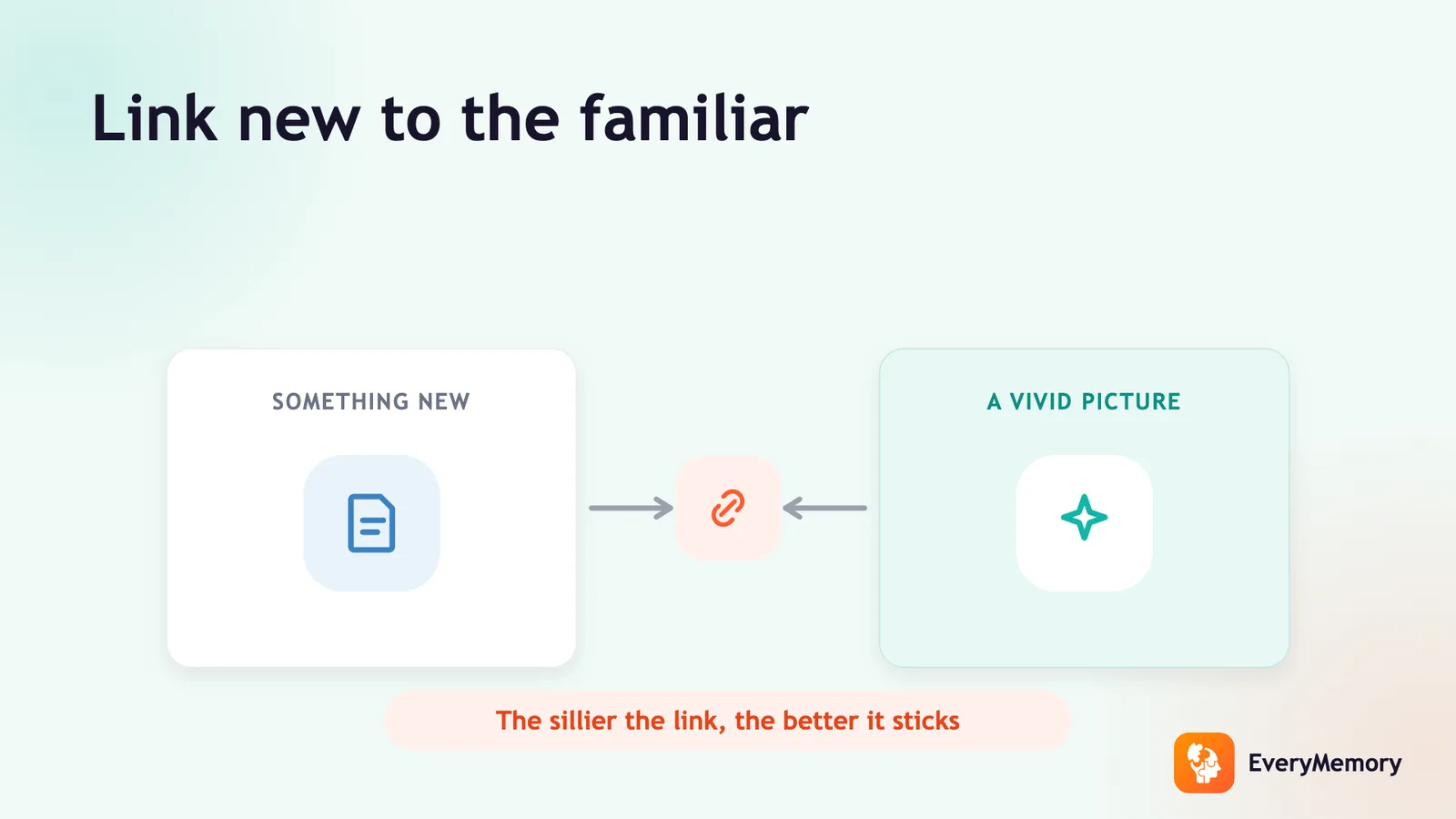
Step 1 - the acoustic link: find a familiar word that sounds like part of the target. For the Spanish carta (letter/menu), the keyword is 'cart'. For the French chapeau (hat), try 'chapel'. A rough match is enough.
Step 2 - the imagery link: create a vivid mental picture connecting the keyword to the meaning. For carta: a shopping cart stuffed with letters. For chapeau: a chapel wearing a hat. The more specific the image, the better it anchors.
This works beyond languages. Learning plant names? The Latin Digitalis (foxglove) - picture a fox wearing digital watches on its fingers. For why associations work so well, see our article on how to use association to remember more.
Write your own sentence: put the word to work
Once you have an association, the next step is to use the word in a sentence you write yourself. Research on vocabulary retention consistently finds that contextual use - actually deploying a word in a meaningful sentence - produces significantly better recall than definition-only study.
The key is to make the sentence personal. Not 'the cat sat on the mat' style, but something connected to your own life: I watched the farfalla land on the lavender in my garden. The personal detail creates an emotional trace that a generic example simply doesn't.
This technique pairs naturally with the keyword method: create the association image first, then write one sentence that uses the word correctly. A small paper notebook works beautifully - handwriting appears to strengthen encoding compared to typing, and the notebook doubles as a ready-made review resource as the weeks go on.
The Leitner flashcard system: organise by what you know
The Leitner system, developed by German science journalist Sebastian Leitner in the early 1970s, is a simple way to sort flashcards by how well you know each one - so review time goes where it is most needed. You need a box with four dividers (or four labelled envelopes). All new cards start in Box 1. Get a card right and it moves up one box; get it wrong and it goes back to Box 1. The review schedule:
- Box 1: review every day - these are words you are still learning.
- Box 2: review every other day - you know these, but they are not solid yet.
- Box 3: review once a week - these are becoming reliable.
- Box 4: review once a month - these are well-known and just need occasional refreshing.
The system automatically concentrates effort on difficult words while freeing you from over-reviewing words you already know. A session that once took twenty minutes shrinks as cards graduate through the boxes - and the visible progress is motivating. For a full walkthrough, see our dedicated guide on the Leitner flashcard system.
Spaced repetition: the science of timing your reviews
Spaced repetition is the principle behind the Leitner system, and it explains why spreading reviews over time beats cramming.
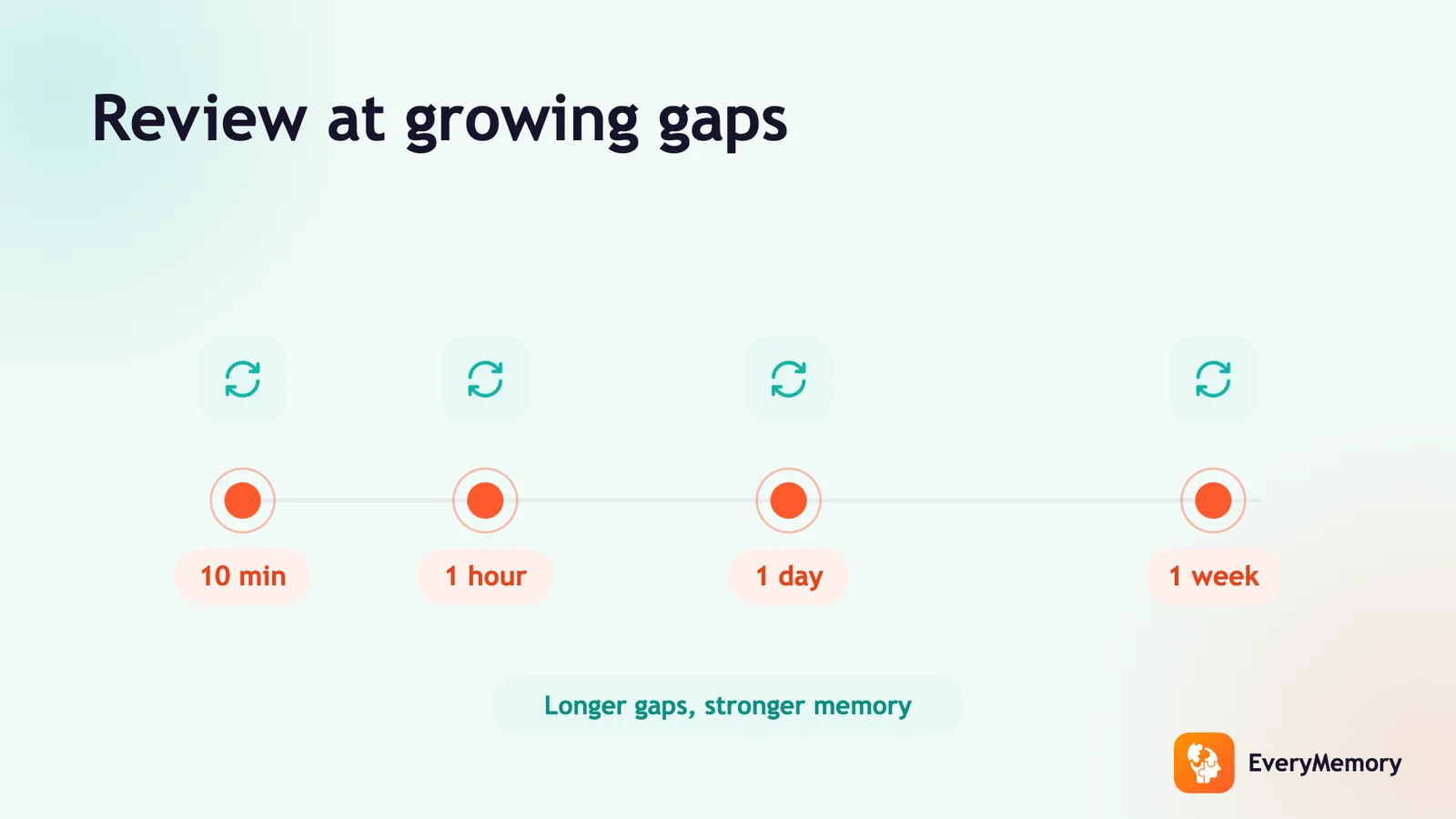
Cognitive science identifies what is called the forgetting curve: memory for new information drops steeply in the first day or two, then levels off. Reviewing a word just before it fades strengthens the trace far more than reviewing it while it is still fresh. A word reviewed today, in two days, in five, and in two weeks will be far more reliable six months later than one studied for an hour in a single sitting.
Apps like Anki implement spaced repetition automatically; the Leitner box does the same with physical cards. Short, regular sessions are what matter. Our guide to spaced repetition for everyday memory covers how to apply this beyond vocabulary.
Putting it all together
These four methods fit naturally into a layered routine:
- New word: apply the keyword method (30 seconds), then write one personal sentence in a small notebook.
- Make a flashcard: word on the front, your image and sentence on the back. Place it in Box 1.
- Daily review: 5–10 minutes on whichever Leitner boxes are due. Say each word aloud as you flip its card.
- Use it: slip the word into a conversation or a piece of writing once this week.
Consistency beats intensity - ten minutes daily outperforms an hour once a week. If you are also studying a language, our guide to learning a language and memory covers the broader picture.
✅ Try this today - The three-card starter
Pick three words you want to remember - from a language, hobby, or garden - and do this right now:
- For each word, find a keyword that sounds like part of it. Imagine a brief, slightly absurd scene linking that keyword to the word's meaning. Thirty seconds per word - quick and imperfect is fine.
- Write one personal sentence for each word in a notebook - something connected to your own life, not a textbook example. Say each sentence aloud once.
- Make one flashcard per word (index cards work well), put all three in an envelope labelled 'Box 1', and set a reminder to review them tomorrow. Your Leitner system is now running.
⚠ When to talk to a professional
This article is for general interest and is not a substitute for medical advice. If you notice sudden, rapid, or noticeably worsening difficulty finding words, understanding language, or following conversation - beyond the occasional tip-of-the-tongue moment - please speak with a qualified healthcare professional rather than attributing the changes to normal ageing.