 EveryMemory
Does Writing by Hand Help You Remember?
Picking up a pen instead of a keyboard might seem old-fashioned, but research suggests handwriting helps your brain encode information more deeply - here's why and how to use it.
Part of the guide: How to Improve Your Memory: The Complete Beginner's Guide →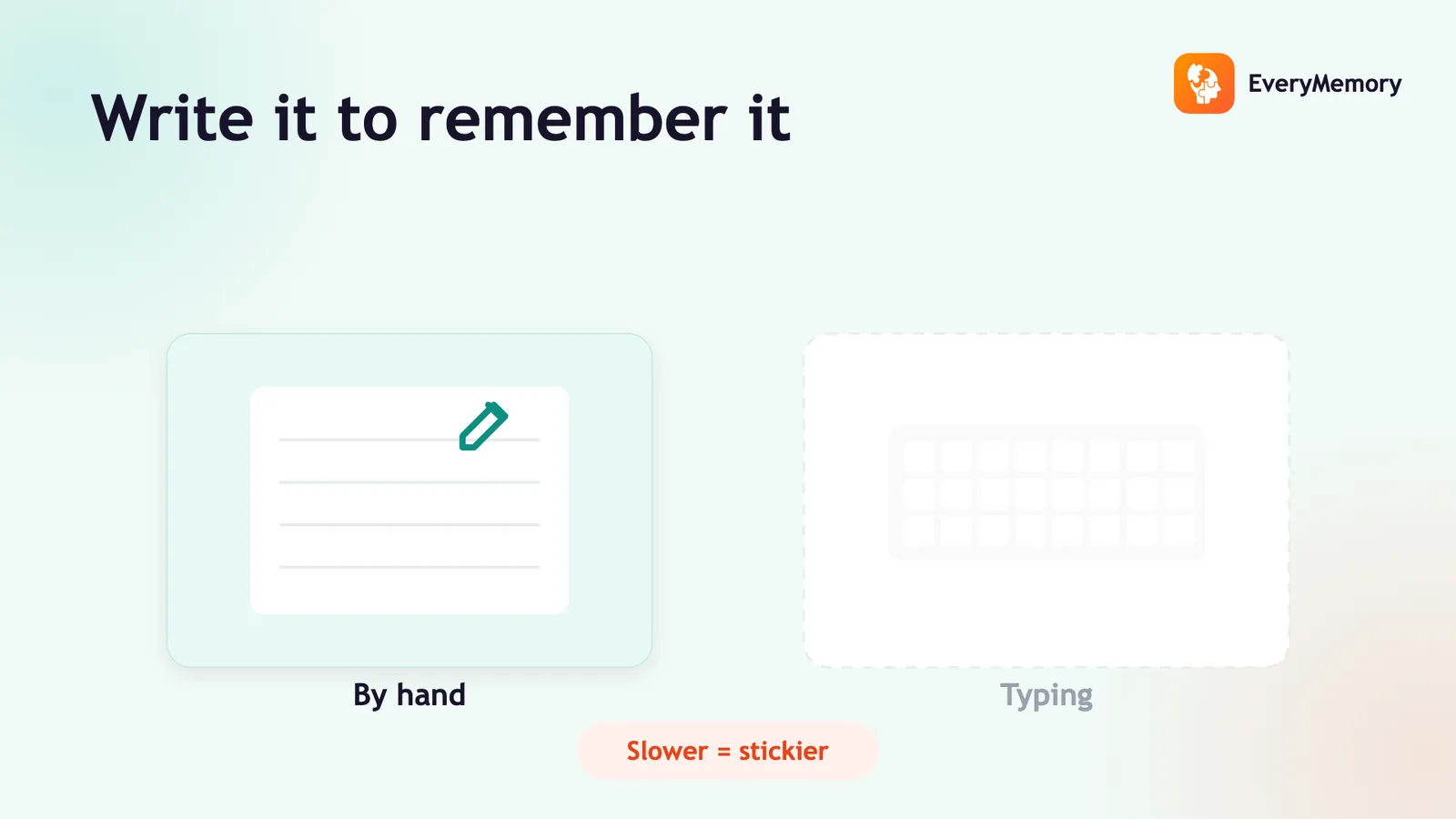
⚡ Quick answer
Yes - writing by hand appears to support memory better than typing in many situations. Because handwriting is slower than typing, you cannot write everything down word for word; instead, you have to listen, process, and summarise in your own words. That extra mental effort deepens encoding, making the information more likely to stick. Handwriting also activates a broader network of brain regions linked to learning and recall than typing does.
Key takeaways
- Handwriting forces you to summarise in your own words, which deepens memory encoding compared to verbatim typing.
- The fine motor activity of writing activates a broader network of brain regions linked to learning and recall.
- Handwritten to-do lists and journals create richer memory traces for future intentions and daily events.
- Even five minutes of handwritten review at the end of the day can meaningfully reinforce what you want to remember.
There's a reason your handwritten shopping list sticks in your mind even when you leave the paper at home, while a typed note on your phone is forgotten the moment you close the app. Writing by hand is slower, more deliberate, and - as it turns out - more demanding on your brain in exactly the right ways.
Over the past decade, researchers have looked carefully at what happens in the brain when we write rather than type. The findings are encouraging for anyone who has held on to a notebook out of habit or instinct: that habit may be quietly supporting your memory in ways that go well beyond simply having a record on paper.
Why slower can mean stronger
When you type, your fingers can keep pace with speech almost effortlessly, so the temptation is to transcribe - to capture words verbatim without really processing them. A 2014 study by psychologists Pam Mueller and Daniel Oppenheimer found that students who typed their lecture notes performed noticeably worse on conceptual questions than those who wrote by hand, even though the typists recorded far more words. The typists had more notes but less understanding.
The handwriters, forced to keep up with a pen, made constant small decisions: what is the key point here? How do I say this in fewer words? Those decisions are not inefficiencies - they are the act of encoding. When you put information into your own language, you connect it to things you already know, and that connection is what makes a memory durable.
Later research has shown mixed results: some replication studies found smaller differences, particularly when typists were instructed not to transcribe verbatim. The benefit of handwriting appears strongest when it nudges you to process rather than simply record.
What your brain is doing while you write
Handwriting is a surprisingly complex motor task. Forming each letter requires fine coordination between your hand, arm, and eye - and that physical effort has cognitive consequences. A 2023 high-density EEG study published in Frontiers in Psychology found that handwriting produced widespread brain connectivity across regions involved in memory, motor control, and language processing, while typing activated a much narrower set of areas.
The sensory feedback loop matters too. Tactile signals from your fingertips, the movement of your hand, and the sight of letters forming on the page all give the brain more to anchor the memory to - more hooks for later retrieval. This is closely related to how association strengthens memory: the richer the encoding experience, the more routes your brain has back to the information.
Note-taking: getting more from what you read and hear
If you attend a talk, a class, a doctor's appointment, or even a family meeting about something important, taking notes by hand can help you retain the substance - not just because you have a written record, but because the act of writing consolidates what you heard while it is still fresh.
A few small habits make handwritten notes more effective:
- Write in your own words, not the speaker's - even if it means leaving gaps.
- Use brief phrases and short sentences rather than trying to capture everything.
- Add a simple sketch, arrow, or underline when something feels important: the visual variation helps your brain flag that item.
- Review your notes the same day, ideally within a few hours, to reinforce the memory before it fades. This pairs naturally with spaced repetition - reviewing again a day or two later solidifies the information further.
To-do lists: intention, not just organisation
Writing a to-do list by hand does more than organise your day - it acts as a rehearsal. When you write "call the pharmacy at 10" on paper, your brain processes that commitment differently than when you tap it into an app. The physical act of forming those words creates a memory trace of the intention itself.
Research on prospective memory - the kind that governs remembering to do things in the future - suggests that concrete, specific intentions are more reliably acted on than vague ones. Writing a task with a specific time or context ("after breakfast", "when I pass the post box") gives your brain a richer cue to trigger the action at the right moment - a strategy covered in our guide to remembering appointments.
There is also something to be said for crossing a completed item off a handwritten list. That small act signals closure to your brain, reducing the low-level mental load of carrying an open task in working memory.
Journaling: the memory you build on purpose
A brief handwritten journal - even three or four sentences before bed - can serve as a practical memory tool. Recounting what happened during the day in your own words is a form of active recall: you are retrieving events, organising them, and re-encoding them in a richer, more connected form.
This matters for older adults in particular, because episodic memory - the kind that stores personal events - can become less reliable over time. A journal gives you an external scaffold: a record you can return to, and a daily habit that keeps the retrieval process active. A few lines noting something that happened, something you want to remember, or one thought worth keeping is all it takes. The act of choosing what to write down is itself a form of chunking - selecting and grouping information in a way that makes it more manageable for memory.
Making handwriting a practical memory habit
You do not need to abandon digital tools entirely. The goal is to use handwriting deliberately, at the moments where deeper encoding matters most: when you want to learn something, plan something, or hold on to something beyond a fleeting task.
Keep a small notebook near your reading chair, on the kitchen counter, or by the phone - the lower the friction, the more likely you are to reach for it. If you find yourself typing out of convenience, try a simple rule: type to capture, write to remember. Transferring the key points into a notebook by hand before the end of the day gives your brain a second pass in your own words, and that is where the real encoding happens.
✅ Try this today - The handwritten review method
At the end of today, try this five-minute exercise to turn ordinary note-taking into a memory habit.
- Take a blank piece of paper and write down three things you want to remember from today - a conversation, something you read, or a plan you made.
- Write each in one or two sentences of your own words, as if explaining to someone else - full thoughts, not bullet fragments.
- Read back what you wrote, then turn the paper over and try to recall each point from memory.
- Tomorrow morning, glance at the paper again. That single short review meaningfully reinforces the memory.
⚠ When to talk to a professional
If you notice sudden, rapid, or significant worsening in your ability to recall recent events, form sentences, or recognise familiar people, it is worth speaking with your doctor. These changes are different from the normal, gradual shifts that come with age and deserve a proper evaluation.