 EveryMemory
The Major System for Numbers: A Beginner's Guide
Turn any number into a vivid picture with the Major System - a centuries-old technique that maps digits to consonant sounds so you can remember PINs, phone numbers, and dates with ease.
Part of the guide: How to Improve Your Memory: The Complete Beginner's Guide →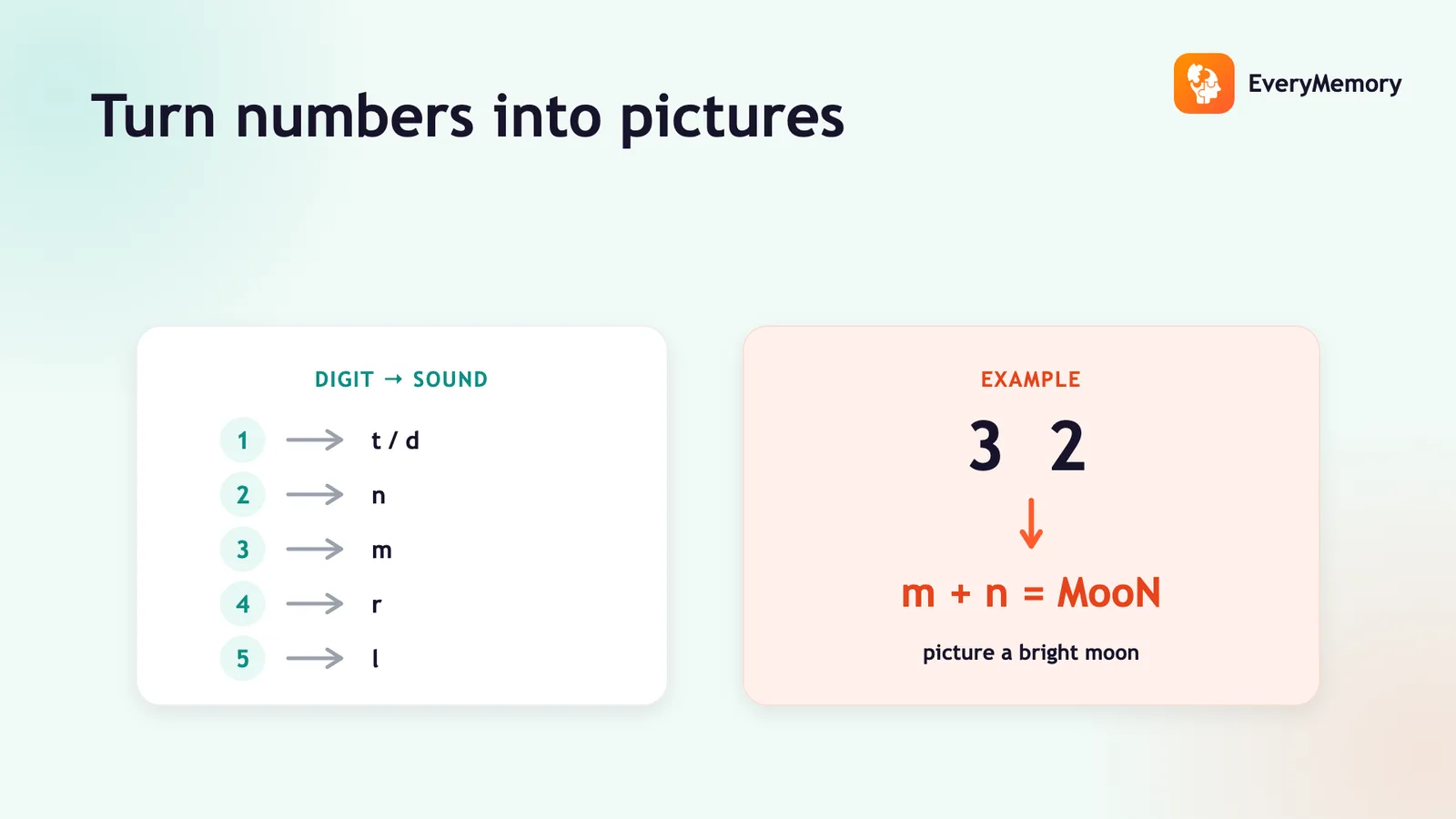
⚡ Quick answer
The Major System converts each digit 0–9 into one or more consonant sounds. You then add vowels freely to form a concrete word, and picture that word vividly. For example, the number 32 becomes the consonants M and N, which can form the word 'moon' - a bright, easy image. By chaining two or three such images together you can reliably hold a full phone number or PIN in memory.
Key takeaways
- The Major System maps digits 0–9 to consonant sounds, letting you build real words - and vivid images - from any number.
- Vowels and the letters W, H, Y carry no value and can be inserted freely to form a word from the consonant sounds.
- Splitting a long number into two-digit pairs and picturing one word per pair dramatically reduces the memory load.
- A few weeks of applying the system to real numbers you want to remember is enough to make the chart feel automatic.
Have you ever walked away from a phone call and immediately lost the number you just heard? Numbers are notoriously slippery for the human brain - we are wired for stories and pictures, not strings of digits. That is where the Major System comes in. Developed over centuries and refined by memory champions, it gives every digit a consonant sound, so any number can be turned into a real word - and real words paint pictures that are far easier to hold onto.
The good news: you do not need a special gift for memory to use this technique. The 0-to-9 sound chart takes about ten minutes to learn, and from that point on any PIN, phone number, or important date can be translated into a vivid image that lodges in your mind naturally. This guide walks through the system step by step, with a full worked example you can follow along with.
Where the Major System Comes From
The earliest version was published in 1634 by the French mathematician Pierre Hérigone. It was refined over two centuries, and by the mid-1800s memory lecturers were teaching it in popular courses across Europe and North America. Memory competitors still use it today to memorise hundreds of digits in sequence.
The core idea: numbers are abstract, but sounds can be assembled into words, and words summon pictures. The system is simply a translation layer between digits and images.
The 0–9 Sound Chart
Each digit is linked to one or two consonant sounds. Vowels (a, e, i, o, u) and the letters W, H, and Y carry no value at all - they are free spacers you can insert anywhere to build a real word. The sound is what matters, not the spelling.
- 0 - S or Z (think: Zero starts with Z)
- 1 - T or D (both have one downstroke; TH counts too)
- 2 - N (lower-case n has two downstrokes)
- 3 - M (lower-case m has three downstrokes)
- 4 - R (fouR ends in R)
- 5 - L (spread your left hand - five fingers make an L shape)
- 6 - J, SH, or soft G (a 6 rotated looks like a J)
- 7 - K or hard G (two 7s back-to-back form a K)
- 8 - F or V (a handwritten 8 looks like a cursive f)
- 9 - P or B (a 9 rotated 180° looks like a lower-case b)
A quick way to remember: Zero starts with Z, one-stroke letters cover 1, count downstrokes for 2 and 3, fouR ends in R, five fingers form an L, rotate 6 for J, two 7s make K, figure-8 for F, flip 9 for B/P. Most people find the chart sticks after a single careful read-through.
| Digit | Sound(s) | Memory hook |
|---|---|---|
| 0 | s, z | “zero” starts with a z sound |
| 1 | t, d | t has one downstroke |
| 2 | n | n has two legs |
| 3 | m | m has three legs |
| 4 | r | “four” ends in r |
| 5 | l | L is Roman numeral 50 |
| 6 | j, sh, ch | a reversed j looks like 6 |
| 7 | k, g | two 7s can form a K |
| 8 | f, v | a cursive f looks like 8 |
| 9 | p, b | 9 is a mirror-image p |
How to Turn a Number Into a Word
The process has three steps: read off the digits, find the matching consonant sounds, then insert vowels freely until you land on a real, concrete, picturable word.
Say you need to remember 45. Digit 4 = R, digit 5 = L. Add vowels: RaiL, RuLe, ReaL, RoLl - any of these work. Choose whichever makes the strongest picture. A giant roll of bread tumbling downhill is far more memorable than the digits 4 and 5.
One important rule: double letters count only once when they make a single sound. The word butter gives B (9) and T (1) - two digits: 91 - not three. Always work from sounds, not spelling. For a deeper look at how vivid images anchor new information, see how to use association to remember more.
A Worked Example: A 6-Digit PIN
Let's say your new PIN is 384 019. Working through the chart: 3 = M, 8 = F/V, 4 = R, 0 = S/Z, 1 = T/D, 9 = P/B.
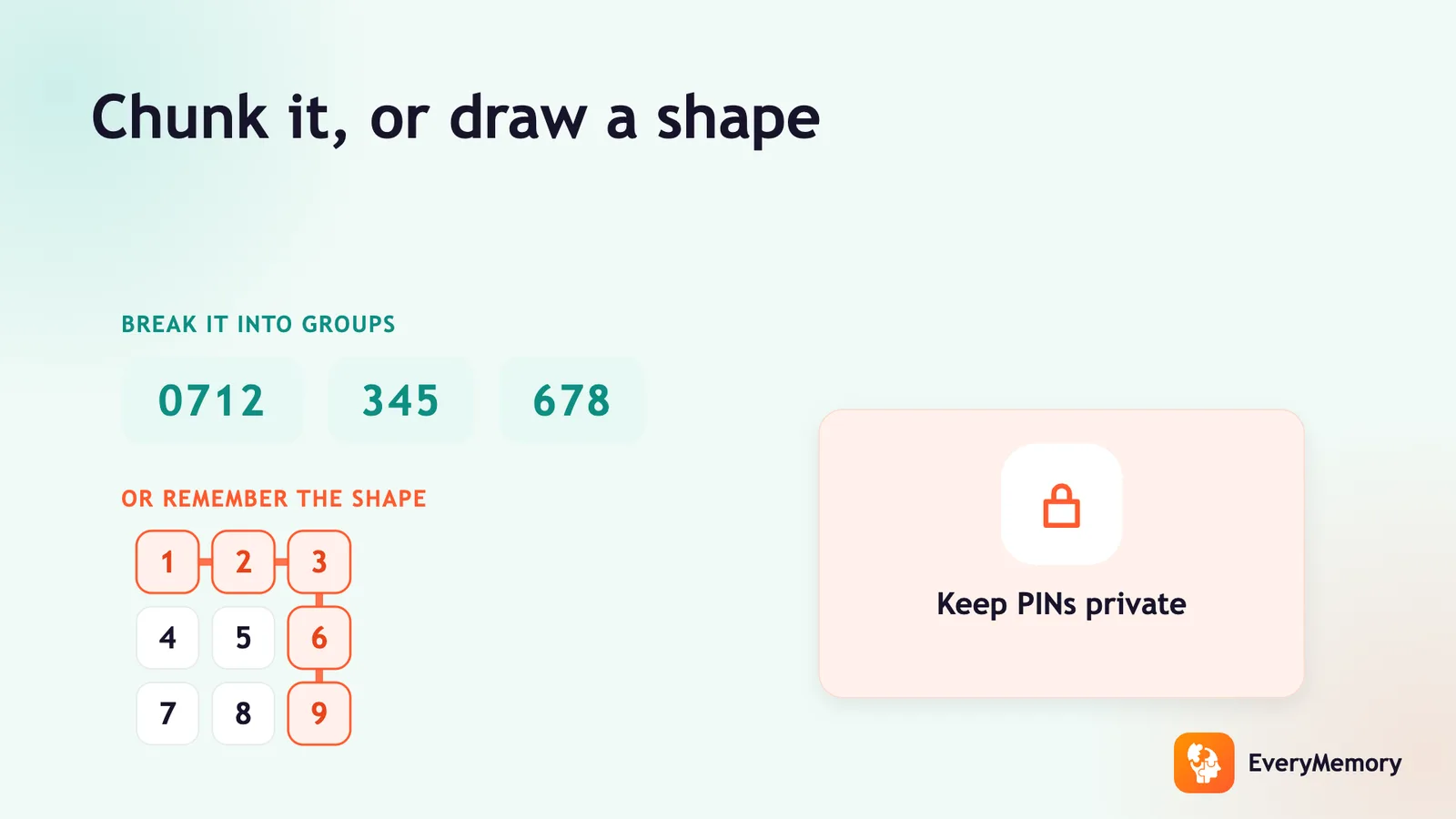
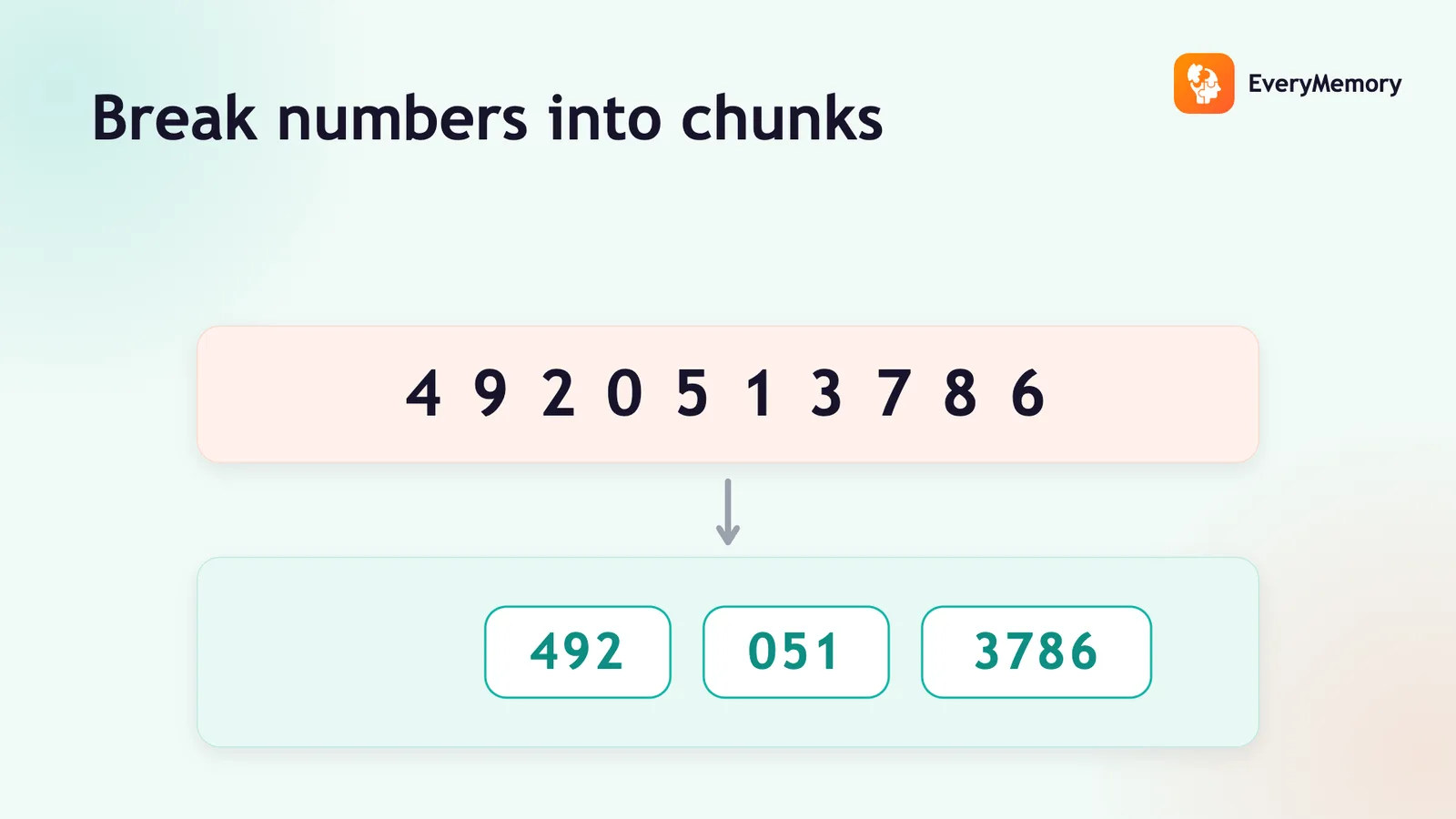
Split the six digits into two pairs and one pair: 38, 40, 19.
- 38 → M + F/V → MoVie (picture a cinema screen)
- 40 → R + S/Z → RoSe (picture a bright red rose)
- 19 → T/D + P/B → TuB (picture a bathtub)
Now link those three images into a tiny scene: a cinema screen shows a close-up of a red rose, and the rose is sitting inside a bathtub. Absurd? Yes. Forgettable? Much less so. When you need the PIN, you recall the scene - movie → rose → tub - and decode 38 / 40 / 19 back into digits.
This is the same chunking logic described in the guide to the chunking technique: breaking a long string into manageable groups makes each group far easier to hold.
Using the Major System for Phone Numbers
A ten-digit phone number looks daunting, but split into five pairs it becomes five words - and five words make a short story. Take the number 07 43 95 12 86:
- 07 → S/Z + K → SaCK
- 43 → R + M → RaM (a male sheep)
- 95 → P/B + L → BaLL
- 12 → T/D + N → TiN
- 86 → F/V + J/SH → FiSH
Story: a sack is headbutted by a ram, the ram kicks a ball into a tin, and out of the tin jumps a fish. Ridiculous? Yes - and that is precisely why it sticks. Vivid, unusual scenes are exactly what long-term memory responds to. For more strategies on holding numbers, see how to remember phone numbers and PINs.
Getting Started: Your First Word List
A helpful first step is to pick a personal word for each digit pair you encounter most often. These become instant images - no translation needed. A few to get you going: 10 = ToeS, 11 = ToaD, 12 = TiN, 20 = NoSe, 30 = MouSe, 40 = RoSe. Choose words that make strong pictures for you specifically.
You do not need all 100 pairs before you start. Begin with numbers that matter right now - your postcode, a family member's phone number, a door code - and build the habit from there. The Major System pairs naturally with the broader goal of improving your memory over time: a little consistent practice beats intensive one-off cramming every time.
✅ Try this today - Try It With One Real Number Today
Pick a number you genuinely want to remember - a PIN, a postcode, a friend's number - and work through these steps.
- Write the number in pairs. For each pair, identify the two consonant sounds using the 0–9 chart above.
- Add vowels around each pair of consonants until you arrive at a concrete, picturable word. If more than one word works, pick the one that gives you the most vivid image.
- Link the words into a short, silly scene - the more unusual and colourful, the better. Replay the scene twice in your mind, then put the paper away and try to recall the digits from the scene alone.
⚠ When to talk to a professional
Occasional difficulty remembering numbers is a common experience at any age and is not usually a cause for concern. If you notice a sudden, rapid, or significantly worsening change in your ability to recall everyday information, it is worth speaking with a qualified healthcare professional.