 EveryMemory
The Peg System for Remembering Lists
The peg system gives you a set of mental hooks numbered 1 to 10 so you can hang list items on them and jump straight to any position - no rehearsing from the top.
Part of the guide: How to Improve Your Memory: The Complete Beginner's Guide →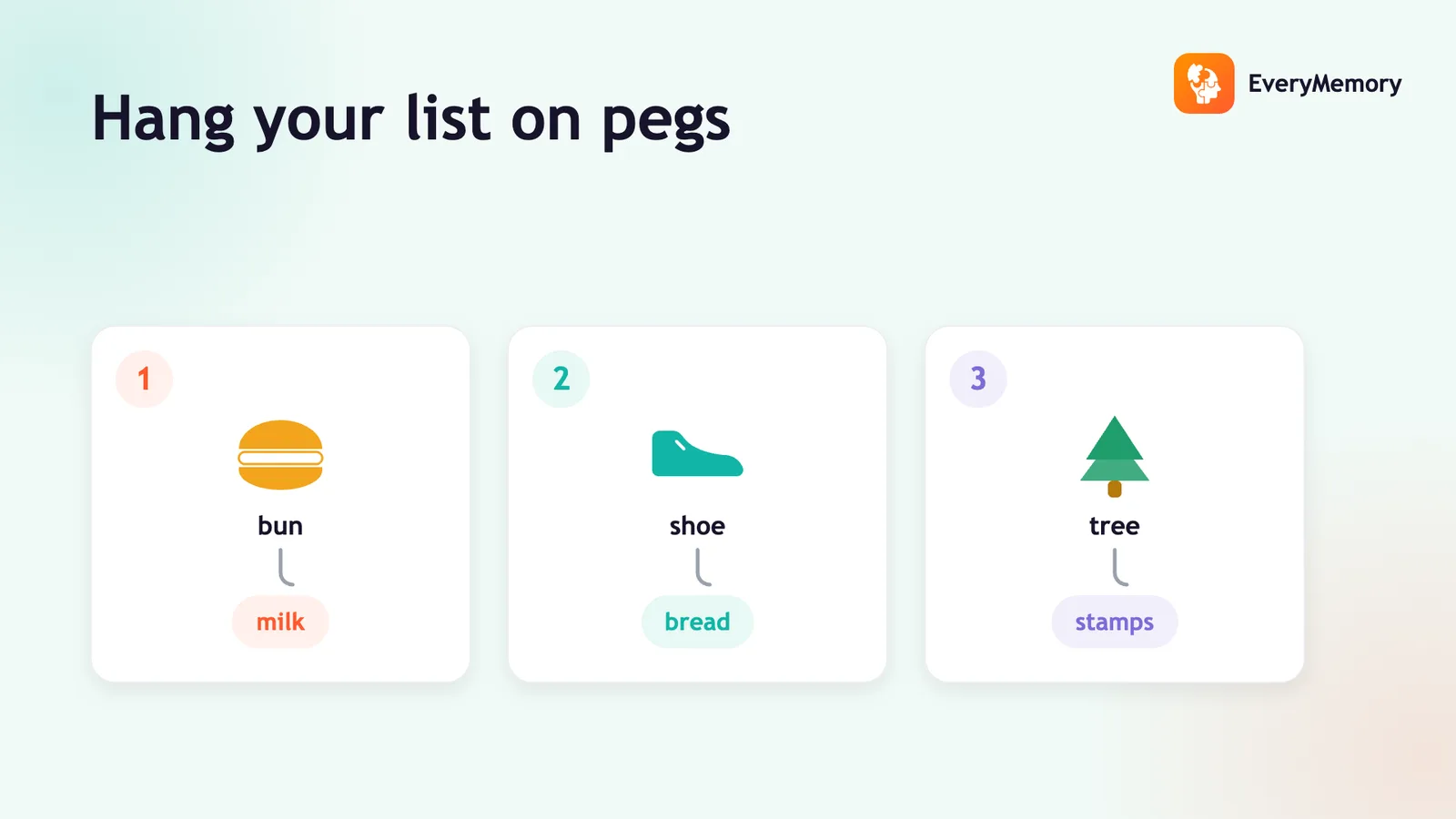
⚡ Quick answer
The peg system is a mnemonic technique that pairs each number with a fixed, memorable image - your "peg" - so you can attach new information to it. Because each peg is always in its numbered spot, you can retrieve any item directly. The most popular version uses rhyming words: one–bun, two–shoe, three–tree, and so on up to ten.
Key takeaways
- Pegs are pre-memorised number–image pairs (one–bun, two–shoe, etc.) that act as permanent numbered hooks in your memory.
- Unlike a chain of associations, pegs let you jump directly to any item - ask for item seven and you go straight there.
- The rhyming peg list (1–10) takes minutes to learn once and can be reused for any short list for the rest of your life.
- Pegs and the memory palace are complementary tools - pegs for numbered short lists, palaces for longer sequences.
Most memory tricks for lists work the same way: you learn item one, then item two leads you to three, and so on. Miss one and you may lose the thread. The peg system is different. Instead of a chain, it gives you a numbered rack - pre-installed in your mind - where each slot is always available, in any order.
The idea is simple: memorise a short set of vivid "pegs" once, then hang new information on them whenever you need it. Whether you want to recall a ten-item shopping list, a sequence of talking points, or just the seventh item without counting from the start, the peg system makes it surprisingly easy.
What a peg actually is
A peg is a pre-memorised image that permanently represents a number. Think of a cloakroom with numbered hooks on the wall. The hooks never move - when you arrive with a coat you hang it on hook five, and later you go straight to hook five without searching. A peg works exactly the same way in your memory.
This is what sets the peg system apart from the simple link method, where items form a chain, or from the memory palace, where items are placed along a familiar route. Pegs give you numbered, direct-access slots - all your mental effort goes into creating the vivid link, not the positioning.
The rhyming peg list (one–bun to ten–hen)
The rhyming peg system is the easiest version to learn because each number rhymes with its peg word, making the pair almost impossible to forget. The classic English list runs:
- One - bun
- Two - shoe
- Three - tree
- Four - door
- Five - hive
- Six - sticks
- Seven - heaven
- Eight - gate
- Nine - vine
- Ten - hen
Spend two or three minutes picturing each object clearly. Make your bun fresh and golden, your shoe well-worn with laces undone, your tree enormous and swaying. The more specific and sensory the image, the stickier the peg. Once you can run through all ten without hesitation, the rack is ready to use - for life.
The number-shape alternative
Some people prefer pegs built on what the numeral looks like rather than what it rhymes with. In the number-shape system, 1 becomes a candle or a pencil, 2 a swan with a curved neck, 3 a pair of lips, 4 a sail on a yacht, 5 a fishhook, 6 a golf club, 7 a cliff edge, 8 an egg-timer, 9 a balloon on a string, and 10 a bat and ball.
Neither version is superior - the best one is whichever produces crisper, more personal images for you. Some people mix and match, keeping the rhyming pegs they already love and swapping in shape pegs where the rhyme feels weak. What matters is that each peg is unique and instantly visual.
How to use the pegs: a worked example
Suppose you need to remember a list of ten things to discuss at a family meeting: 1. Insurance, 2. Holiday dates, 3. Cleaning rota, 4. New boiler, 5. Mum's medication, 6. Wi-Fi password, 7. Car service, 8. Birthday gift, 9. Spare keys, 10. Weekend plans.
For each item, create a brief, vivid mental scene that combines the peg with the item. Do not just name them - see them interacting:
- 1 (bun): A giant insurance document stuffed inside a sesame-seed bun.
- 2 (shoe): A calendar shoved inside a muddy boot, marking the holiday week.
- 5 (hive): Bees buzzing around a medicine bottle, very loud.
- 7 (heaven): A car floating on a cloud while an angel checks the engine oil.
To recall item seven later, you simply think "seven - heaven" and the car-service scene appears. No counting, no running through items one to six first. This is the peg system's central advantage: random access. You can jump straight to any numbered slot. Understanding how vivid association supports recall explains why those absurd, surprising images work so much better than plain repetition.
If your list has fewer than ten items, some pegs sit empty - that is perfectly fine. If you have more than ten, you can either extend the list with an additional set of pegs or combine it with a memory palace for larger volumes.
Peg system versus memory palace
These two techniques are often compared because both use pre-built mental structures. The main differences are worth knowing so you can choose the right tool:
- Setup time: A 10-peg list takes minutes to learn once and is reusable immediately. A memory palace requires choosing a route and placing items along it - more effort upfront, but it scales to dozens of items.
- Capacity: A basic peg list handles around 10–20 items comfortably. A palace can hold far more if you use a large familiar building.
- Random access: Both allow jumping to a specific item - the peg system through numbered slots, the palace through spatial position.
- Reuse: Pegs can be cleared for a new list between uses; palaces can too, but benefit from a brief "mental clean" first.
Many memory champions use both - pegs for shorter numbered lists and shopping tasks, palaces for speeches, card sequences, and longer study material. There is no rivalry; they complement each other. For a deeper comparison, see our guide to mnemonics, which covers several techniques side by side.
| Peg system | Memory palace | |
|---|---|---|
| Structure | Fixed numbered pegs you reuse | A route through a familiar place |
| Best for | Short lists; jumping to item 7 | Longer, ordered material |
| Setup | Learn the pegs once | Pick a place you know well |
| Random access | Yes - go straight to a number | Less direct; you walk the route |
Building the habit over time
The peg system rewards regular use. The first time you apply it, building each scene takes a little deliberate thought. After a few weeks of using it for shopping lists, to-do sequences, or agenda points, the process speeds up considerably - images arrive almost automatically.
A practical way to start is to use it every time you have a list of four or more things to remember without writing them down. Keep a mental note of which peg you reach (three pegs? five?), and aim to stretch that number slightly each week. For more guidance on building this kind of gentle daily practice, our overview of memory improvement strategies offers a good starting point.
✅ Try this today - Build your peg rack right now
This takes about five minutes and, once done, is yours to use any time.
- Write out the ten rhyming pairs: one–bun, two–shoe, three–tree, four–door, five–hive, six–sticks, seven–heaven, eight–gate, nine–vine, ten–hen.
- Close your eyes and picture each peg as a specific, colourful object. Give the bun sesame seeds; give the shoe a broken lace; make the hive drip with honey. Spend about 20 seconds on each.
- Without looking, recite the list from one to ten, picturing each peg as you go. Then try it backwards from ten to one.
- Now pick four items from today's to-do list and hang one on pegs 1, 2, 3, and 4 - invent a brief, ridiculous scene for each pair. Test yourself in an hour.
⚠ When to talk to a professional
The peg system is a practical memory tool for everyday life and is suitable for most adults. If you notice sudden, rapid, or worsening changes in your memory that go well beyond typical forgetfulness, it is worth speaking with a qualified healthcare professional.