 EveryMemory
What Is a Mnemonic? A Simple Guide With Examples
A mnemonic is any trick that helps your brain hold onto information - from a simple rhyme to a full memory palace. Here is how each type works and how to make your own.
Part of the guide: How to Improve Your Memory: The Complete Beginner's Guide →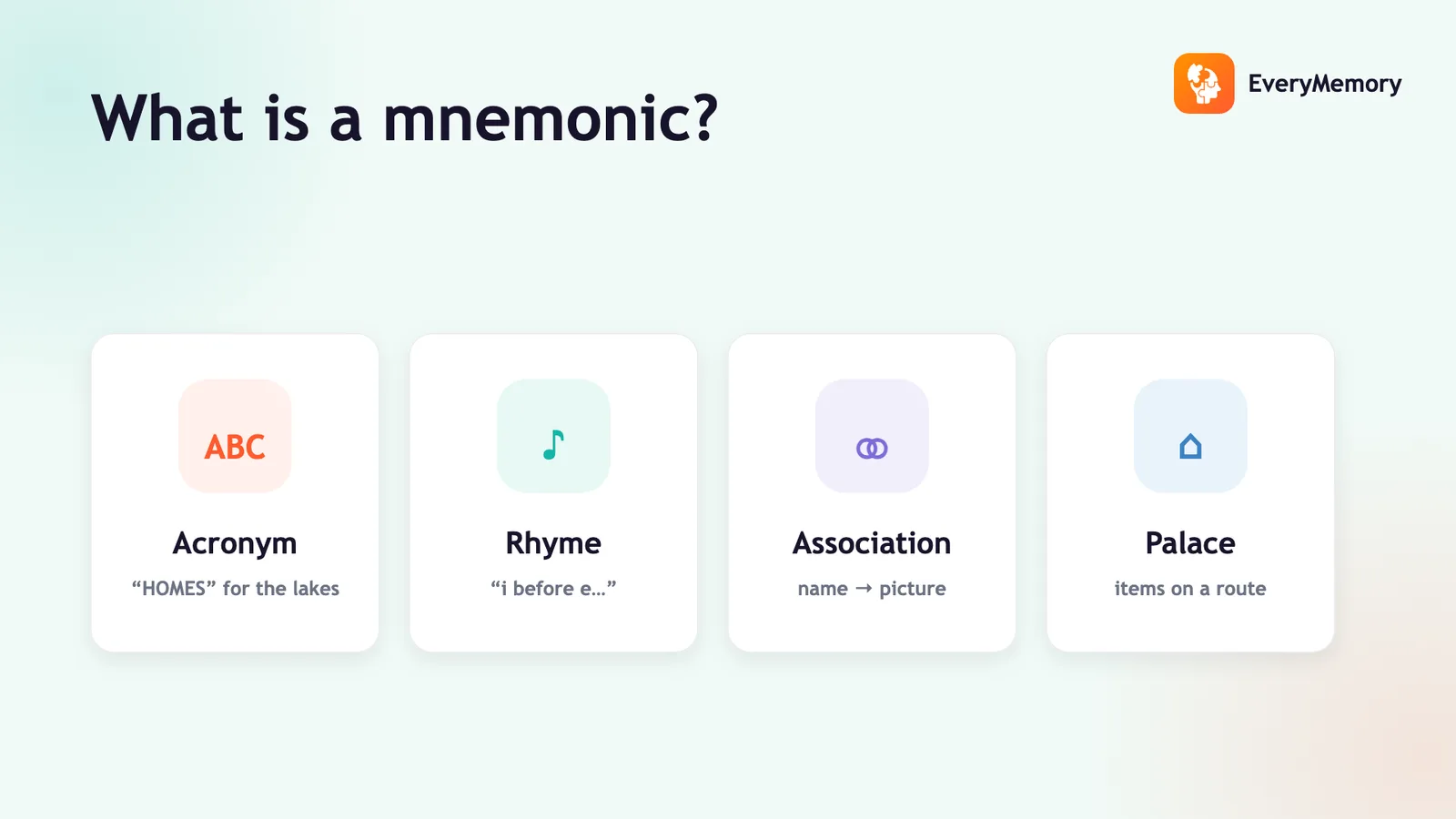
⚡ Quick answer
A mnemonic (pronounced neh-MON-ik) is a memory aid that links new information to something you can already recall easily - a rhyme, an acronym, a vivid image, or a familiar route. Mnemonics work by giving your brain multiple hooks to the same memory, making retrieval far more reliable than rote repetition. Anyone can learn to build and use them; no special talent is required.
Key takeaways
- A mnemonic is any memory aid - rhyme, acronym, image, or mental route - that links new information to something already familiar.
- Mnemonics work by creating multiple retrieval pathways to the same memory, making recall faster and more reliable than repetition alone.
- The five most useful types are acronyms, rhymes, association, chunking, and the memory palace - each suits a different kind of information.
- Anyone can build effective mnemonics: vivid, personal, and slightly unusual connections consistently outperform polished or complex ones.
If you have ever used "ROY G BIV" to recall the colors of the rainbow, you have already used a mnemonic. The word sounds technical, but the idea is simple: a mnemonic is any trick - a rhyme, an image, a pattern - that makes information stickier than it would be on its own.
This guide explains what mnemonics are, how they work, and walks through the five types most useful in everyday life - along with a short process for building your own whenever you need one.
Why mnemonics work: the science in plain language
Your brain stores connections - links between ideas, images, emotions, sounds, and places. The more connections a memory has, the easier it is to retrieve. Cognitive scientists call this elaborative encoding: you encode material more deeply by weaving it into things you already know.
A mnemonic is a shortcut to that process. Instead of repeating something twenty times, you spend ten seconds building a vivid link to something already in long-term memory. Many mnemonics also engage multiple memory systems at once - a rhyme uses acoustic memory, an image uses visual and spatial memory - which creates even more retrieval pathways.
Acronyms and acrostics: the alphabet as a scaffold
An acronym turns the first letter of each item in a list into a pronounceable word. HOMES is the most cited example - one word that stands in for five Great Lakes: Huron, Ontario, Michigan, Erie, Superior. ROY G BIV encodes the seven colors of the rainbow. Neither is a real word, but both are far easier to hold in memory than an unstructured list of seven items.
An acrostic uses the same idea but builds a sentence instead. "Every Good Boy Deserves Fudge" has encoded the musical notes E, G, B, D, F for generations of musicians.
For everyday life, invent your own on the spot. Four errands - bank, library, optician, dry cleaner - give you B, L, O, D: "Bright Lights Often Dazzle" or any phrase that sticks. The sillier it is, the better.
Rhymes and rhythm: when sound does the remembering
Rhyme and rhythm exploit acoustic memory - the same system that lets you recall lyrics to a song you have not heard in years. A piece of information set to a predictable sound pattern becomes self-correcting: if you mis-recall a word, the rhythm signals that something is wrong.
"Thirty days hath September, April, June, and November" has been passed down for centuries precisely because the rhythm carries it. For practical use, invent your own short phrase. If you regularly forget to take a medication with breakfast, a phrase like "morning pill, morning meal" gives you a consistent cue. It does not need to be clever - it only needs to stick for you.
Association: connecting the new to the familiar
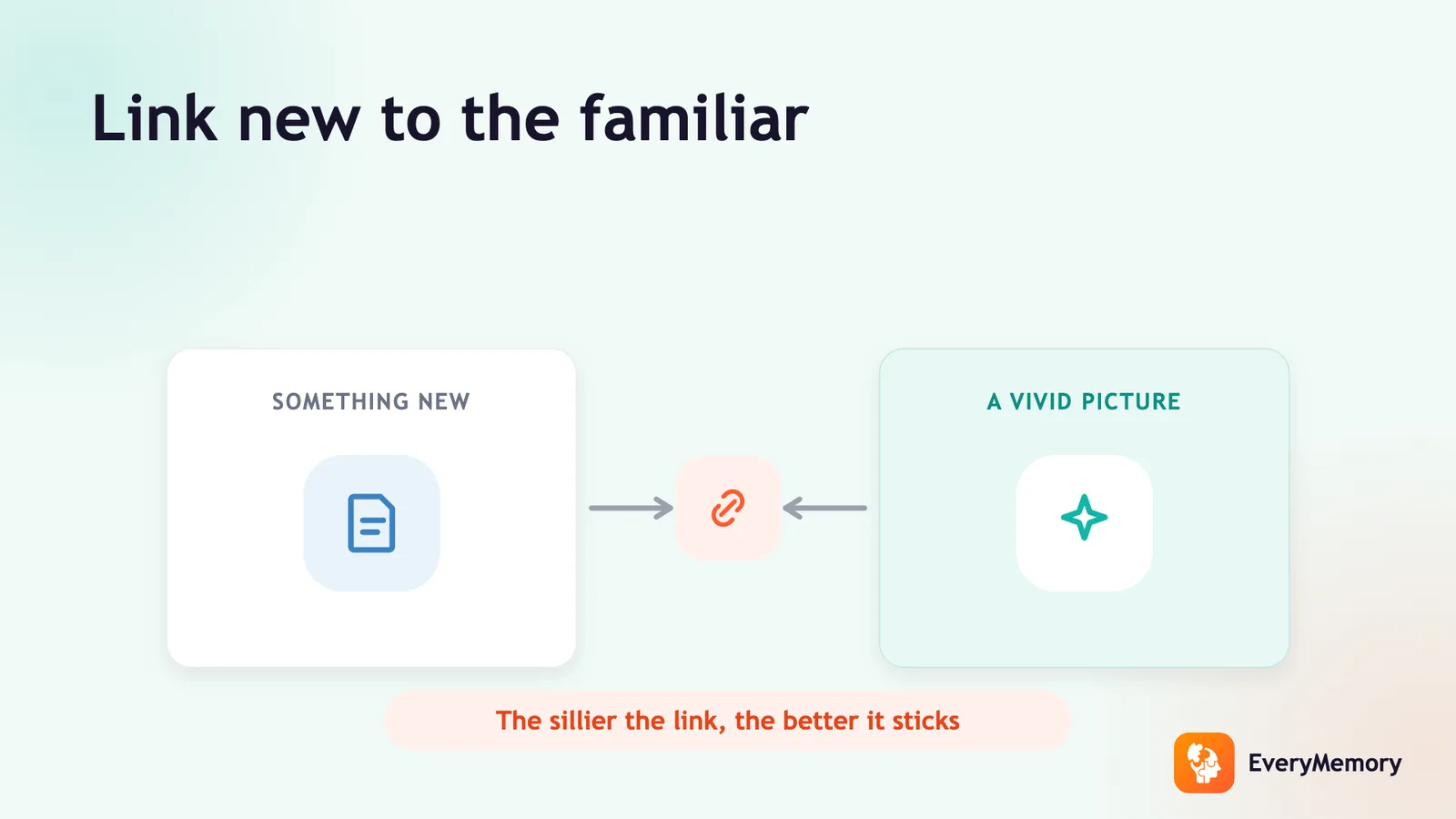
Association is arguably the most versatile mnemonic technique because it can be applied to almost anything: names, faces, vocabulary, facts, routes. The principle is to take the new piece of information and deliberately link it to something already vivid in your memory - a person you know, a strong image, a personal story.
Meeting someone named Rosa who has striking red earrings? Picture the earrings as roses - the color and shape create an instant visual bridge back to the name. Trying to remember that the French word fenêtre means window? Imagine a "phantom" (fenêtre sounds a little like phantom) peering through a window. The stranger and more vivid the image, the more reliably it comes back.
Our guide on how to use association to remember more covers how to apply this to names, numbers, and concepts. For names specifically - where association is especially powerful - see our guide on how to remember names and faces.
Chunking: grouping information into manageable pieces
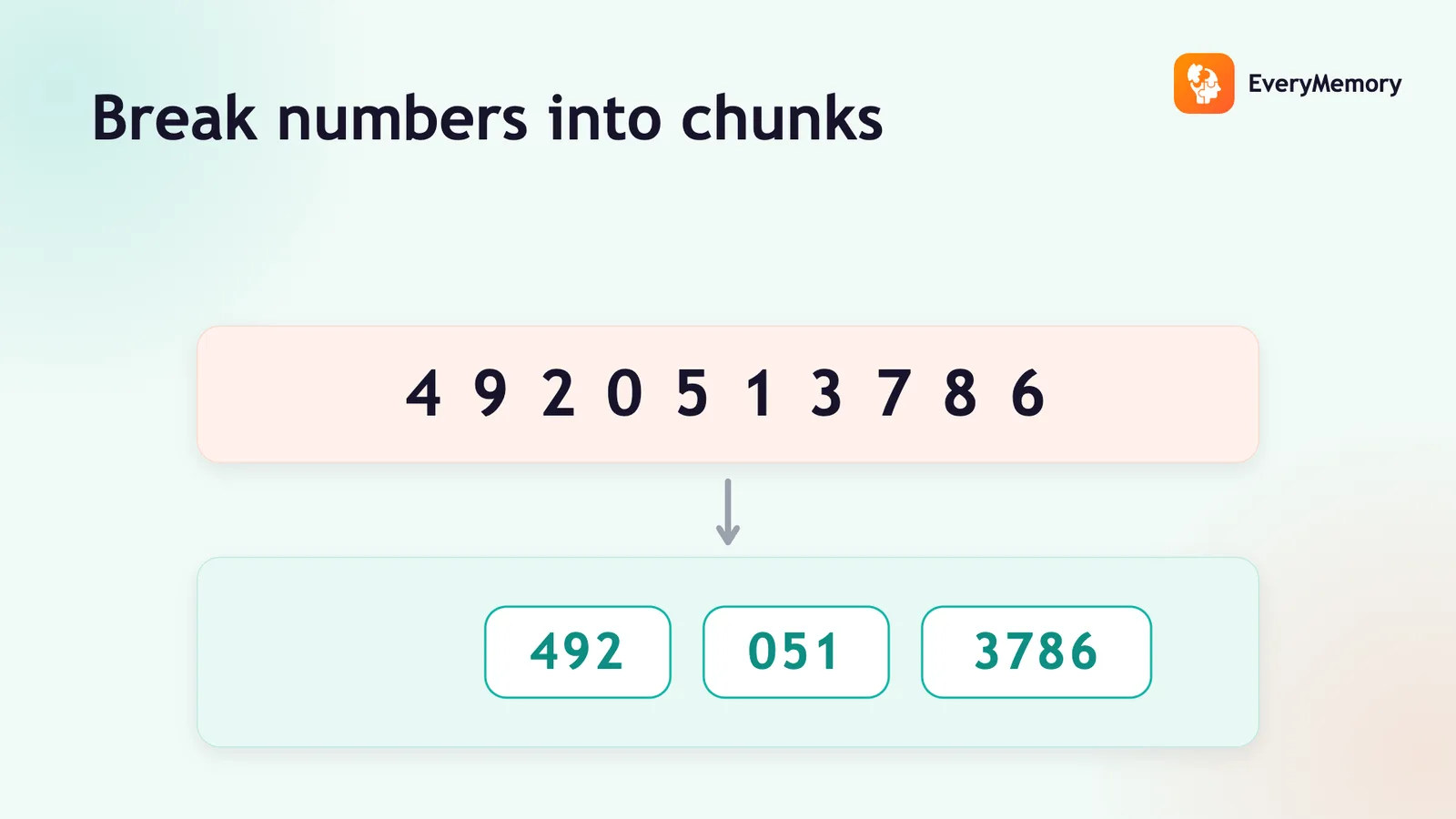
Working memory can hold only about four separate items at once. Chunking gets around this by grouping items into meaningful clusters - each cluster counts as one unit rather than many. A ten-digit phone number broken into three sections (0207 946 0308) is far easier to hold than ten individual digits.
The same logic applies to a shopping list, a set of directions, or anything else you need to carry in mind. A list of twelve items grouped by aisle - produce, dairy, dry goods - uses three memory slots, not twelve. Our guide on the chunking technique explained simply shows how to apply this to numbers, lists, and new concepts.
The memory palace: placing memories in space
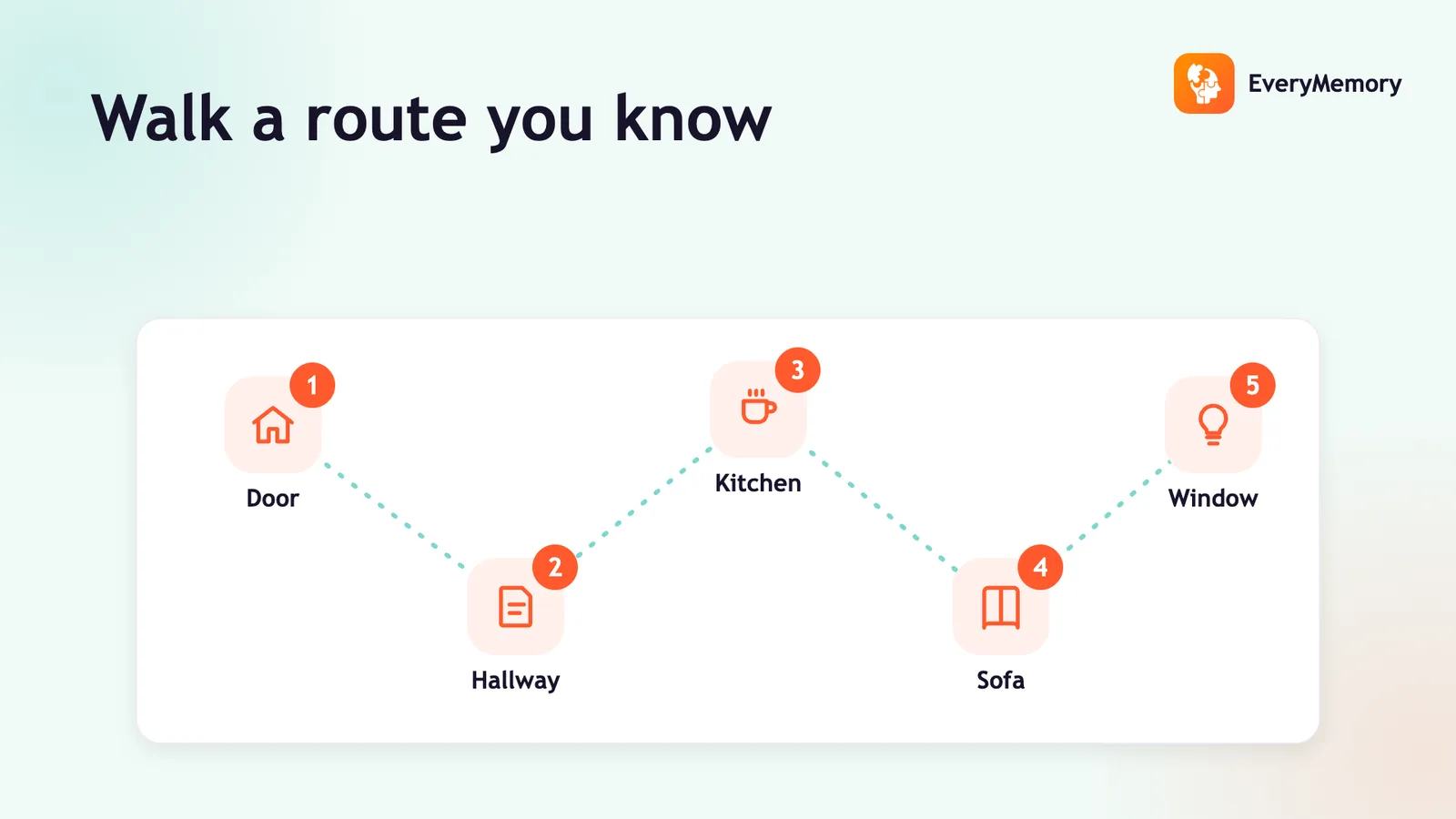
The memory palace - also called the method of loci - was used by ancient Greek and Roman orators to deliver long speeches without notes. You choose a familiar space (your home, a regular walking route), mentally place each item you want to remember at a different spot within it, then "walk through" the space to retrieve them in order.
It works because spatial memory is one of the brain's most durable systems - we are naturally good at remembering where things are. Before a dinner party, for example, place each guest's dietary preference at a spot in your kitchen: no gluten at the fridge, vegetarian at the stove, nut allergy at the window. A quick mental walk retrieves all three. Our memory palace for beginners guide walks you through building your first one.
How to build your own mnemonic in four steps
The most effective mnemonics are personal - built around your own memories, humor, and associations. Here is a reliable process for constructing one whenever you need it.
- Identify what you need to remember. Be specific: a list, a name, a number, a sequence. Vague targets produce vague mnemonics.
- Choose your type. List of items? Try an acronym. A name? Try visual association. A long number? Try chunking. A sequence? Try the memory palace or a short linking story.
- Build a vivid, personal connection. Use humor or exaggeration. It does not need to make logical sense - it only needs to be memorable to you. Stranger is usually better.
- Test it once immediately. Cover the original information and recall it using only the mnemonic. A single rehearsal later that day often cements it in long-term memory.
The most common mistake is over-engineering. A rough, slightly absurd image invented in thirty seconds almost always outperforms a carefully constructed system that took ten minutes to build.
| Mnemonic | How it works | Example |
|---|---|---|
| Acronym | First letters form a word | ROYGBIV for the rainbow colours |
| Acrostic | First letters start a sentence | “Every Good Boy Deserves Fun” |
| Rhyme | Rhythm and rhyme lock it in | “Thirty days has September…” |
| Association | Link the new to the familiar | Picture a name on a person's feature |
| Chunking | Group into smaller pieces | 555 · 12 · 34 for 5551234 |
| Memory palace | Place items along a route | Items on a walk through your home |
✅ Try this today - Build a mnemonic today
Pick one thing you regularly forget - a name, a PIN, an errand - and work through this now.
- Write down exactly what you need to remember. For a list, write all items; for a name, write the name plus one distinctive feature of the person's face.
- Choose the simplest type that fits: acronym for a short list, vivid image for a name, chunking for a number. Spend thirty seconds building it - go with the first thing that comes to mind.
- Test yourself immediately. Cover the original and recall it from your mnemonic alone. Test once more before bed. Two successful recalls usually secure the memory for the long term.
⚠ When to talk to a professional
This article contains general, non-medical information about memory techniques. If you notice sudden, rapid, or noticeably worsening changes in memory - or changes that are affecting your daily life - please speak with a qualified healthcare professional.