 EveryMemory
What Is a Senior Moment? A Reassuring Guide
Everyone has them - the lost name, the forgotten errand, the blank at the top of the stairs. Here's what a 'senior moment' actually is and why it happens at any age.
Part of the guide: Understanding Memory Loss and Forgetfulness: A Calm, Reassuring Guide →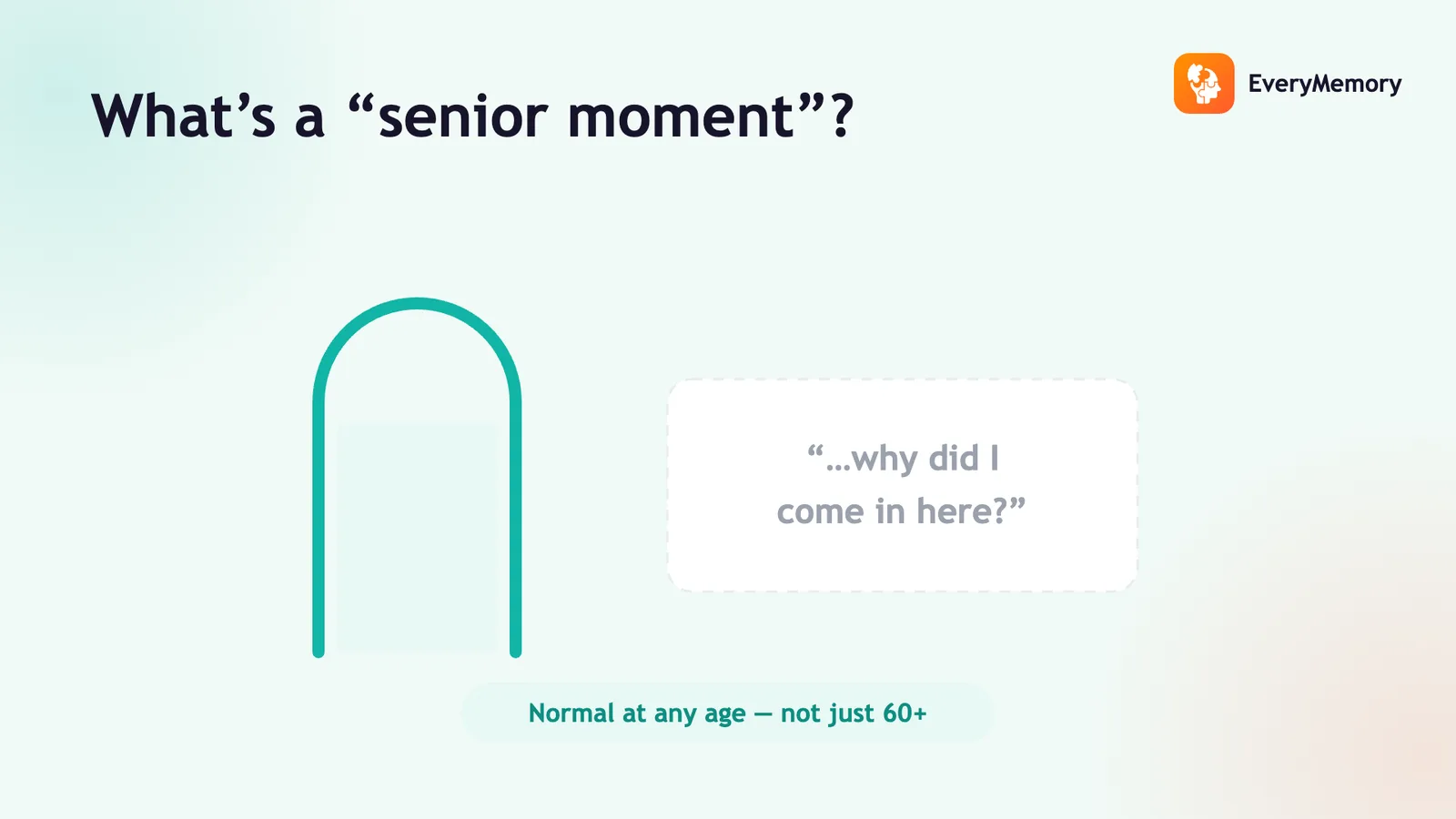
⚡ Quick answer
A 'senior moment' is an informal term for a brief, everyday memory slip - forgetting a name, losing a word, or walking into a room and blanking on why. These lapses happen at every age, though they tend to be more noticeable later in life because the brain's processing speed and attentional resources gradually ease off. They are a normal feature of how memory works, not a sign of anything going wrong.
Key takeaways
- Senior moments - forgotten names, lost words, blanked errands - are normal memory slips that happen at every age, not just in later life.
- They become more noticeable with age due to a gradual ease in processing speed and divided-attention capacity, not because memory is breaking down.
- Sleep, stress, distraction, and dehydration all amplify everyday memory lapses significantly, and most are within your control.
- The pattern over time matters far more than any individual lapse - recoverable, occasional slips are a very different picture from changes affecting daily life.
You walk into the kitchen with clear purpose and then stand there, blameless and bewildered, with no idea why you came. You are mid-sentence, you have the word right there - and then it evaporates. Welcome to the universal experience that everyone under 40 blames on distraction and everyone over 50 calls a senior moment. Understanding why these lapses happen turns out to be genuinely reassuring: the mechanics are perfectly ordinary, and they have very little to do with anything sinister.
This guide unpacks what a senior moment actually is, why the brain produces them at any age, and when a pattern is worth a closer look.
Where the phrase comes from - and who it actually applies to
The term 'senior moment' entered popular use as a wry shorthand for small memory slips, implying those lapses belong exclusively to older adults - which turns out to be rather unfair to everyone involved.
Research on cognitive aging consistently shows that the slips we call senior moments - tip-of-the-tongue failures, forgetting why you walked into a room, blanking on a name - happen across all adult age groups. Younger people experience them too; they just tend to shrug them off rather than give them a name. What changes with age is not that these slips appear from nowhere, but that they become slightly more frequent, and because we expect them less, we notice them more acutely.
The three most common types - and the science behind each
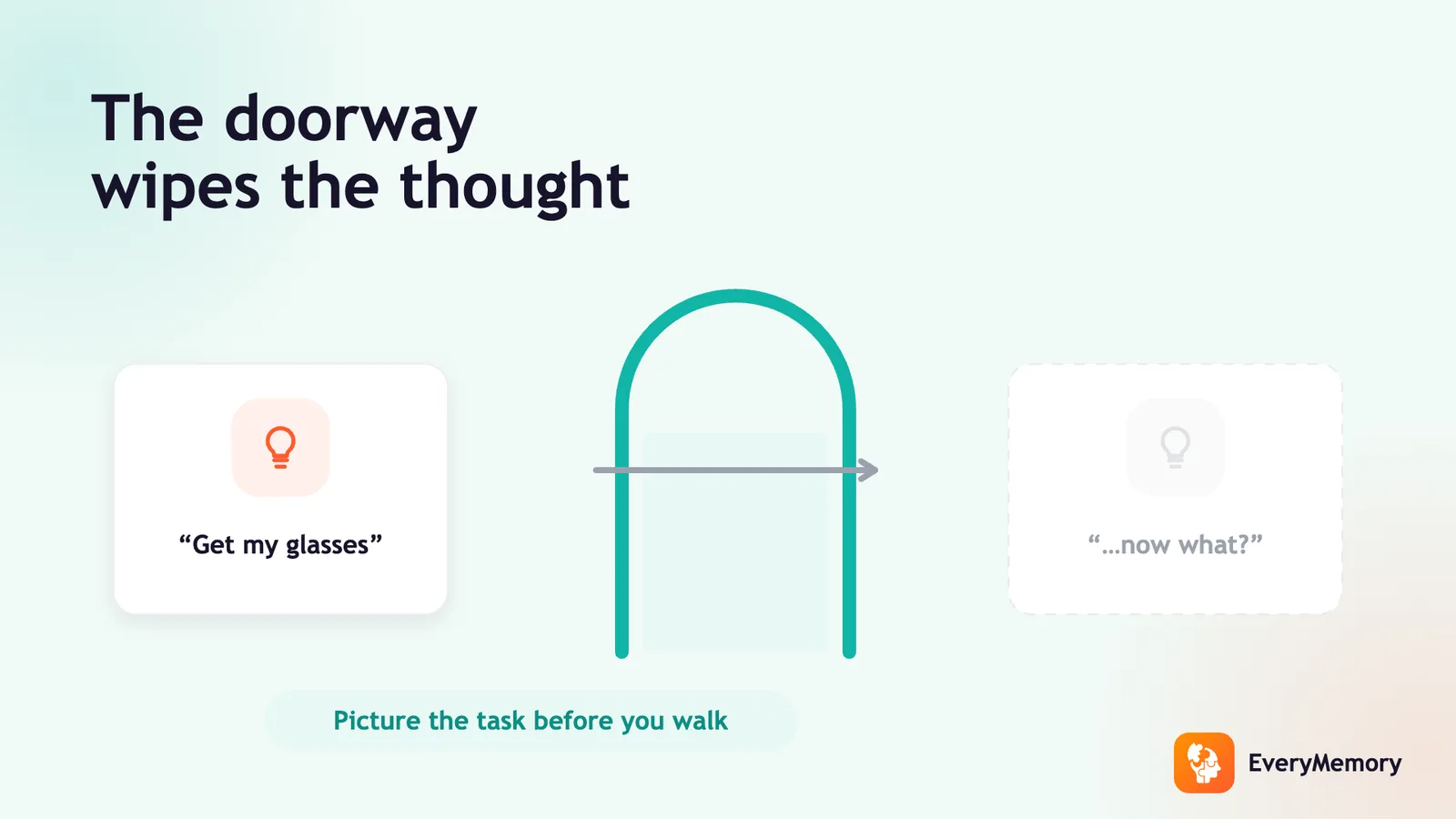
Forgetting why you walked into a room. The brain treats a doorway as an 'event boundary' - a signal to close one mental file and open a new one. The intention you were carrying sometimes gets filed away in the transition, especially when your attention is already divided. Why do I forget why I walked into a room covers the event-boundary research in detail.
The tip-of-the-tongue moment. The brain retrieves words in stages: meaning first, then the sound of the word. With age, the second step becomes slightly slower - especially for names and rarely used words. The word almost always does come back; older adults resolve these moments at the same rate as younger people, it just takes a little longer. See why words get stuck on the tip of the tongue.
Forgetting a name. Names carry no meaning in themselves - 'Margaret' tells your brain nothing useful about Margaret - so there is no semantic hook to grab during retrieval. Heard briefly in a busy social setting, they fade fast. That is not a memory failure; it is the brain behaving logically, if inconveniently. More at is it normal to forget names after 60.
Why we notice them more as we get older
The brain in later life is not a broken version of the younger brain. It is a different operating mode - one with vast accumulated knowledge, but a slightly lower processing speed and a narrower bandwidth for divided attention.
Processing speed is the rate at which the brain handles incoming information. From the mid-40s onward, this eases off gradually. The encoding window for a new piece of information - a name at a party, the reason you picked up your phone - grows slightly shorter. Anything not fully encoded is hard to retrieve later, not because memory is broken, but because the original impression was faint.
There is also a subtler factor: awareness. Older adults tend to be more self-monitoring about memory. A 28-year-old who forgets a colleague's name thinks nothing of it; a 62-year-old may catalogue the same lapse as worrying. That heightened self-scrutiny can make slips feel more frequent than they are.
Senior moments versus memory changes that deserve attention
The distinction that matters is not how often a lapse happens but whether it is interfering with daily life. The occasional forgotten name or lost errand is everyday forgetfulness. The changes worth paying attention to look different: getting lost somewhere genuinely familiar, struggling to follow a conversation that should be easy, forgetting significant recent events entirely rather than briefly, or repeated confusion about time or place.
Another useful signal is awareness. A person having normal senior moments is generally aware that they forgot something - they know there was a name, they know they had a reason for going upstairs, and they can often recover the information with a little patience. When that self-awareness becomes unreliable, or when other people begin noticing patterns before the person does, those are the moments worth discussing with a doctor.
For a fuller picture of the line between normal and notable, memory loss vs normal aging walks through the distinctions in plain language.
Things that make senior moments worse - and most of them are fixable
Several common, everyday factors amplify memory slips significantly and are worth knowing about because they are changeable:
- Poor sleep. Memory consolidation happens largely during sleep. Consistently broken rest is one of the most reliable drivers of increased memory lapses.
- Stress and anxiety. Stress hormones interfere directly with encoding and retrieval. An anxious day reliably produces more blanks than a calm one.
- Multitasking. Doing several things at once means none of them gets fully encoded. Single-tasking - one thing, full attention - is a simple and effective counter.
- Dehydration. Even mild dehydration affects concentration. Older adults tend to register thirst less reliably, making this easy to overlook.
- Certain medications. Some common prescriptions list concentration or memory among their side effects. Worth mentioning to a pharmacist if slips increased after starting something new.
A note on the phrase itself
There is one thing worth questioning about the term 'senior moment': it can carry more anxiety than it deserves. For some people, joking about it is a comfortable way to acknowledge a harmless lapse and move on. For others, the label quietly reinforces a fear that every forgotten name is the beginning of something serious.
Neither framing is accurate. These moments are normal, they are not exclusive to older adults, and most reflect nothing more than the ordinary way a busy brain manages a noisy world. Lightness is fine; worry, in most cases, is unnecessary.
✅ Try this today - The 'notice and move on' practice
The next time you have a senior moment, try this three-step response instead of worrying about it.
- Name it lightly. When the word or name disappears, say to yourself (or out loud): 'Tip-of-the-tongue - it will come back.' This simple acknowledgment reduces the anxious searching that actually makes retrieval harder.
- Stop trying for 60 seconds. Actively drop the search, move your attention to something else briefly, and let the brain work in the background. The answer often surfaces on its own within a minute or two. This works because the retrieval attempt creates a residual trace the brain keeps working on.
- Recover without drama. When the word or name does come back, resist the urge to review it as evidence of decline. One forgotten name is just one forgotten name. The pattern over weeks and months is what matters - not the individual moment.
⚠ When to talk to a professional
The information here is general and non-medical. If you notice memory changes that are sudden, rapid, significantly worsening, or affecting your ability to manage everyday tasks, please speak with a qualified healthcare professional rather than relying on self-assessment.