 EveryMemory
Why Do I Forget Why I Entered a Room?
Forgetting why you walked into a room is so common it has a name - and understanding it makes the fix much easier.
Part of the guide: Understanding Memory Loss and Forgetfulness: A Calm, Reassuring Guide →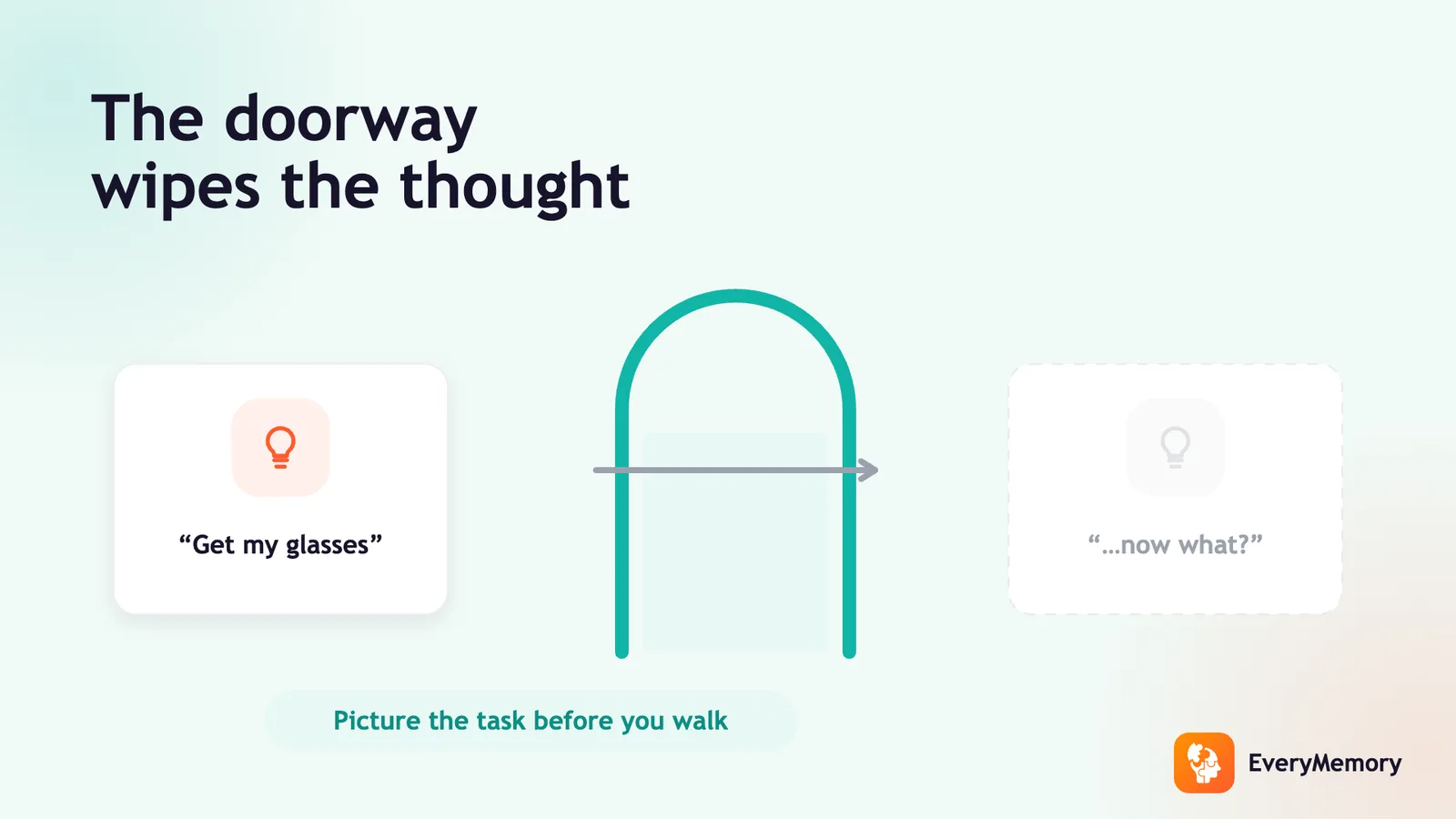
⚡ Quick answer
Walking through a doorway acts as a mental boundary that causes your brain to file away the memory from the previous room and start fresh. This is a normal feature of how the mind organises events, not a sign of memory decline. It becomes more noticeable when you are distracted, hurried, or tired.
Key takeaways
- Researchers call this the doorway effect: crossing a physical boundary signals the brain to close the previous mental chapter, which can temporarily file away the intention you were carrying.
- The memory has not disappeared - returning to the room where you formed the intention almost always brings it straight back, thanks to context-dependent retrieval.
- Fatigue and stress shrink working memory capacity, making the doorway effect noticeably worse on tired or stressful days.
- Saying your intention aloud before you move, or pausing for one second at the doorway, gives the memory a stronger hold before the boundary effect kicks in.
You stand up from the sofa with a clear purpose in mind, walk down the hallway - and the moment you cross into the kitchen you have absolutely no idea why you came. You retrace your steps to the sofa, and suddenly it clicks back. Sound familiar? You are far from alone.
This particular kind of forgetting is so well-studied that researchers gave it a name: the doorway effect. Understanding why it happens can stop you from worrying about it unnecessarily - and gives you a genuinely practical way to keep the thought intact.
What the doorway effect actually is
Cognitive scientists at the University of Notre Dame found that memory is organised around events, not just time. When you move through a physical boundary - a doorway, a staircase, even stepping outside - your brain treats it as a signal that one event has ended and another has begun. It packages up what just happened, files it away, and prepares for whatever comes next.
The intention you were carrying belongs to the previous event. Once the doorway closes that chapter, the intention can be hard to access. The good news: it hasn't vanished. It's simply been filed one layer deeper, which is why going back to where you started usually brings it straight back.
Why it seems to get worse with age
The doorway effect is real at every age - younger adults experience it too. What changes over time is the buffer that protects intentions while you move. Working memory, the mental scratchpad that holds information you're actively using, tends to narrow slightly as we get older. A narrower scratchpad means a competing thought or a brief distraction is more likely to bump your original intention aside before you get where you were going.
Fatigue amplifies this considerably. A tired brain has an even smaller working-memory buffer, so intentions are vulnerable. Poor sleep, stress, and simply doing too many things at once can all make the doorway effect feel much more pronounced. This is well worth knowing because those factors are changeable - and if you notice your forgetfulness getting worse after a few bad nights, sleep is often the main story, not a lasting memory change. Our article on sleep and memory explains the link in more detail.
How to hold onto the thought
The strategies that work best do one of two things: they either stop the doorway from closing the mental file, or they make sure the intention is re-opened the moment you arrive.
- Say it out loud before you move. Verbalising the intention - even quietly - forces you to encode it more strongly. "I'm going to the kitchen to turn off the hob."
- Carry something that represents the task. If you need to fetch scissors, hold a finger pointing as you walk. The physical cue travels with you through the doorway.
- Picture the destination task vividly. A quick mental image of doing the thing in the other room creates a stronger memory trace than a fleeting thought.
- Pause at the doorway. A one-second stop before crossing the threshold gives your working memory a moment to consolidate the intention.
These are not tricks - they are ways of giving the memory more to hold onto before the boundary effect kicks in. With a little practice they become automatic. You can build them into the same kind of routine covered in a simple daily memory routine.
When it's worth tracking more carefully
Occasionally blanking on your purpose as you enter a room is genuinely normal. It happens to most adults regardless of age. It's worth paying more attention if the forgetting is frequent across all parts of your day, if you're also getting confused about familiar surroundings, or if other people are noticing changes in you.
A useful first step is simply logging what you notice for a couple of weeks. A non-medical memory check gives you a structured, low-pressure way to do that - not to label anything, but to spot patterns and have a clearer picture when talking to a professional if you need to.
It's also worth reading memory loss vs. normal aging for a broader sense of which kinds of forgetting tend to be routine and which are worth discussing with a qualified professional.
Building attention habits that help
The doorway effect is ultimately an attention problem as much as a memory problem - if you are fully focused on your intention as you move, the effect is much weaker. Strengthening your focus and attention through regular short exercises builds the mental habit of holding a thought through transitions, not just in the safety of a single room.
Small wins compound. Even five minutes of focused attention practice a day, done consistently, makes a real difference to how well intentions survive movement and distraction.
✅ Try this today - The doorstep pause
Use this every time you get up to do something in another room:
- Before you stand up, say the intention aloud: "I'm going to get the phone charger."
- Form a quick mental picture of yourself doing that specific thing in the other room.
- Pause for one second at the doorway before crossing.
- If you still blank, simply turn around and return to the spot where the intention started - it nearly always comes back.