 EveryMemory
Tip of the Tongue: Why Words Get Stuck
That maddening moment when a word hovers just out of reach is called the tip-of-the-tongue state - a normal retrieval hiccup, not a warning sign, and it almost always resolves on its own.
Part of the guide: Understanding Memory Loss and Forgetfulness: A Calm, Reassuring Guide →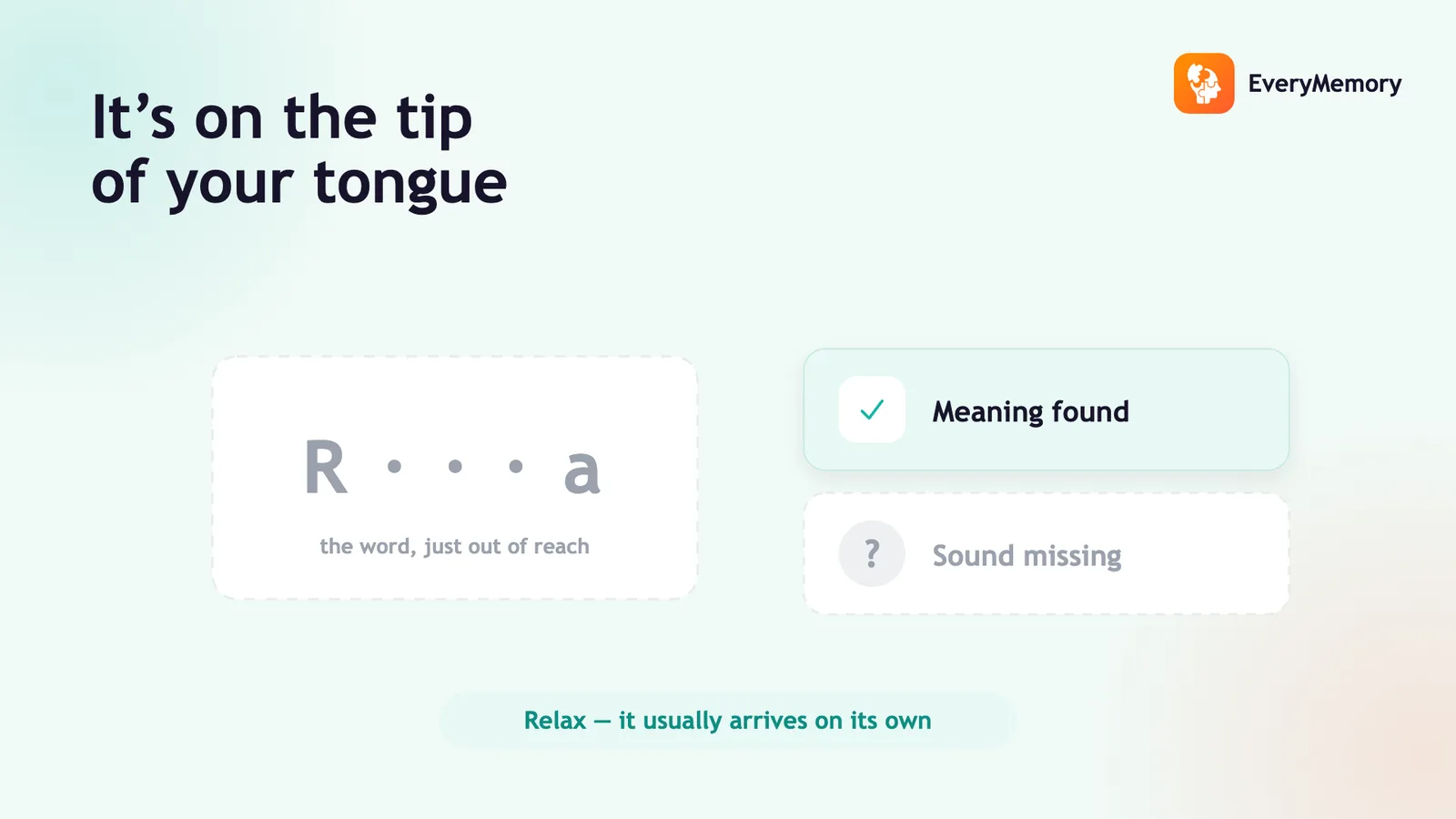
⚡ Quick answer
The tip-of-the-tongue experience happens when your brain successfully retrieves the meaning of a word but temporarily fails to activate its sound pattern. This is a normal retrieval hiccup, not a sign of decline. It becomes more common with age and is especially frequent for names and proper nouns. Trying too hard tends to make it worse; most TOT states resolve on their own within minutes.
Key takeaways
- The tip-of-the-tongue state happens when you retrieve a word's meaning but temporarily can't access its sound - a two-step retrieval glitch.
- It is more common with age and especially frequent for names, because proper nouns have fewer retrieval routes into them.
- Straining makes TOT states last longer; letting go and moving your attention elsewhere is the most effective strategy.
- Most TOT moments resolve on their own within minutes - they are a normal retrieval hiccup, not a warning sign.
You're mid-sentence and suddenly the word you need has vanished. You know you know it - you can almost feel its shape, sense how many syllables it has, maybe even hear the first sound - but it simply won't arrive. This is the tip-of-the-tongue state, abbreviated by researchers as TOT, and it is one of the most universally human of all memory experiences.
It's also one of the most misread. People often interpret a TOT moment as a sign that something is wrong with their memory, when in fact it is a completely ordinary retrieval glitch that affects people of all ages - and that almost always resolves itself without any effort at all.
What is actually happening in your brain
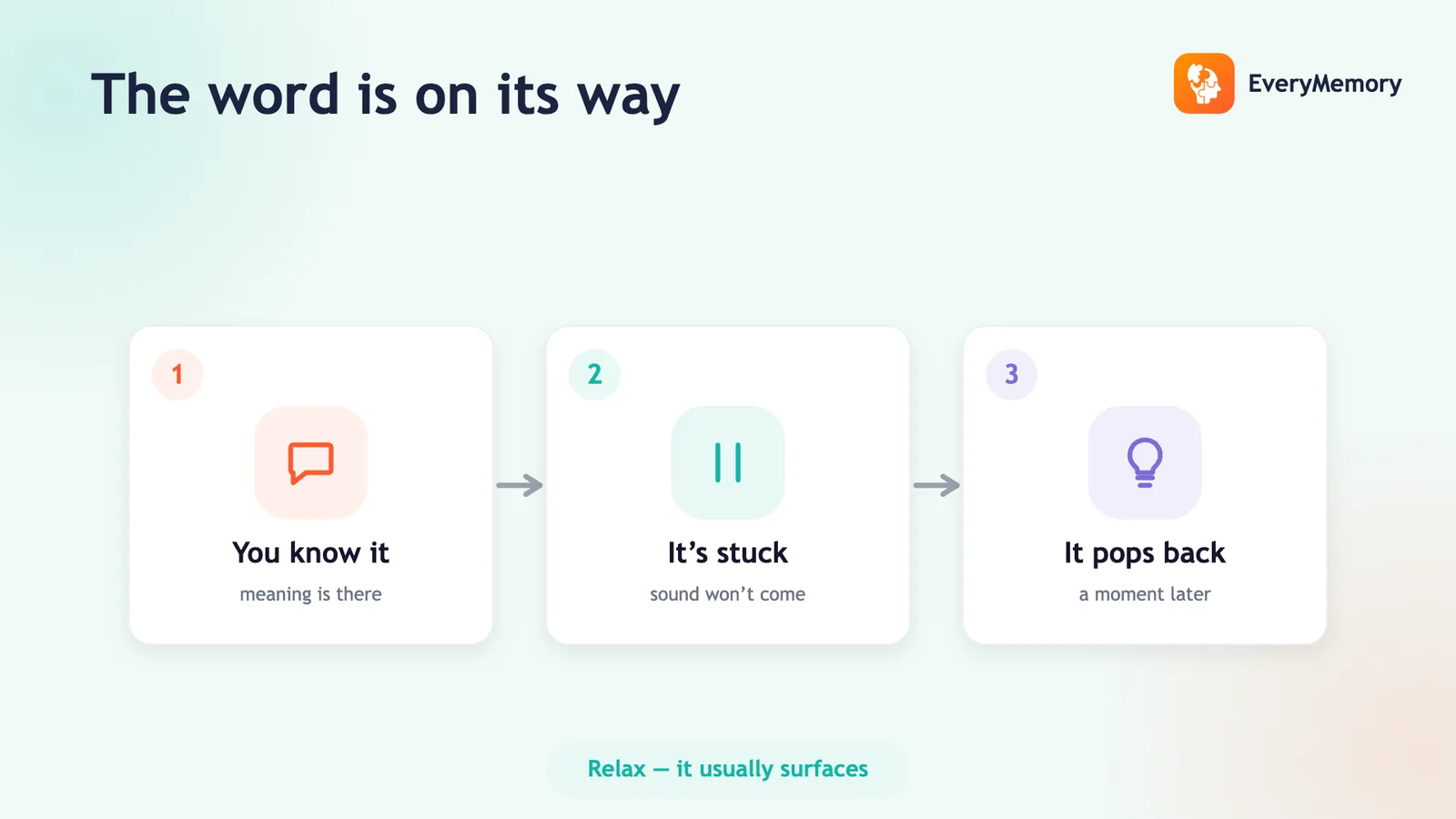
Words are not stored as single, unified entries. The brain keeps a word's meaning (its semantic representation) and its sound pattern (its phonological form) in somewhat separate systems. Retrieving a word is a two-step process: first you activate the concept, then you activate the sound code needed to say it aloud.
The tip-of-the-tongue state is what happens when step one succeeds but step two stalls. This is why, during a TOT moment, you can describe the word perfectly and would recognise it instantly if someone said it - but you cannot produce the sound from scratch. The meaning is fully available; only the phonological pathway is momentarily under-activated.
Why names are the worst offenders
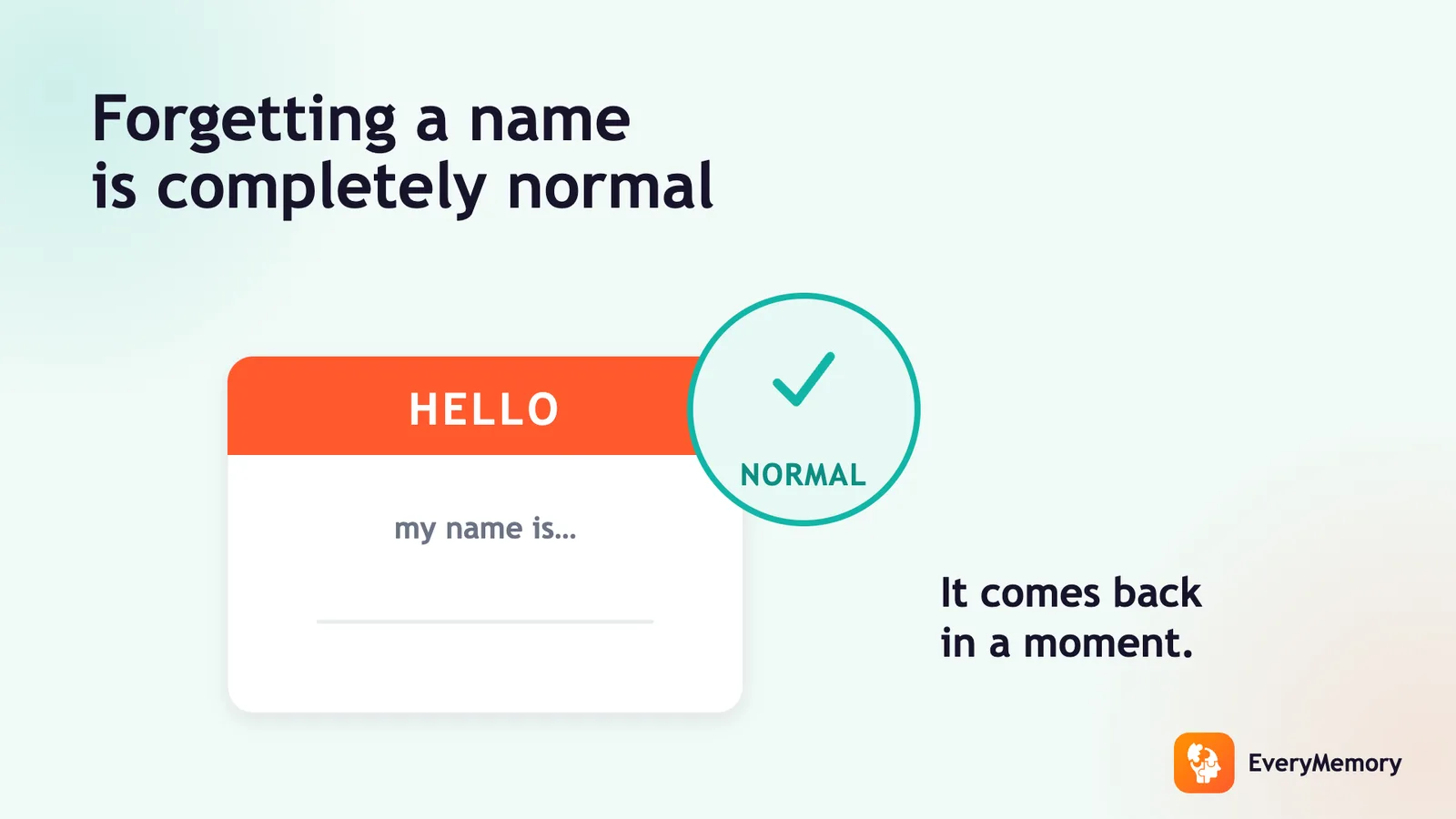
If tip-of-the-tongue moments feel most frequent with people's names, you're in good company - this is one of the most consistent findings in the research. Proper nouns, and names in particular, are especially vulnerable to TOT states for a structural reason: they have no meaning beyond the person or place they refer to.
Common nouns carry semantic richness. The word "umbrella" connects to rain, shelter, colour, walking, and dozens of related concepts - each one a possible retrieval route. A person's name, by contrast, connects only to memories of that individual. There are fewer pathways into the word, which means fewer chances to activate the sound pattern from a different angle. Our article on why forgetting names after 60 is so common explores this further.
This is also why it feels oddly distressing to blank on a name - the person matters to you, and the failure feels personal. It isn't. It's a quirk of how proper nouns are encoded, not a measure of how much you care.
Why it happens more often as we get older
Adults in their fifties and beyond report TOT moments more frequently than younger adults - even those with strong vocabularies. The size of someone's word knowledge does not protect against the retrieval difficulty.
The most widely supported explanation is the transmission deficit model: as we age, the connection between the meaning system and the sound system becomes slightly less efficient. You know exactly what you want to say, but the signal activating the sound pattern is weaker, so it arrives slowly or not at all. This is a normal feature of the ageing language system, not a symptom of anything more serious. Understanding how memory works as a whole makes it easier to see TOT moments as the minor processing delay they are.
Why straining makes it worse
The instinct when a word won't come is to push harder - to mentally grip it, circle the gap, keep prodding. This almost always makes the state last longer. Intensely focusing on the absence of a word reinforces incorrect alternatives and tightens attention around the very gap you are trying to close.
Think of it like trying to remember a dream - the moment you strain, it recedes further. The most efficient response is to let go of it entirely. Redirect attention elsewhere and the background retrieval process will run undisturbed - the word often arrives on its own within minutes.
Gentle ways to coax the word out
There are a handful of approaches that research suggests are genuinely helpful - none of them involve forcing.
- Try the first sound: Run through the alphabet slowly. Research shows a rough phonological cue - even just sensing the opening syllable - can be enough to re-activate the full sound pattern.
- Think sideways: Approach the word from a different direction. Think about where you last heard it, who uses it, what category it belongs to. A related memory can open an unexpected route back.
- Say related words aloud: Verbalising nearby words in meaning or sound activates the phonological system more directly than silent thought.
- Walk away: Stop trying and do something else. The word tends to surface unprompted once the mental pressure is removed.
These gentle strategies connect naturally to broader word-finding difficulties during conversation - a related experience with some overlapping causes and solutions.
When it resolves itself - and when to take note
The vast majority of tip-of-the-tongue states resolve on their own, usually within minutes. Studies tracking TOT events in daily life find that spontaneous resolution is the most common outcome - the word simply appears later, often when the person has moved on to something else entirely.
What is worth paying attention to is context: if word-finding difficulty is happening across multiple types of words, is worsening over months, or comes alongside confusion or changes in daily functioning, that is worth discussing with a doctor. A single stuck word is not evidence of anything beyond a momentary retrieval delay.
If you find that names are a particular challenge, the memory technique of deliberately forming vivid associations when meeting someone new can reduce future TOT states for that person. Our article on how to remember names and faces walks through practical methods for exactly this.
✅ Try this today - The alphabet coax
Next time a word gets stuck, try this sequence instead of pushing harder.
- Notice and release: The moment you feel the word hovering, take one slow breath and consciously let go of the direct search. Remind yourself it will probably surface on its own.
- Try the first sound: Slowly move through the alphabet - A, B, C… - and notice if any letter feels like it could be the start of the word. Don't force an answer; just let each letter lightly suggest itself.
- Think around it: Ask yourself: what category is this word? Where have I heard it used? What does it make me picture? Let these sideways prompts activate a different retrieval route rather than the blocked one.
- Move on: Switch your attention to something else - make a cup of tea, look out the window, read a sentence of a book. Then notice when the word arrives on its own - it usually does.
⚠ When to talk to a professional
If word-finding difficulty is happening frequently across many types of words, is noticeably worsening over weeks or months, or is accompanied by confusion, difficulty following conversations, or changes in daily functioning, it is worth mentioning to a qualified healthcare professional - they can help clarify what is driving it.