EveryMemory
What Is Cognitive Reserve - and Can You Build It?
Cognitive reserve is the brain's built-up capacity to cope with the changes of aging - and a lifetime of learning, connection, and activity is how it grows.
Part of the guide: How to Keep Your Brain Healthy: A Complete Lifestyle Guide →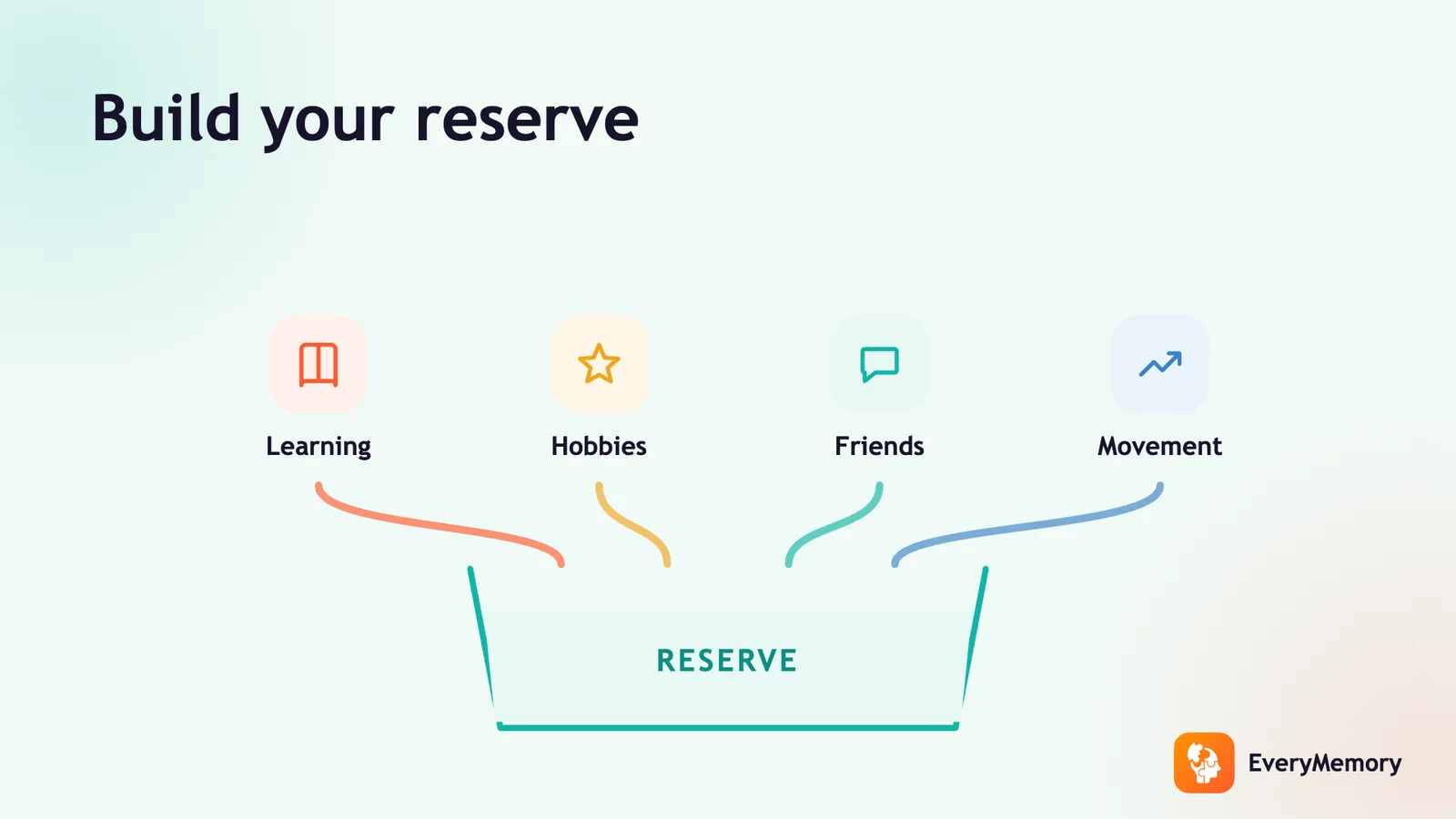
⚡ Quick answer
Cognitive reserve is the brain's ability to function well despite the normal changes that come with aging. It builds gradually through education, mentally stimulating work, learning new things, staying socially engaged, and keeping physically active. Research pioneered by neuroscientist Yaakov Stern and others shows that people who build more reserve across their lives tend to maintain sharper thinking for longer - and it's never too late to contribute to it.
Key takeaways
- Cognitive reserve is the brain's accumulated buffer against the effects of aging - built through a lifetime of learning, engagement, and activity.
- Education, stimulating hobbies, social connection, language learning, and regular physical activity are all consistently linked with stronger reserve.
- It is never too late to contribute: activities pursued in your 60s and 70s still add to the reserve your brain can draw on.
- Reserve doesn't mean the brain is unchanging - it means the brain has more capacity to compensate, keeping thinking sharper for longer.
Some people seem to stay remarkably sharp well into their 70s and 80s - curious, quick, engaged with the world. Others notice more pronounced changes at a younger age. For decades, researchers have been working to understand what makes the difference, and a concept called cognitive reserve has become one of the most compelling answers they've found.
Cognitive reserve isn't a magic property some people are born with. It's something that accumulates over a lifetime - and, encouragingly, something you can keep adding to at any age. Understanding what it is, what builds it, and why it matters is one of the most practical things you can do for your long-term brain health.
A buffer, not a guarantee
The simplest way to picture cognitive reserve is as a kind of buffer. Over the course of a normal life, the brain undergoes gradual changes - mild shifts in how efficiently certain circuits fire, small reductions in some types of processing speed. These changes don't necessarily translate into noticeable problems in thinking or memory, because a brain with strong reserve has more capacity to absorb them.
Neuroscientist Dr. Yaakov Stern at Columbia University was central to developing this idea. His research suggests the brain uses its accumulated experience to work around challenges - people with more reserve appear to draw on alternative neural pathways and more flexible strategies. You can explore the key research in our Library.
Reserve doesn't mean invulnerability. It means the brain is better equipped to compensate - so the gap between what's happening inside and what you notice day-to-day can be meaningfully wider.
What a lifetime of experience contributes
Cognitive reserve isn't built by any single activity. It accumulates across decades through the richness and variety of a person's mental and social life. Researchers have identified several experience categories that show consistent links with stronger reserve:
- Education and lifelong learning: Formal schooling is one of the most studied contributors, but the effect continues well beyond school years. Adults who keep challenging themselves intellectually - through reading, courses, or new skills - show measurable benefits. Our article on learning new skills and brain health explores this further.
- Mentally stimulating work and hobbies: Careers and leisure that demand problem-solving, creativity, or complex thinking are consistently linked with stronger reserve. Gardening, chess, making music, writing - any sustained mentally engaging activity counts.
- Social connection: Regular, meaningful interaction with other people is one of the most robust factors in the research. Conversation is cognitively complex, requiring attention, memory, language, and emotional intelligence simultaneously. See our article on social activity and memory for more.
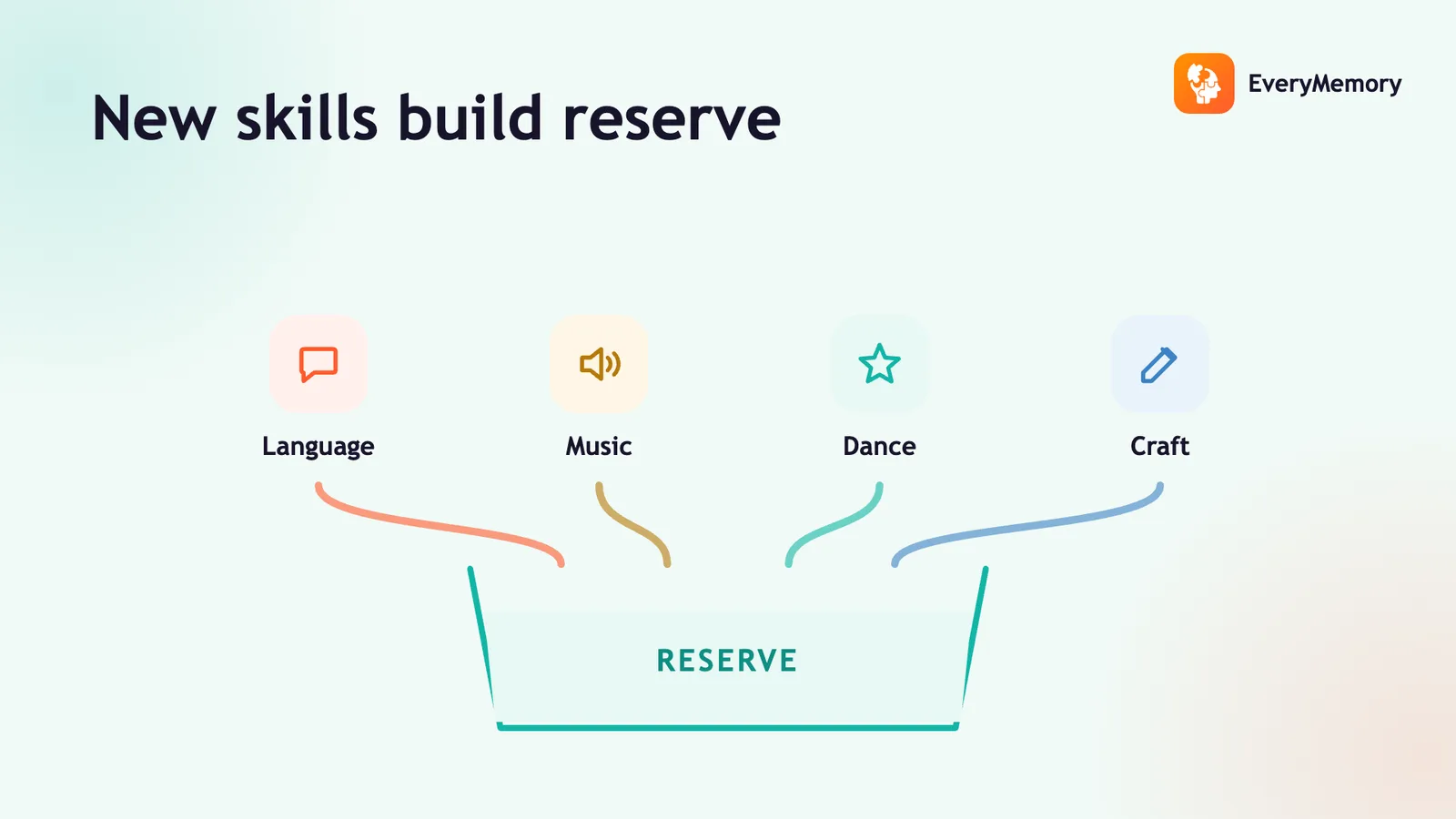
- Bilingualism and language learning: Managing two languages requires the brain to juggle competing systems, strengthening attentional control and executive function. Studies link long-term bilingualism with stronger reserve across the lifespan.
- Physical activity: Regular aerobic activity is associated with better blood flow to the brain and measurable support for memory and attention. Even regular walking shows meaningful links with cognitive health.
Why this research is encouraging
One of the most important things about the cognitive reserve concept is what it implies: that the choices made throughout a life genuinely matter. The brain isn't simply a fixed resource that depletes on a predetermined schedule. It is shaped - continuously - by how it is used.
This means that a rich mental and social life isn't just pleasant - it is also an investment in long-term brain function. And it means it is never too late to contribute. Studies consistently find that adults who take up new activities or become more physically active in their 60s and 70s show measurable benefits. The reserve you build at 65 still counts.
Cognitive reserve and neuroplasticity
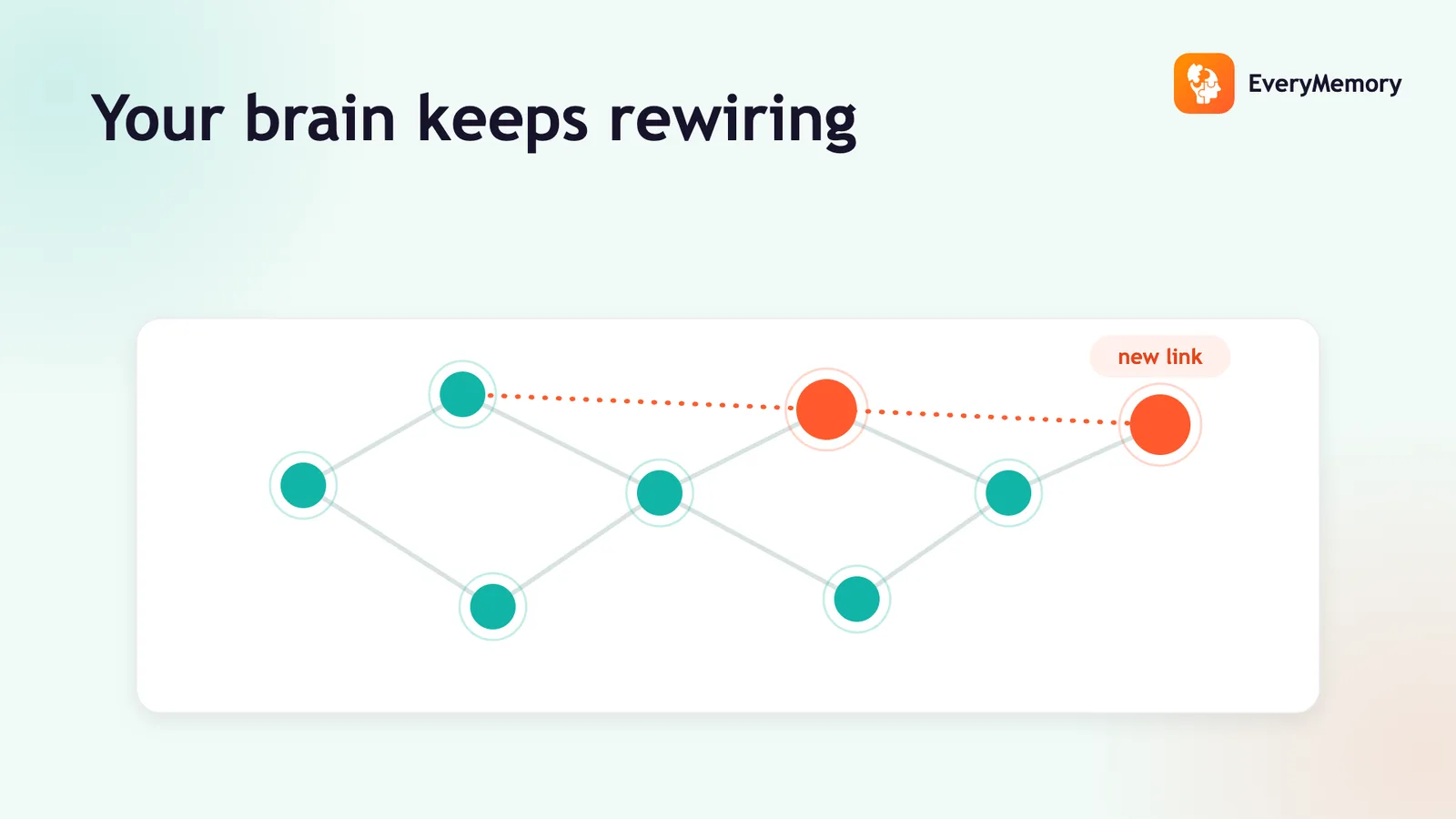
Cognitive reserve and neuroplasticity are closely related ideas. Neuroplasticity is the brain's ongoing ability to adapt - to form new connections, strengthen existing ones, and reorganise in response to experience. Cognitive reserve, in a sense, is what accumulates when neuroplasticity is put to work over time.
Each time you learn something genuinely new, grapple with an unfamiliar problem, or engage deeply with other people, you are exercising the mechanisms that build reserve. Variety also matters - a brain challenged across different domains (musical, linguistic, social, physical) builds a richer network of pathways and more flexible thinking than one exercised in a narrow range.
Practical ways to keep building reserve now
The good news is that almost every positive mental and social habit contributes something. You don't need to enrol in a degree programme or learn five languages. Small, consistent additions to an already engaged life add up over time.
- Take up something genuinely new - an instrument, a craft, a language, a style of cooking. The challenge of learning, not the subject, is what matters.
- Stay socially active. Join a group, maintain regular contact with friends and family, volunteer, or find a class that brings you into contact with others.
- Move regularly. Walking, swimming, dancing, cycling - the form matters less than consistency. Aim for something that raises your heart rate several times a week.
- Read broadly and pursue topics outside your usual zone. Encountering unfamiliar ideas keeps the brain working in ways that familiar material doesn't.
- Use structured brain practice to keep recall and attention sharp - our article on whether brain games really work covers what the evidence actually shows.
Age is not a barrier
The brain does not close for deposits at a certain birthday. Research involving adults in their 70s and 80s consistently shows that cognitively demanding pursuits taken up later in life still produce measurable benefit.
Starting something new at 68 feels harder than it did at 35 - and that's real. Learning slows with age. But slower acquisition does not mean no acquisition, and engaging with a challenge at any pace still exercises the mechanisms that matter. The most important step is the first one.
✅ Try this today - Your cognitive reserve inventory
Take 10 minutes to honestly assess where you are and where you could add a little more:
- List three activities in your current week that genuinely challenge your brain - things that require effort or problem-solving, not just routine tasks. If you struggle to find three, that's a useful signal.
- Identify one area of your life where you could add novelty this month: a new topic to read about, a class to try, a social group to join, or a physical activity to start. Novelty is the ingredient reserve responds to most.
- Check in on your social life. Are you having real conversations with people outside your household at least a couple of times a week? If not, consider one step to change that - even a regular phone call or a community group counts.
⚠ When to talk to a professional
This article contains general, non-medical information about brain health and lifestyle. If you notice sudden, rapid, or significantly worsening changes in your memory or thinking - rather than gradual, mild shifts - please discuss these with a qualified healthcare professional.